

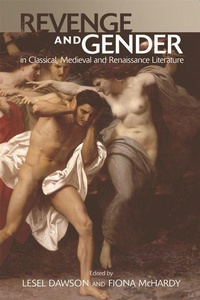
Revenge and Gender in Classical, Medieval, and Renaissance Literature
Published on 5. June 2018
Book
Hardback
352 pages
978-1-4744-1409-8 (ISBN)
Description
Explores the representation of revenge from Classical to early modern literature
This collection explores a range of literary and historical texts from ancient Greece and Rome, medieval Iceland and medieval and early modern England to provide an understanding of wider historical continuities and discontinuities in representations of gender and revenge.
It brings together approaches from literary criticism, gender theory, feminism, drama, philosophy and ethics to allow greater discussion between these subjects and across historical periods and to provide a more complex and nuanced understanding of the ways in which ideas about gender and revenge interrelate.
Key features:
The coverage, from classical through to renaissance literature, gives a sense of how the revenge motifs work over time with gender in mind
It will appeal to a wide readership including those working in classics; medieval and renaissance literature; gender studies; revenge and revenge tragedy; the intertextual relations between ancient, medieval and early modern texts
It considers what constitutes the literary revenge tragedy tradition, suggesting points of continuity and difference as well as rethinking the parameters of the genre
Contributors include Edith Hall, Alison Findlay and Janet Clare
This collection explores a range of literary and historical texts from ancient Greece and Rome, medieval Iceland and medieval and early modern England to provide an understanding of wider historical continuities and discontinuities in representations of gender and revenge.
It brings together approaches from literary criticism, gender theory, feminism, drama, philosophy and ethics to allow greater discussion between these subjects and across historical periods and to provide a more complex and nuanced understanding of the ways in which ideas about gender and revenge interrelate.
Key features:
The coverage, from classical through to renaissance literature, gives a sense of how the revenge motifs work over time with gender in mind
It will appeal to a wide readership including those working in classics; medieval and renaissance literature; gender studies; revenge and revenge tragedy; the intertextual relations between ancient, medieval and early modern texts
It considers what constitutes the literary revenge tragedy tradition, suggesting points of continuity and difference as well as rethinking the parameters of the genre
Contributors include Edith Hall, Alison Findlay and Janet Clare
Reviews / Votes
[T]his book is an important, and powerful, example of how interdisciplinary and cross-period studies can illuminate otherwise-overlooked points that lead to essential reconsiderations of subjects... -- Melissa Ridley Elmes, Lindenwood University * Bryn Mawr Classical Review * this book is an important, and powerful, example of how interdisciplinary and cross-period studies can illuminate otherwise-overlooked points that lead to essential reconsiderations of subjects... -- Melissa Ridley Elmes, Lindenwood University * Bryn Mawr Classical Review * The intersection of gender trouble with the ambivalence of revenge provides a theme sufficiently broad to be of general interest, and yet sufficiently well defined to produce a coherent volume, in which intriguing connections are on display between various cultures, periods, and textual genres. -- Richard Seaford, University of ExeterMore details
Language
English
Place of publication
Edinburgh
United Kingdom
Target group
College/higher education
Product notice
sewn/stitched
Cloth over boards
Illustrations
4 black and white illustrations, 3 black and white tables
Dimensions
Height: 241 mm
Width: 159 mm
Thickness: 25 mm
Weight
669 gr
ISBN-13
978-1-4744-1409-8 (9781474414098)
Copyright in bibliographic data and cover images is held by Nielsen Book Services Limited or by the publishers or by their respective licensors: all rights reserved.
Schweitzer Classification
Other editions
Additional editions
Lesel Dawson | Fiona Mchardy
Revenge and Gender in Classical, Medieval, and Renaissance Literature
E-Book
05/2018
1st Edition
Edinburgh University Press
€29.49
Available for download
Lesel Dawson | Fiona Mchardy
Revenge and Gender in Classical, Medieval, and Renaissance Literature
E-Book
05/2018
1st Edition
Edinburgh University Press
€29.49
Available for download
Persons
Lesel Dawson is Senior Lecturer in English at the University of Bristol. She is the author of Lovesickness and Gender in Early Modern English Literature (OUP, 2008) and has published journal articles on John Ford, the Elizabethan succession crisis and early modern ideas about menstruation and Quentin Tarantino. Fiona McHardy is Professor of Classics at the University of Roehampton. She is author of Revenge in Athenian Culture (London: Duckworth, 2008).
Content
Contents; List of Figures; Acknowledgements and Dedication
Introduction: Female Fury and the Masculine Spirit of Vengeance, Lesel Dawson
The Gendering of Revenge
1. Why are the Erinyes Female? or, What is so Feminine about Revenge?, Edith Hall
2. Re-marking Revenge in Early Modern Drama, Alison Findlay
Friends and Family: 'Revenging Home'
3. Vengeance and Male Devotion in Laxdaela saga and Njals saga, Ian Felce
4. 'Now I am Medea': Gender, Identity and the Birth of Revenge in Seneca's Medea, Kathrin Winter
5. The Avenging Daughter in King Lear, Marguerite Tassi
6. 'Brother Unkind': Annabella's Heart in 'Tis Pity She's a Whore, Sara Eaton
Women's Weapons
7. Cursing-Prayers and Female Vengeance in the Ancient Greek World, Lydia Matthews and Irene Salvo
8. 'The Power of our Mouths': Gossip as a Female Mode of Revenge, Fiona McHardy
9. 'Women's Weapons': Education and Female Revenge on the Early Modern Stage, Chloe Preedy
Women Transmogrified
10. The Vengeful Lioness in Greek Tragedy: A Posthumanist Perspective, Alessandra Abbattista
11. 'She's Turned Fury': Women Transmogrified in Revenge Plays, Janet Clare
Lamentation, Gender Roles and Vengeance
12. A Phrygian Tale of Love and Revenge: Oenone Paridi (Ovid Heroides 5), Andreas N. Michalopoulos
13. Lament and Vengeance in the Alliterative Morte Arthure, Annie Baden-Danetree
14. What's Hecuba to Shakespeare?, Tanya Pollard
15. 'Nursed in Blood': Masculinity and Grief in Marston's Antonio's Revenge, Rebecca Yearling
16. Outfacing Vengeance: Heroic Dying in Webster's The Duchess of Malfi and Ford's The Broken Heart, Lesel Dawson
Details of Contributors
Introduction: Female Fury and the Masculine Spirit of Vengeance, Lesel Dawson
The Gendering of Revenge
1. Why are the Erinyes Female? or, What is so Feminine about Revenge?, Edith Hall
2. Re-marking Revenge in Early Modern Drama, Alison Findlay
Friends and Family: 'Revenging Home'
3. Vengeance and Male Devotion in Laxdaela saga and Njals saga, Ian Felce
4. 'Now I am Medea': Gender, Identity and the Birth of Revenge in Seneca's Medea, Kathrin Winter
5. The Avenging Daughter in King Lear, Marguerite Tassi
6. 'Brother Unkind': Annabella's Heart in 'Tis Pity She's a Whore, Sara Eaton
Women's Weapons
7. Cursing-Prayers and Female Vengeance in the Ancient Greek World, Lydia Matthews and Irene Salvo
8. 'The Power of our Mouths': Gossip as a Female Mode of Revenge, Fiona McHardy
9. 'Women's Weapons': Education and Female Revenge on the Early Modern Stage, Chloe Preedy
Women Transmogrified
10. The Vengeful Lioness in Greek Tragedy: A Posthumanist Perspective, Alessandra Abbattista
11. 'She's Turned Fury': Women Transmogrified in Revenge Plays, Janet Clare
Lamentation, Gender Roles and Vengeance
12. A Phrygian Tale of Love and Revenge: Oenone Paridi (Ovid Heroides 5), Andreas N. Michalopoulos
13. Lament and Vengeance in the Alliterative Morte Arthure, Annie Baden-Danetree
14. What's Hecuba to Shakespeare?, Tanya Pollard
15. 'Nursed in Blood': Masculinity and Grief in Marston's Antonio's Revenge, Rebecca Yearling
16. Outfacing Vengeance: Heroic Dying in Webster's The Duchess of Malfi and Ford's The Broken Heart, Lesel Dawson
Details of Contributors