

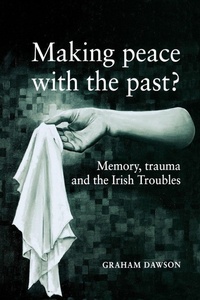
Making Peace with the Past?
Memory, Trauma and the Irish Troubles
Published on 1. October 2010
Book
Paperback/Softback
416 pages
978-0-7190-5672-7 (ISBN)
Description
This book explores the psychic, cultural and political ramifications of memory within the Irish Troubles. It investigates the traumatic impact of the violence perpetrated since 1969; the antagonistic cultural narratives of memory fashioned and mobilised in this context within public and private arenas; and the conflicts, paradoxes and contradictions involved in 'coming to terms with the past' both before and during the Irish peace process initiated in 1993-94.
The study focuses on personal and collective remembrance within two particular locations: the Unionist communities along the Irish Border, and nationalist Derry. It traces the formation from below of competing public narratives, one concerned with the 'ethnic cleansing' of Protestants by the Irish Republican Army, the other with British state violence on Bloody Sunday; and analyses their subjective roots in specific experiences of fear and loss, their role in ideological struggle, and their complicated relation to private, familial and individual remembering. -- .
The study focuses on personal and collective remembrance within two particular locations: the Unionist communities along the Irish Border, and nationalist Derry. It traces the formation from below of competing public narratives, one concerned with the 'ethnic cleansing' of Protestants by the Irish Republican Army, the other with British state violence on Bloody Sunday; and analyses their subjective roots in specific experiences of fear and loss, their role in ideological struggle, and their complicated relation to private, familial and individual remembering. -- .
Reviews / Votes
Dawson's book... stands head and shoulders above anything so far published on this vexed subject... it also extremely timely...' -- .More details
Language
English
Place of publication
Manchester
United Kingdom
Target group
College/higher education
Professional and scholarly
Illustrations
Illustrations, black & white
Dimensions
Height: 234 mm
Width: 156 mm
Thickness: 22 mm
Weight
632 gr
ISBN-13
978-0-7190-5672-7 (9780719056727)
Copyright in bibliographic data and cover images is held by Nielsen Book Services Limited or by the publishers or by their respective licensors: all rights reserved.
Schweitzer Classification
Person
Graham Dawson is a Reader in Cultural History at the University of Brighton. His research has focused on the inter-relations between cultural memory, narrative and identity, and on the memory of war in modern times. He is author of Soldier Heroes: British Adventure, Empire and the Imagining of Masculinities (Routledge, 1994), and a co-editor and contributor to Trauma: Life Stories of Survivors and Commemorating War: The Politics of Memory (both Transaction, 2004; first published in the Routledge Memory and Narrative series). -- .
Content
List of Figures
List of Maps
Acknowledgements
Preface
Introduction: Political Transition, peace-making and the past
Part 1 Cultural memory, trauma, and conflict in the Irish Troubles
1. Memory, myth, and tradition: Concepts of the past in the Irish Troubles
2. Trauma, memory, politics: Paradoxes of the Irish peace process
Part 2 Remembering Bloody Sunday
3. Public arenas, personal testimonies: The institution and contestation of British offical memory of Bloody Sunday
4. Trauma and life-stories: Survivor memories of Bloody Sunday
5. Widening the circle of memory: Human rights and the politics of Bloody Sunday commemoration
6. Counter memory, truth and justice: Bloody Sunday and the Irish peace process
Part 3 'The Forgotten Victims?' Border Protestants and the Memory of Terror
7. The Troubles on the Border: Ulster-British identity and the cultural memory of 'ethnic cleansing'
8. Giving voice: Protestant and Unionist victims' groups and memories of the Troubles in the Irish peace process
9. Mobilizing memories: The Unionist politics of victimhood and the Good Friday Agreement
10. Remembrance, reconciliation, and the reconstruction of the site of the Enniskillen 'Poppy Day' bomb
Afterword
Bibliography -- .
List of Maps
Acknowledgements
Preface
Introduction: Political Transition, peace-making and the past
Part 1 Cultural memory, trauma, and conflict in the Irish Troubles
1. Memory, myth, and tradition: Concepts of the past in the Irish Troubles
2. Trauma, memory, politics: Paradoxes of the Irish peace process
Part 2 Remembering Bloody Sunday
3. Public arenas, personal testimonies: The institution and contestation of British offical memory of Bloody Sunday
4. Trauma and life-stories: Survivor memories of Bloody Sunday
5. Widening the circle of memory: Human rights and the politics of Bloody Sunday commemoration
6. Counter memory, truth and justice: Bloody Sunday and the Irish peace process
Part 3 'The Forgotten Victims?' Border Protestants and the Memory of Terror
7. The Troubles on the Border: Ulster-British identity and the cultural memory of 'ethnic cleansing'
8. Giving voice: Protestant and Unionist victims' groups and memories of the Troubles in the Irish peace process
9. Mobilizing memories: The Unionist politics of victimhood and the Good Friday Agreement
10. Remembrance, reconciliation, and the reconstruction of the site of the Enniskillen 'Poppy Day' bomb
Afterword
Bibliography -- .