

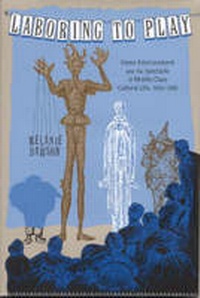
Laboring to Play
Home Entertainment and the Spectacle of Middle-Class Cultural Life, 1850-1920
Will be published approx. on 30. March 2008
Book
Hardback
272 pages
978-0-8173-1449-1 (ISBN)
Description
The changing styles of middle-class home entertainments, Melanie Dawson argues, point to evolving ideas of class identity in U.S. culture. Drawing from 19th- and early-20th-century fiction, guidebooks on leisure, newspaper columns, and a polemical examination of class structures, Laboring to Play interrogates the ways that leisure performances (such as parlor games, charades, home dramas, and tableaux vivants) encouraged participants to test out the boundaries that were beginning to define middling lifestyles. From 19th-century parlor games involving grotesque physical contortions to early-20th-century recitations of an idealized past, leisure employments mediated between domestic and public spheres, individuals and class-based affiliations, and ideals of egalitarian social life and visible hierarchies based on privilege. Negotiating these paradigms, home entertainments provided their participants with unique ways of performing displays of individual ambitions within a world of polite social interaction. Laboring to Play deals with subjects as wide ranging as social performances, social history (etiquette and gentility), literary history, representations of childhood, and the history of the book.
Reviews / Votes
The purposes of Laboring to Play are several: to give new and sustained attention to the parlor as an important site of social and cultural formation; to consider the ways in which home entertainment texts and practices helped shape an emerging middle-class identity in the United States; to chart the evolution of such texts and practices and thus also their changing effects on class formation; to extend existing scholarship on the middle class; to reexamine the inter-relationship of work and play in American culture; and to explore the roles of pleasure and game-playing in American identity. Highly effective are the detailed readings of the 'entertainment chronotope' in a number of important American literary texts, including Alcott's Little Women, Wharton's The House of Mirth, Lewis's Main Street, Gilman's Herland, and Cather's My Antonia. - William Gleason, author of The Leisure Ethic: Work and Play in American Literature, 1840-1940. ""A learned and engaging analysis based on an impressive body of research.... Dawson's focus on entertainment in the home has the benefit of providing us with a close and careful look at the intersections between ideologies of domesticity, class, and leisure."" - Cynthia J. Davis, author of Bodily and Narrative Forms: The Influence of Medicine in American Literature, 1845-1915More details
Language
English
Place of publication
Alabama
United States
Target group
College/higher education
Professional and scholarly
Illustrations
21 illustrations
Dimensions
Height: 228 mm
Width: 152 mm
Thickness: 27 mm
Weight
588 gr
ISBN-13
978-0-8173-1449-1 (9780817314491)
Copyright in bibliographic data and cover images is held by Nielsen Book Services Limited or by the publishers or by their respective licensors: all rights reserved.
Schweitzer Classification
Other editions
Additional editions
Melanie Dawson
Laboring to Play
Home Entertainment and the Spectacle of Middle-Class Cultural Life, 1850-1920
E-Book
10/2013
1st Edition
University of Alabama Press
€76.99
Available for download