

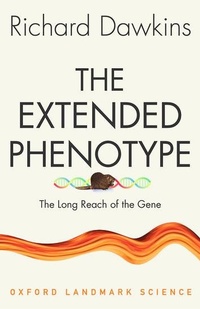
The Extended Phenotype
The Long Reach of the Gene
Published on 22. September 2016
Book
Paperback/Softback
496 pages
978-0-19-878891-1 (ISBN)
Description
In The Selfish Gene, Richard Dawkins crystallized the gene's eye view of evolution developed by W.D. Hamilton and others. The book provoked widespread and heated debate. Written in part as a response, The Extended Phenotype gave a deeper clarification of the central concept of the gene as the unit of selection; but it did much more besides. In it, Dawkins extended the gene's eye view to argue that the genes that sit within an organism have an influence that reaches out beyond the visible traits in that body - the phenotype - to the wider environment, which can include other individuals. So, for instance, the genes of the beaver drive it to gather twigs to produce the substantial physical structure of a dam; and the genes of the cuckoo chick produce effects that manipulate the behaviour of the host bird, making it nurture the intruder as one of its own. This notion of the extended phenotype has proved to be highly influential in the way we understand evolution and the natural world. It represents a key scientific contribution to evolutionary biology, and it continues to play an important role in research in the life sciences.
The Extended Phenotype is a conceptually deep book that forms important reading for biologists and students. But Dawkins' clear exposition is accessible to all who are prepared to put in a little effort.
Oxford Landmark Science books are 'must-read' classics of modern science writing which have crystallized big ideas, and shaped the way we think.
The Extended Phenotype is a conceptually deep book that forms important reading for biologists and students. But Dawkins' clear exposition is accessible to all who are prepared to put in a little effort.
Oxford Landmark Science books are 'must-read' classics of modern science writing which have crystallized big ideas, and shaped the way we think.
Reviews / Votes
The Extended Phenotype is a sequel to The Selfish Gene ... he writes so clearly it could be understood by anyone prepared to make the effort * John Maynard Smith, LRB * This entertaining and thought-provoking book is an excellent illustration of why the study of evolution is in such an exciting ferment these days. * Science *More details
Series
Language
English
Place of publication
Oxford
United Kingdom
Dimensions
Height: 198 mm
Width: 131 mm
Thickness: 50 mm
Weight
452 gr
ISBN-13
978-0-19-878891-1 (9780198788911)
Copyright in bibliographic data and cover images is held by Nielsen Book Services Limited or by the publishers or by their respective licensors: all rights reserved.
Schweitzer Classification
Other editions
Additional editions
E-Book
09/2016
1st Edition
OUP eBook
€10.49
Available for download
E-Book
09/2016
1st Edition
OUP eBook
€10.49
Available for download
Previous edition
Book
03/1999
Oxford University Press
€11.13
Article exhausted; check for reprint
Person
Professor Richard Dawkins is one of the most influential science writers and communicators of our generation. He was the first holder of the Charles Simonyi Chair of the Public Understanding of Science at Oxford, a position he held from 1995 until 2008, and is Emeritus Fellow of New College, Oxford.
His bestselling books include The Selfish Gene (1976), The Extended Phenotype (1982) and its sequel The Blind Watchmaker (1986), River Out of Eden (1995), Climbing Mount Improbable (1996), Unweaving the Rainbow (1998), A Devil's Chaplain (2004), The Ancestor's Tale (2004), and The God Delusion (2007).
He has won many literary and scientific awards, including the 1987 Royal Society of Literature Award, the 1990 Michael Faraday Award of the Royal Society, the 1994 Nakayama Prize for Human Science, the 1997 International Cosmos Prize, and the Nierenberg Prize for Science in the Public Interest in 2009.
His bestselling books include The Selfish Gene (1976), The Extended Phenotype (1982) and its sequel The Blind Watchmaker (1986), River Out of Eden (1995), Climbing Mount Improbable (1996), Unweaving the Rainbow (1998), A Devil's Chaplain (2004), The Ancestor's Tale (2004), and The God Delusion (2007).
He has won many literary and scientific awards, including the 1987 Royal Society of Literature Award, the 1990 Michael Faraday Award of the Royal Society, the 1994 Nakayama Prize for Human Science, the 1997 International Cosmos Prize, and the Nierenberg Prize for Science in the Public Interest in 2009.
Content
AFTERWORD BY DANIEL DENNETT; GLOSSARY; AUTHOR INDEX; SUBJECT INDEX