


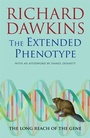
The Extended Phenotype
Published on 1. October 1989
Book
Paperback/Softback
318 pages
978-0-19-286088-0 (ISBN)
Description
By suggesting that individual organisms should be viewed as a single coherent unit, working to maximize their own reproductive success, the author explains that as these organisms are "selfish" they have the capacity to effect the body of another animal, so revolutionizing our views of adaptation. Dawkins shows that some such revolution is logically necessary, as genes can be said to have extended phenotypes outside the body in which they sit. Other topics that the book examines include the theory of evolutionary stable strategies, the relationship between Darwinian and Lamarckian theories of general adaptation and the suggestion, first made in "The Selfish Gene", Dawkin's controversial first book, and also recently reopened by molecular biologists under the catchphrase "Selfish DNA", that some of the surplus DNA in eukaryotic genomes may be parasitic. In the final chapter the author returns to the individual organism as a phenomenon that needs explaining in its own right. Dawkin has also written "The Blind Watchmaker".
More details
Edition
New edition
Language
English
Place of publication
Oxford
United Kingdom
Publishing group
Oxford University Press
Target group
College/higher education
Professional and scholarly
Edition type
New edition
Illustrations
bibliography, index
ISBN-13
978-0-19-286088-0 (9780192860880)
Copyright in bibliographic data is held by Nielsen Book Services Limited or its licensors: all rights reserved.
Schweitzer Classification
Other editions
New editions
Book
03/1999
Oxford University Press
€11.13
Article exhausted; check for reprint
Content
Necker cubes and buffaloes' genetic determinism and gene selectionism; constraints on perfection; arms races and manipulation; the active germ-line replicator; organisms, groups and memes - replicators or vehicles?; outlaws and modifiers; selfish DNA, jumping genes and a Lamarckian scare; an agony in five fits; the genetical evolution of animal artefacts; host phenotypes of parasite genes; action at a distance; rediscovering the organism.