

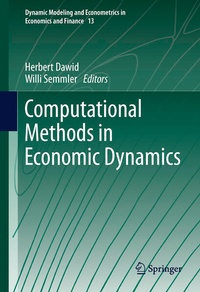
Computational Methods in Economic Dynamics
Published on 26. March 2011
Book
Hardback
VIII, 216 pages
978-3-642-16942-7 (ISBN)
Description
This volume is centered around the issue of market design and resulting market dynamics. The economic crisis of 2007-2009 has once again highlighted the importance of a proper design of market protocols and institutional details for economic dynamics and macroeconomics. Papers in this volume capture institutional details of particular markets, behavioral details of agents' decision making as well as spillovers between markets and effects to the macroeconomy. Computational methods are used to replicate and understand market dynamics emerging from interaction of heterogeneous agents, and to develop models that have predictive power for complex market dynamics. Finally treatments of overlapping generations models and differential games with heterogeneous actors are provided.
More details
Series
Edition
2011 ed.
Language
English
Place of publication
Berlin
Germany
Publishing group
Springer Berlin
Target group
Professional and scholarly
Research
Illustrations
VIII, 216 p.
Dimensions
Height: 23.5 cm
Width: 15.5 cm
Weight
1090 gr
ISBN-13
978-3-642-16942-7 (9783642169427)
DOI
10.1007/978-3-642-16943-4
Schweitzer Classification
Other editions
Additional editions
Herbert Dawid | Willi Semmler
Computational Methods in Economic Dynamics
Book
04/2013
Springer
€106.99
Shipment within 7-9 days
Herbert Dawid | Willi Semmler
Computational Methods in Economic Dynamics
E-Book
03/2011
1st Edition
Springer
€96.29
Available for download
Content
Editorial.- Market Dynamics With Heterogeneous Agents: Allocative Efficiency and Traders' Protection Under Zero Intelligence Behavior.- Using Software Agents to Supplement Tests Conducted by Human Subjects.- Diversification Effect of Heterogeneous Beliefs.- Can Investors Benefit from Using Trading Rules Evolved by Genetic Programming? A Test of the Adaptive Efficiency of U.S. Stock Markets With Margin Trading Allowed.- Bankruptcy Prediction: A Comparison of Some Statistical and Machine Learning Techniques.- Dynamic Policy Perspectives: Testing Institutional Arrangements via Agent-Based Modeling: A U.S. Electricity Market Application.- Energy Shocks and Macroeconomic Stabilization Policies in an Agent-based Macro Model.- The Impact of Migration on Origin Countries: A Numerical Analysis.- An Algorithmic Equilibrium Solution for n-Person Dynamic Stackelberg Difference Games With Open-Loop Information Pattern.