

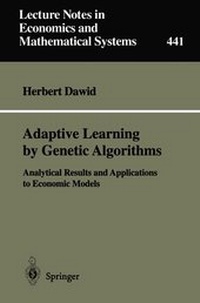
Adaptive Learning by Genetic Algorithms
Analytical Results and Applications to Economical Models
Published on 13. September 1996
Book
Paperback/Softback
IX, 170 pages
978-3-540-61513-2 (ISBN)
Description
An analysis of the learning behavior of genetic algorithms in economic systems with mutual interaction, such as markets. These systems are characterized by a state-dependent fitness function and - for the first time - mathematical results characterizing the long-term outcome of genetic learning in such systems are provided. The usefulness of such results is illustrated by many simulations in evolutionary games and economic models.
More details
Series
Edition
Softcover reprint of the original 1st ed. 1996
Language
English
Place of publication
Heidelberg
Germany
Publishing group
Springer Berlin
Target group
Professional and scholarly
Research
Illustrations
45 figures, 2 tables
Dimensions
Height: 23.5 cm
Width: 15.5 cm
Weight
280 gr
ISBN-13
978-3-540-61513-2 (9783540615132)
DOI
10.1007/978-3-662-00211-7
Schweitzer Classification
Other editions
New editions
Herbert Dawid
Adaptive Learning by Genetic Algorithms
Analytical Results and Applications to Economic Models
Book
08/2012
2nd Edition
Springer
€106.99
Shipment within 7-9 days
Herbert Dawid
Adaptive Learning by Genetic Algorithms
Analytical Results and Applications to Economic Models
Book
04/1999
2nd Edition
Springer
€106.99
Shipment within 10-15 days
Content
1. Introduction.- 2. Bounded Rationality and Artificial Intelligence.- 2.1 Bounded Rationality in Economics.- 2.2 Artificially Intelligent Agents in Economic Systems.- 2.3 Learning Techniques of Artificially Intelligent Agents.- 2.3.1 Genetic Algorithms and Related Techniques.- 2.3.2 Classifier Systems.- 2.3.3 Neural Networks.- 2.3.4 Cellular Automata.- 2.4 Some Applications of CI Methods in Economic Systems.- 2.4.1 Bidding Strategies in Auctions.- 2.4.2 The Iterated Prisoner's Dilemma.- 2.4.3 Market Models.- 2.4.4 Further Simple Economic Models.- 2.5 Potentiality and Problems of CI Techniques in Economics.- 3. Genetic Algorithms.- 3.1 What are Genetic Algorithms?.- 3.2 The Structure of Genetic Algorithms.- 3.3 Genetic Operators.- 3.3.1 Selection.- 3.3.2 Crossover.- 3.3.3 Mutation.- 3.3.4 Other Operators.- 3.3.5 An Example.- 3.4 Genetic Algorithms with a Non-Standard Structure.- 3.5 Economic Interpretation of Genetic Learning.- 3.6 Some Analytical Approaches to Model Genetic Algorithms.- 3.6.1 The Schema Theorem.- 3.6.2 The Quantitative Genetics Approach.- 3.6.3 Markov Chain Models.- 4 Genetic Algorithms with a State Dependent Fitness Function.- 4.1 State Dependency in Economic Systems.- 4.2 A Markov Model for Systems with a State Dependent Fitness Function.- 4.3 The Difference Equations Describing the GA.- 4.4 Deviation from the Markov Process.- 4.5 A Numerical Example.- 4.6 Stability of the Uniform States.- 4.7 Two-Population Models.- 5 Genetic Learning in Evolutionary Games.- 5.1 Equilibria and Evolutionary Stability.- 5.2 Learning in Evolutionary Games.- 5.3 Learning by a Simple Genetic Algorithm.- 5.3.1 Rock-Scissors-Paper Games.- 5.3.2 A GA Deceptive Game.- 5.3.3 Learning in Non Deceptive Games.- 5.4 Two-Population Contests.- 6 Simulations with Genetic Algorithms in Economic Systems.- 6.1 A Model of a Competitive Market.- 6.1.1 Pure Quantity Decision.- 6.1.2 Exit and Entry Decisions.- 6.2 An Overlapping Generations Model with Fiat Money.- 6.2.1 Learning of Cyclical Equilibria.- 6.2.2 Learning of Sunspot Equilibria.- 7 Stability and Encoding.- 7.1 The Cobweb Example Revisited.- 7.2 Impact of a Change in Encoding and Scaling.- 7.3 A Method for Finding Economic Equilibria.- 8 Conclusions.- A. Basic Definitions and Results Used.- A.1 Time Homogeneous Markov Chains.- A.2 Nonlinear Difference Equations and Stability.- B. Calculation of the Equilibria of the Evolutionary Games in Chapter 5.- B.1 Rock-Scissor-Paper Games.- B.2 The GA Deceptive Game GAD.- B.3 The Games G1 and G2.- References.- List of Figures.- List of Tables.