

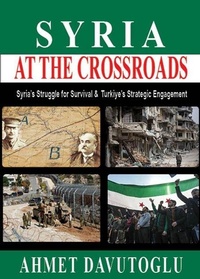
Syria at the Crossroads
Syria's Struggle for Survival & Turkiye's Strategic Engagement
Will be published approx. on 10. January 2027
Book
Paperback/Softback
460 pages
978-1-963892-40-6 (ISBN)
Description
Syria at the Crossroads provides a comprehensive political and strategic analysis of one of the most consequential crises of the 21st century by a former Turkish prime minister, who was diplomatically engaged in a part of that history. It situates the Syrian tragedy within the broader transformation of regional and global order, examining how domestic fragility, regional rivalries, and great power competition converged to produce state collapse.
Ahmet Davutoglu examines Syria's structural foundations, the geopolitical, socio-political, and ideological dynamics that shaped modern Syria, the Hafez al-Assad regime, the challenges of reform during the transition to Bashar al-Assad, and how, in the post-Cold War and post-9/11 environments, Syria became increasingly exposed to regional crises and external strategic pressures.
During the period of strategic transformation in Türkiye-Syria relations (2003--2011) Syria was a battleground between strategic visions. Notably, Türkiye's Strategic Depth doctrine, which emphasized regional ownership, economic interdependence, political dialogue, and cooperative security, was competing with, not abetting, the interventionist and regime-engineering logic of the U.S.-led Greater Middle East Project versus
Here, drawing on Davutoglu's firsthand diplomatic experience, the book documents an unprecedented period of bilateral integration. It also examines Türkiye's diplomatic efforts in Lebanon, Iraq, and indirect Israel-Syria negotiations. It details Türkiye's attempts to promote reform and prevent systemic breakdown through direct engagement with the Syrian leadership.
Nonetheless, the regime's increasingly repressive methods together with escalating external intervention transformed the process from peaceful protests into armed conflict. The rise of DAESH marked a regional shift from reform-oriented agendas to security-centered policies, then devolved into proxy warfare, primarily engaging Russia, the United States, and Iran, then a frozen conflict. Following territorial fragmentation and economic collapse, a new governing force under al Sharaa displaced Assad, coming at once under attack by Israel.
Can Syria be reconstructed as a viable nation-state? Davutoglu proposes a strategic framework for internal transformation, including identity reconstruction, constitutional reform, socio-economic recovery, and the return of refugees, arguing that sustainable stability requires reintegration into a cooperative regional order.
Ahmet Davutoglu examines Syria's structural foundations, the geopolitical, socio-political, and ideological dynamics that shaped modern Syria, the Hafez al-Assad regime, the challenges of reform during the transition to Bashar al-Assad, and how, in the post-Cold War and post-9/11 environments, Syria became increasingly exposed to regional crises and external strategic pressures.
During the period of strategic transformation in Türkiye-Syria relations (2003--2011) Syria was a battleground between strategic visions. Notably, Türkiye's Strategic Depth doctrine, which emphasized regional ownership, economic interdependence, political dialogue, and cooperative security, was competing with, not abetting, the interventionist and regime-engineering logic of the U.S.-led Greater Middle East Project versus
Here, drawing on Davutoglu's firsthand diplomatic experience, the book documents an unprecedented period of bilateral integration. It also examines Türkiye's diplomatic efforts in Lebanon, Iraq, and indirect Israel-Syria negotiations. It details Türkiye's attempts to promote reform and prevent systemic breakdown through direct engagement with the Syrian leadership.
Nonetheless, the regime's increasingly repressive methods together with escalating external intervention transformed the process from peaceful protests into armed conflict. The rise of DAESH marked a regional shift from reform-oriented agendas to security-centered policies, then devolved into proxy warfare, primarily engaging Russia, the United States, and Iran, then a frozen conflict. Following territorial fragmentation and economic collapse, a new governing force under al Sharaa displaced Assad, coming at once under attack by Israel.
Can Syria be reconstructed as a viable nation-state? Davutoglu proposes a strategic framework for internal transformation, including identity reconstruction, constitutional reform, socio-economic recovery, and the return of refugees, arguing that sustainable stability requires reintegration into a cooperative regional order.
More details
Language
English
Product notice
Paperback (trade)
Unsewn / adhesive bound
Dimensions
Height: 229 mm
Width: 152 mm
Thickness: 38 mm
Weight
621 gr
ISBN-13
978-1-963892-40-6 (9781963892406)
Copyright in bibliographic data and cover images is held by Nielsen Book Services Limited or by the publishers or by their respective licensors: all rights reserved.
Schweitzer Classification
Person
Ahmet Davutoglu is former Foreign Minister and Prime Minister of Turkiye. Founder and leader of the Future Party that is represented in the Turkish Parliament, author of Systemic Earthquake: The struggle for World Order (2019), and prominent academic in International Relations.