

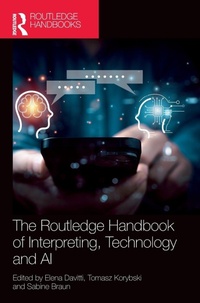
The Routledge Handbook of Interpreting, Technology and AI
1st Edition
Published on 26. May 2025
Book
Hardback
434 pages
978-0-367-51300-9 (ISBN)
Description
This handbook provides a comprehensive overview of the history, development, use, and study of the evolving relationship between interpreting and technology, addressing the challenges and opportunities brought by advances in AI and digital tools.
Encompassing a variety of methods, systems, and devices applied to interpreting as a field of practice as well as a study discipline, this volume presents a synthesis of current thinking on the topic and an understanding of how technology alters, shapes, and enables the interpreting task. The handbook examines how interpreting has evolved through the integration of both purpose-built and adapted technologies that support, automate, or even replace (human) interpreting tasks and offers insights into their ethical, practical, and socio-economic implications. Addressing both signed and spoken language interpreting technologies, as well as technologies for language access and media accessibility, the book draws together expertise from varied areas of study and illustrates overlapping aspects of research.
Authored by a range of practicing interpreters and academics from across five continents, this is the essential guide to interpreting and technology for both advanced students and researchers of interpreting and professional interpreters.
Encompassing a variety of methods, systems, and devices applied to interpreting as a field of practice as well as a study discipline, this volume presents a synthesis of current thinking on the topic and an understanding of how technology alters, shapes, and enables the interpreting task. The handbook examines how interpreting has evolved through the integration of both purpose-built and adapted technologies that support, automate, or even replace (human) interpreting tasks and offers insights into their ethical, practical, and socio-economic implications. Addressing both signed and spoken language interpreting technologies, as well as technologies for language access and media accessibility, the book draws together expertise from varied areas of study and illustrates overlapping aspects of research.
Authored by a range of practicing interpreters and academics from across five continents, this is the essential guide to interpreting and technology for both advanced students and researchers of interpreting and professional interpreters.
Reviews / Votes
"Amid a plethora of handbooks, this volume is particularly timely as a much-needed stock-taking of technological developments that have been and will be shaping the way interpreting is practiced and future technology-using professionals are educated to enable communication in a variety of settings."Franz Poechhacker, University of Vienna, Austria
"If you want to understand or evaluate technologies for interpreting, this comprehensive handbook by the leading experts in the field is a must. Ranging from remote interpreting to under-researched niche technologies, hybrid modalities and AI, it embraces spoken and sign languages as well as technological aspects of interpreter training and development. The clear structure helps the reader navigate to their own interests and questions effectively, while the authors' engagement with critical and ethical aspects of technological change will make this a core resource for years to come, however the tools themselves evolve."
Jo Drugan, Heriot-Watt University, UK
"This Handbook brings together cutting-edge research on interpreting and technology, tracing its development through to the AI era and offering a rich foundation for scholarly inquiry into a rapidly evolving field."
Josh Goldsmith, techforword
More details
Series
Language
English
Place of publication
London
United Kingdom
Publishing group
Taylor & Francis Ltd
Target group
College/higher education
Postgraduate
Illustrations
18 s/w Abbildungen, 7 s/w Photographien bzw. Rasterbilder, 11 s/w Zeichnungen, 2 s/w Tabellen
2 Tables, black and white; 11 Line drawings, black and white; 7 Halftones, black and white; 18 Illustrations, black and white
Dimensions
Height: 250 mm
Width: 175 mm
Thickness: 29 mm
Weight
950 gr
ISBN-13
978-0-367-51300-9 (9780367513009)
Copyright in bibliographic data and cover images is held by Nielsen Book Services Limited or by the publishers or by their respective licensors: all rights reserved.
Schweitzer Classification
Other editions
Additional editions
Elena Davitti | Tomasz Korybski | Sabine Braun
The Routledge Handbook of Interpreting, Technology and AI
E-Book
05/2025
1st Edition
Routledge
€68.49
Available for download
Elena Davitti | Tomasz Korybski | Sabine Braun
The Routledge Handbook of Interpreting, Technology and AI
E-Book
05/2025
1st Edition
Routledge
€68.49
Available for download
Persons
Elena Davitti is Associate Professor of Translation Studies at the Centre for Translation Studies at the University of Surrey, Co-Director of the Leverhulme Doctoral Network 'AI-Enabled Digital Accessibility' (ADA), and Co-Editor of the journal Translation, Cognition & Behavior.
Tomasz Korybski is Assistant Professor at the Institute of Applied Linguistics at the University of Warsaw, Visiting Researcher at the Centre for Translation Studies at the University of Surrey, and a conference interpreter/translator with over 20 years' experience.
Sabine Braun is Professor of Translation Studies and Director of the Centre for Translation Studies at the University of Surrey, Co-Director of the Surrey Institute for People-Centred AI, and Director of the Leverhulme Doctoral Network 'AI-Enabled Digital Accessibility' (ADA).
Tomasz Korybski is Assistant Professor at the Institute of Applied Linguistics at the University of Warsaw, Visiting Researcher at the Centre for Translation Studies at the University of Surrey, and a conference interpreter/translator with over 20 years' experience.
Sabine Braun is Professor of Translation Studies and Director of the Centre for Translation Studies at the University of Surrey, Co-Director of the Surrey Institute for People-Centred AI, and Director of the Leverhulme Doctoral Network 'AI-Enabled Digital Accessibility' (ADA).
Content
List of Contributors
Acknowledgments
Introduction
Elena Davitti, Tomasz Korybski, and Sabine Braun
Part I: Technology-enabled interpreting
1 Telephone interpreting
Raquel Lazaro Gutierrez
2 Video-mediated interpreting
Sabine Braun
3 Remote simultaneous interpreting
Agnieszka Chmiel and Nicoletta Spinolo
4 Video relay service
Camilla Warnicke
5 Portable interpreting equipment
Tomasz Korybski
6 Technology-enabled consecutive interpreting
Cihan UEnlue
7 Tablet interpreting
Francesco Saina
Part II: Technology and interpreter training
8 Computer-assisted interpreting (CAI) tools and CAI tools training
Bianca Prandi
9 Digital pens for interpreter training
Marc Orlando
10 Technology for training in conference interpreting
Amalia Amato, Mariachiara Russo, Gabriele Carioli, and Nicoletta Spinolo
Part III: Technology for (semi-)automating interpreting workflows
11 Technology for hybrid modalities
Elena Davitti
12 Machine interpreting
Claudio Fantinuoli
Part IV: Technology in professional interpreting settings
13 Conference settings
Kilian G. Seeber
14 Healthcare settings
Esther de Boe
15 Legal settings
Jerome Devaux
16 Immigration, asylum and refugee settings
Diana Singureanu and Sabine Braun
Part V: Current issues and debates
17 Quality-related aspects
Elena Davitti, Tomasz Korybski, Constantin Orasan, and Sabine Braun
18 Ethical aspects
Deborah Giustini
19 Cognitive aspects
Christopher D. Mellinger
20 International and professional standards
Veronica Perez Guarnieri and Haris Ghinos
21 Workflows and working models
Anja Ruetten
22 Ergonomics and accessibility
Wojciech Figiel
Index
Acknowledgments
Introduction
Elena Davitti, Tomasz Korybski, and Sabine Braun
Part I: Technology-enabled interpreting
1 Telephone interpreting
Raquel Lazaro Gutierrez
2 Video-mediated interpreting
Sabine Braun
3 Remote simultaneous interpreting
Agnieszka Chmiel and Nicoletta Spinolo
4 Video relay service
Camilla Warnicke
5 Portable interpreting equipment
Tomasz Korybski
6 Technology-enabled consecutive interpreting
Cihan UEnlue
7 Tablet interpreting
Francesco Saina
Part II: Technology and interpreter training
8 Computer-assisted interpreting (CAI) tools and CAI tools training
Bianca Prandi
9 Digital pens for interpreter training
Marc Orlando
10 Technology for training in conference interpreting
Amalia Amato, Mariachiara Russo, Gabriele Carioli, and Nicoletta Spinolo
Part III: Technology for (semi-)automating interpreting workflows
11 Technology for hybrid modalities
Elena Davitti
12 Machine interpreting
Claudio Fantinuoli
Part IV: Technology in professional interpreting settings
13 Conference settings
Kilian G. Seeber
14 Healthcare settings
Esther de Boe
15 Legal settings
Jerome Devaux
16 Immigration, asylum and refugee settings
Diana Singureanu and Sabine Braun
Part V: Current issues and debates
17 Quality-related aspects
Elena Davitti, Tomasz Korybski, Constantin Orasan, and Sabine Braun
18 Ethical aspects
Deborah Giustini
19 Cognitive aspects
Christopher D. Mellinger
20 International and professional standards
Veronica Perez Guarnieri and Haris Ghinos
21 Workflows and working models
Anja Ruetten
22 Ergonomics and accessibility
Wojciech Figiel
Index