

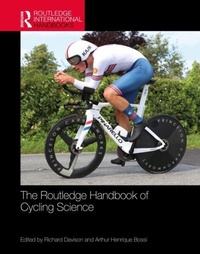
The Routledge Handbook of Cycling Science
1st Edition
Will be published approx. on 27. October 2026
Book
Hardback
488 pages
978-1-032-64909-2 (ISBN)
Description
The Routledge Handbook of Cycling Science brings together internationally recognised experts to showcase the growing body of both experimental and applied knowledge in cycling science, explaining how it can be used to improve and optimise performance at all levels.
With 43 chapters spanning race demands, physiology, training methods, nutrition, equipment, tactics, performance analysis, environmental factors, and health, this is the most comprehensive reference work in cycling science to date. The handbook addresses the full spectrum of cyclists, from elite road and track riders to masters, youth, female, and para-cyclists, and covers disciplines from sprint track and BMX to endurance road racing, mountain biking, ultra-endurance and gravel events.
Written by leading sport scientists and coaching academics and supported by the most recent peer-reviewed evidence, the chapters are designed to translate scientific knowledge into practical application for sport scientists, coaches, and athletes alike. The book does not shy away from areas of genuine scientific debate, topics such as training intensity distribution, relative energy deficiency in sport, and the integration of artificial intelligence in coaching are examined critically, with contributors acknowledging where current evidence is equivocal, consensus remains elusive, and further research is needed. Importantly, every chapter concludes with a dedicated future research section, making explicit the gaps in current knowledge and setting an agenda for the field.
The Routledge Handbook of Cycling Science is essential reading for sport scientists, students, coaches, and athletes in competitive cycling and related endurance sports.
With 43 chapters spanning race demands, physiology, training methods, nutrition, equipment, tactics, performance analysis, environmental factors, and health, this is the most comprehensive reference work in cycling science to date. The handbook addresses the full spectrum of cyclists, from elite road and track riders to masters, youth, female, and para-cyclists, and covers disciplines from sprint track and BMX to endurance road racing, mountain biking, ultra-endurance and gravel events.
Written by leading sport scientists and coaching academics and supported by the most recent peer-reviewed evidence, the chapters are designed to translate scientific knowledge into practical application for sport scientists, coaches, and athletes alike. The book does not shy away from areas of genuine scientific debate, topics such as training intensity distribution, relative energy deficiency in sport, and the integration of artificial intelligence in coaching are examined critically, with contributors acknowledging where current evidence is equivocal, consensus remains elusive, and further research is needed. Importantly, every chapter concludes with a dedicated future research section, making explicit the gaps in current knowledge and setting an agenda for the field.
The Routledge Handbook of Cycling Science is essential reading for sport scientists, students, coaches, and athletes in competitive cycling and related endurance sports.
More details
Series
Language
English
Place of publication
London
United Kingdom
Publishing group
Taylor & Francis Ltd
Target group
College/higher education
Professional and scholarly
Academic, Postgraduate, Professional Reference, and Undergraduate Advanced
Illustrations
28 s/w Photographien bzw. Rasterbilder, 34 s/w Zeichnungen, 21 s/w Tabellen, 62 s/w Abbildungen
21 Tables, black and white; 34 Line drawings, black and white; 28 Halftones, black and white; 62 Illustrations, black and white
Dimensions
Height: 276 mm
Width: 219 mm
Weight
453 gr
ISBN-13
978-1-032-64909-2 (9781032649092)
Copyright in bibliographic data and cover images is held by Nielsen Book Services Limited or by the publishers or by their respective licensors: all rights reserved.
Schweitzer Classification
Persons
Richard Davison is an internationally recognised exercise physiologist with 35+ years of academic and coaching experience, currently serving as a Visiting Professor of Exercise Physiology at the Mountain Bike Centre of Scotland, Edinburgh Napier University, UK. He is a Fellow and former President of the European College of Sport Sciences and a Fellow and former Chair and Honorary Treasurer of the British Association of Sport and Exercise Sciences. He has held editorial board positions at leading sport science journals, including the Journal of Sports Sciences, the Journal of Sport Medicine, and the Journal of Science and Cycling, and has contributed to the BASES Physiological Testing Guidelines since 1996. Richard spent 22 years as a Coach Educator with British Cycling, and his research and expertise have been applied to coaching riders to British and World Championship victories and podiums at the Commonwealth and Olympic Games.
Arthur Henrique Bossi is a lecturer and applied researcher at Edinburgh Napier University, specialising in exercise physiology and endurance performance. His work centres on understanding individual responses to exercise training and translating that knowledge into personalised performance interventions. Before taking up his lectureship, Dr Bossi spent more than 12 years coaching cyclists at every level, from beginners to elite mountain bikers, and served as a consultant for the Mountain Bike Centre of Scotland. This breadth of experience, spanning both the laboratory and the field, has given him a deep understanding of the cyclist-bicycle interaction and the physiological determinants of endurance performance. In this book, he brings a practical, evidence-based perspective firmly grounded in the realities of competitive cycling.
Arthur Henrique Bossi is a lecturer and applied researcher at Edinburgh Napier University, specialising in exercise physiology and endurance performance. His work centres on understanding individual responses to exercise training and translating that knowledge into personalised performance interventions. Before taking up his lectureship, Dr Bossi spent more than 12 years coaching cyclists at every level, from beginners to elite mountain bikers, and served as a consultant for the Mountain Bike Centre of Scotland. This breadth of experience, spanning both the laboratory and the field, has given him a deep understanding of the cyclist-bicycle interaction and the physiological determinants of endurance performance. In this book, he brings a practical, evidence-based perspective firmly grounded in the realities of competitive cycling.
Content
1. Introduction. Section 1: Demands of Competitive Cycling. 2. Demands of Competitive Cycling: Short-Distance Events. 3. Biomechanics of Sprint Cycling. 4. Demands of Endurance Cycling Races. 5. Ultra-Endurance Cycling. 6. The Demands of Multi-Stage Cycling Races. 7. Off-Road Races. Section 2: Physiological and Performance Assessment for Cyclists. 8. Critical Power: Theory, Methods, and Application. 9. Body Composition in Cycling Performance. 10. Explosive Power. 11. Incremental Testing in Cycling. 12. Neuromuscular Fatigability and Fatigue Resistance During Cycling. 13. Utilising Training Data to Monitor Physical Progression and Fatigue. Section 3: Training for Cycling Performance. 14: Individual Differences in Cycling: Genetics, Training Response, Nutrition, and Pacing. 15. Training Zones. 16. Power-Based Measurement and Training in Cycling. 17. Heart Rate-Based Training. 18. Training Load Monitoring in Cycling. 19. Improvement of Cycling Performance by Means of Strength Training. 20. Training Intensity Distribution (TID) in Cyclists: A Review of Evidence and Methodological Challenges. 21. Tapering and Peaking for Road Cycling Events. Section 4: Bike Setup for Comfort and Performance. 22. Aerodynamics and Bike Fit. 23. Physiological and Biomechanical Basis for Positional Optimisation. Section 5: Nutritional Strategies for Cycling Performance. 24. Carbohydrates - Storage, Utilization and Implications for Performance in Cycling. 25. Hydration in Cycling. 26. Dietary Strategies to Effectively Reduce Body Mass. 27. Supplements to Improve Cycling Performance. Section 6: Cycling Racing Strategies. 28. Climbing. 29. Pacing Strategy in Cycling. 30. Group Riding Dynamics. 31. Performance Analysis in Cycling. Section 7: Specialist Cycling Applications and Unique Groups. 32. Hand Cycling. 33. The Master Cyclist. 34. The Female Cyclist. 35. Paracycling. 36. The Youth Cyclist. Section 8: Environmental Factors Affecting Cycling Performance. 37. Altitude. 38. Cycling in the Heat - Challenges and Opportunities. 39. Cold. 40. Vibration Measurement in Cycling: Methods and Applications. Section 9: The Role of Sport Science in Coaching Cyclists. 41. Integrating Sports Science into Effective Coaching Practices. 42. Integration of Artificial Intelligence in Coaching. 43. Cycling Injuries and Illness.