

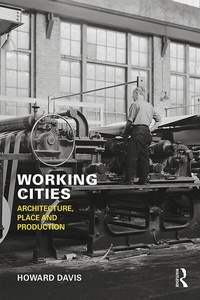
Working Cities
Architecture, Place and Production
1st Edition
Published on 17. December 2019
Book
Hardback
270 pages
978-1-138-32863-1 (ISBN)
Description
Cities have historically supported production, commerce, and consumption, all central to urban life. But in the contemporary Western city, production has been hidden or removed, and commerce and consumption have dominated. This book is about the importance of production in the life of the city, and the relationships between production, architecture, and urban form. It answers the question: What will cities be like when they become, once again, places of production and not only of consumption?
Through theoretical arguments, historical analysis, and descriptions of new initiatives, Working Cities: Architecture, Place and Production argues that contemporary cities can regain their historic role as places of material production-places where food is processed and things are made. The book looks toward a future that builds on this revival, providing architectural and urban examples and current strategies within the framework of a strong set of historically-based arguments.
The book is illustrated in full colour with archival and contemporary photographs, maps, and diagrams especially developed for the book. The diagrams help illustrate the different variables of architectural space, urban location, and production in different historical eras and in different kinds of industries, providing a compelling visual understanding for the reader.
Through theoretical arguments, historical analysis, and descriptions of new initiatives, Working Cities: Architecture, Place and Production argues that contemporary cities can regain their historic role as places of material production-places where food is processed and things are made. The book looks toward a future that builds on this revival, providing architectural and urban examples and current strategies within the framework of a strong set of historically-based arguments.
The book is illustrated in full colour with archival and contemporary photographs, maps, and diagrams especially developed for the book. The diagrams help illustrate the different variables of architectural space, urban location, and production in different historical eras and in different kinds of industries, providing a compelling visual understanding for the reader.
Reviews / Votes
"Working Cities is a spatial, historical analysis of urban industrial production and a rallying cry for the return of production to cities. And while the loss of industrial production in cities is not a new topic for scholars in the social sciences, Davis's book offers a novel perspective by examining the topic through the analytical lens of the built environment."Sharone L. Tomer, Virginia Tech (excerpt from Traditional Dwellings and Settlements Review. International Association for the Study of Traditional Environments)
"I recommend Working Cities to all those who are interested in how architecture and planning can help new forms of production to branch out from the fertile 'asphalt terroir' of our cities. The recent pandemic has only underlined the value of Davis's arguments, reinforcing the shrinkage of global supply chains, and raising new interest in hybrid co-working and living spaces, and in shorter neighbourhood-based commutes."
Francesca Froy, University of Oxford (excerpt from Journal of Urban Design review)
More details
Language
English
Place of publication
London
United Kingdom
Publishing group
Taylor & Francis Ltd
Target group
College/higher education
Illustrations
29 s/w Photographien bzw. Rasterbilder, 94 Farbfotos bzw. farbige Rasterbilder, 15 s/w Zeichnungen, 45 farbige Zeichnungen, 6 s/w Tabellen, 44 s/w Abbildungen, 139 farbige Abbildungen
6 Tables, black and white; 45 Line drawings, color; 15 Line drawings, black and white; 94 Halftones, color; 29 Halftones, black and white; 139 Illustrations, color; 44 Illustrations, black and white
Dimensions
Height: 246 mm
Width: 174 mm
Weight
884 gr
ISBN-13
978-1-138-32863-1 (9781138328631)
Copyright in bibliographic data and cover images is held by Nielsen Book Services Limited or by the publishers or by their respective licensors: all rights reserved.
Schweitzer Classification
Other editions
Additional editions
Book
01/2020
1st Edition
Routledge
€67.03
Shipment within 10-20 days
E-Book
12/2019
1st Edition
Routledge
€52.49
Available for download
E-Book
12/2019
1st Edition
Routledge
€52.49
Available for download
Person
Howard Davis is Professor of Architecture at the University of Oregon. His research is concerned with the relationships between architecture and the contemporary city, focusing on how the form of the city and the architecture of its buildings help enable diversity, economic and cultural sustainability, and resilience. Through his teaching of design studios, lecture courses, and seminars that examine architectural contexts of culture and place, his students view architecture as strongly anchored in the worlds of people, cultures, and geography.
Howard Davis has been on the faculty at the University of California, Berkeley; Edinburgh University; the Universidad Autonoma de Baja California, Mexico; the Bartlett School of Architecture in London; and the School of Planning and Architecture in New Delhi. His first book, The Culture of Building, was named "Best Work in Architecture and Urban Studies" by the Association of American Publishers in 2000. He was named Distinguished Professor of the Association of Collegiate Schools of Architecture in 2009, and received the University of Oregon's Thomas F. Herman Award for Distinguished Teaching in 2011.
Howard Davis has been on the faculty at the University of California, Berkeley; Edinburgh University; the Universidad Autonoma de Baja California, Mexico; the Bartlett School of Architecture in London; and the School of Planning and Architecture in New Delhi. His first book, The Culture of Building, was named "Best Work in Architecture and Urban Studies" by the Association of American Publishers in 2000. He was named Distinguished Professor of the Association of Collegiate Schools of Architecture in 2009, and received the University of Oregon's Thomas F. Herman Award for Distinguished Teaching in 2011.
Content
Introduction: Beyond the city as object PART 1: THE EVOLUTION OF PRODUCTION SPACE 1. Typologies of capital and control 2. Pre-industrial workshops 3. Factory zones 4. Cities adrift 5. New work in old cities PART 2: THE VITALITY OF CITY LIFE 6. Production and urban complexity 7. The terroir of things 8. Including the maker 9. 'One great workshop': a new industrial urbanism PART 3: MAKING SPACE FOR PRODUCTION 10. Design and policy for the new working city Conclusion: The city in 2050 Bibliography Index