

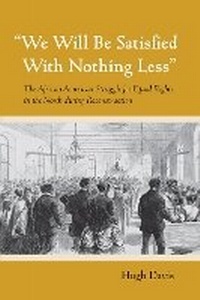
"We Will Be Satisfied with Nothing Less"
The African American Struggle for Equal Rights in the North During Reconstruction
Published on 15. August 2011
Book
Hardback
232 pages
978-0-8014-5009-9 (ISBN)
Description
Historians have focused almost entirely on the attempt by southern African Americans to attain equal rights during Reconstruction. However, the northern states also witnessed a significant period of struggle during these years. Northern blacks vigorously protested laws establishing inequality in education, public accommodations, and political life and challenged the Republican Party to live up to its stated ideals.
In "We Will Be Satisfied With Nothing Less", Hugh Davis concentrates on the two issues that African Americans in the North considered most essential: black male suffrage rights and equal access to the public schools. Davis connects the local and the national; he joins the specifics of campaigns in places such as Cincinnati, Detroit, and San Francisco with the work of the National Equal Rights League and its successor, the National Executive Committee of Colored Persons. The narrative moves forward from their launching of the equal rights movement in 1864 to the "end" of Reconstruction in the North two decades later.
The struggle to gain male suffrage rights was the centerpiece of the movement's agenda in the 1860s, while the school issue remained a major objective throughout the period. Following the ratification of the Fifteenth Amendment in 1870, northern blacks devoted considerable attention to assessing their place within the Republican Party and determining how they could most effectively employ the franchise to protect the rights of all citizens.
In "We Will Be Satisfied With Nothing Less", Hugh Davis concentrates on the two issues that African Americans in the North considered most essential: black male suffrage rights and equal access to the public schools. Davis connects the local and the national; he joins the specifics of campaigns in places such as Cincinnati, Detroit, and San Francisco with the work of the National Equal Rights League and its successor, the National Executive Committee of Colored Persons. The narrative moves forward from their launching of the equal rights movement in 1864 to the "end" of Reconstruction in the North two decades later.
The struggle to gain male suffrage rights was the centerpiece of the movement's agenda in the 1860s, while the school issue remained a major objective throughout the period. Following the ratification of the Fifteenth Amendment in 1870, northern blacks devoted considerable attention to assessing their place within the Republican Party and determining how they could most effectively employ the franchise to protect the rights of all citizens.
Reviews / Votes
Building upon literature focusing on local movements, Davis makes a strong case for the ability of northern African American activists to overcome internal divisions and significant external challenges (especially tepid support from white Republicans) to champion male suffrage and civil rights legislation. Davis argues persuasively that despite comprising but 2 percent of the northern population during Reconstruction, African American organizations placed 'relentless pressure on the white power structure at all levels of government,' and as a result were able to achieve universal male suffrage and some important civil rights gains, especially greater access to public education. Recommended.(Choice) Davis contributes significantly to intensifying interest in moving beyond misplaced regionalism to understand the embedded power of racism nationwide in America.... Davis nicely connects blacks' postwar activism with their antebellum abolitionism and their wartime military service.
(Journal of American History) With this book, Hugh Davis demonstrates the importance of including the North, and especially northern African Americans, in any account of the Reconstruction era. It concisely and persuasively charts northern black activism on behalf of campaigns for universal male voting rights, access to public education, and the abolition of all racial and caste discrimination.... Among the insights that Davis offers is the continuity in tactics and ideology that connected black northern activism before the Civil War with black activism later in the century.... Written in crisp and clear prose, this book is a valuable addition to the crowded field of Reconstruction scholarship.
- W. Fitzhugh Brundage (Pennsylvania Magazine of History and Biography)
More details
Language
English
Place of publication
Ithaca
United States
Product notice
Paper over boards
Dimensions
Height: 229 mm
Width: 152 mm
Thickness: 24 mm
Weight
454 gr
ISBN-13
978-0-8014-5009-9 (9780801450099)
Copyright in bibliographic data and cover images is held by Nielsen Book Services Limited or by the publishers or by their respective licensors: all rights reserved.
Schweitzer Classification
Other editions
Additional editions
Hugh Davis
"We Will Be Satisfied with Nothing Less"
The African American Struggle for Equal Rights in the North During Reconstruction
E-Book
08/2011
Cornell University Press
€39.99
Available for download
Person
Hugh Davis is Professor Emeritus of History at Southern Connecticut State University. He is the author of Leonard Bacon: New England Reformer and Antislavery Moderate and Joshua Leavitt: Evangelical Abolitionist.
Content
Prologue
1. Launching the Equal Rights Movement
2. Toward the Fifteenth Amendment
3. The Crusade for Equal Access to Public Schools, 1864-1870
4. The Equal Rights Struggle in the 1870s
5. The Republican Retreat from Reconstruction
EpilogueNotes
Bibliography
Index
1. Launching the Equal Rights Movement
2. Toward the Fifteenth Amendment
3. The Crusade for Equal Access to Public Schools, 1864-1870
4. The Equal Rights Struggle in the 1870s
5. The Republican Retreat from Reconstruction
EpilogueNotes
Bibliography
Index