

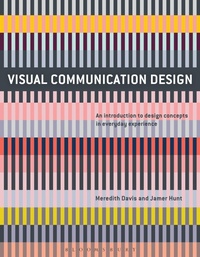
Visual Communication Design
An Introduction to Design Concepts in Everyday Experience
Published on 7. September 2017
Book
Paperback/Softback
208 pages
978-1-4742-2157-3 (ISBN)
Description
Where do design principles come from? Are they abstract "rules" established by professionals or do they have roots in human experience? And if we encounter these visual phenomena in our everyday lives, how do designers use them to attract our attention, orient our behavior, and create compelling and memorable communication that stands out among the thousands of messages we confront each day? Today's work in visual communication design shifts emphasis from simply designing objects to designing experiences; to crafting form that acknowledges cognitive and cultural influences on interpretation.
In response, Meredith Davis and Jamer Hunt provide a new slant on design basics from the perspective of audiences and users. Chapters break down our interactions with communication as a sequence of meaningful episodes, each with related visual concepts that shape the interpretive experience. Explanatory illustrations and professional design examples support definitions of visual concepts and discussions of context. Work spans print, screen, and environmental applications from around the world.
This introduction to visual communication design demystifies the foundational concepts that underpin professional design decisions and shape our experiences in a complex visual world.
In response, Meredith Davis and Jamer Hunt provide a new slant on design basics from the perspective of audiences and users. Chapters break down our interactions with communication as a sequence of meaningful episodes, each with related visual concepts that shape the interpretive experience. Explanatory illustrations and professional design examples support definitions of visual concepts and discussions of context. Work spans print, screen, and environmental applications from around the world.
This introduction to visual communication design demystifies the foundational concepts that underpin professional design decisions and shape our experiences in a complex visual world.
Reviews / Votes
A great reference text for all graphic design students. Effectively places many of the main theoretical principles that lie behind successful design outcomes. Clearly links theory to practice in a single accessible volume and a great reference source for either a practical or theoretical module. * Anthony Roocroft, University of Bolton, UK *More details
Series
Language
English
Place of publication
London
United Kingdom
Publishing group
Bloomsbury Publishing PLC
Target group
College/higher education
Illustrations
254 colour illus
Dimensions
Height: 269 mm
Width: 215 mm
Thickness: 17 mm
Weight
795 gr
ISBN-13
978-1-4742-2157-3 (9781474221573)
Copyright in bibliographic data and cover images is held by Nielsen Book Services Limited or by the publishers or by their respective licensors: all rights reserved.
Schweitzer Classification
Other editions
Additional editions
Meredith Davis | Jamer Hunt
Visual Communication Design
An Introduction to Design Concepts in Everyday Experience
E-Book
09/2017
1st Edition
Bloomsbury Visual Arts
€36.49
Available for download
Meredith Davis | Jamer Hunt
Visual Communication Design
An Introduction to Design Concepts in Everyday Experience
E-Book
09/2017
1st Edition
Bloomsbury Visual Arts
€36.49
Available for download
Persons
Meredith Davis is an award winning educator and designer. She teaches at North Carolina State University and is the author of Graphic Design in Context: Graphic Design Theory as well as of numerous articles. She is the former president of the American Center for Design and the Graphic Design Education Association and is part of the accreditation commission for NASAD (National Assn of Schools of Art & Design).
Jamer Hunt teaches is Associate Professor of Transdisciplinary Design at Parsons New School of Design in NYC. He has served on the Board of Design and Culture and is on the Icograda Design Education Manifesto Steering Committee. He is the author of numerous articles.
Jamer Hunt teaches is Associate Professor of Transdisciplinary Design at Parsons New School of Design in NYC. He has served on the Board of Design and Culture and is on the Icograda Design Education Manifesto Steering Committee. He is the author of numerous articles.
Content
Foreword
CHAPTER 1 - The importance of form
The relationship between form and context: Goodness of fit
Form and meaning
A little bit of history: Twentieth-century attitudes toward "good form"
New practices: The changing context for contemporary design
The shift in attention from artifact to experience
How this book is organized
CHAPTER 2 - Getting attention
Introduction
Contrast
Figure-Ground
Camouflage
Color
Size constancy
Scale
Proportion
Proximity
Focus
Layering
Symmetry/Asymmetry
Closure
Continuity
Series and Sequences
Pattern
Rhythm and Pacing
Motion
Summary
CHAPTER 3 - Orienting for use and interpretive behavior
Introduction
Affordances
Channel
Medium and Format
Feedback
Wayfinding
Mapping
Hierarchy
Reading Pattern
Grouping
Edge Relationships
Direction
Point of View
Summary
CHAPTER 4 - Interpreting, interacting, and experiencing
Introduction
Legibility and Readability
Denotation and Connotation
Framing
Abstraction
Icon, Index, and Symbol
Materiality
Substitution
Metaphor
Parallel Form
Appropriation
Ambiguity
Cognitive Dissonance
Summary
CHAPTER 5 - Extending and retaining meaning
Introduction
Schemas and Stereotypes
Narrative
Archetypes
Mnemonics
Chunking
Redundancy
Graphic Identity
Branding
Summary
CONCLUSION
Bibliography
Index
CHAPTER 1 - The importance of form
The relationship between form and context: Goodness of fit
Form and meaning
A little bit of history: Twentieth-century attitudes toward "good form"
New practices: The changing context for contemporary design
The shift in attention from artifact to experience
How this book is organized
CHAPTER 2 - Getting attention
Introduction
Contrast
Figure-Ground
Camouflage
Color
Size constancy
Scale
Proportion
Proximity
Focus
Layering
Symmetry/Asymmetry
Closure
Continuity
Series and Sequences
Pattern
Rhythm and Pacing
Motion
Summary
CHAPTER 3 - Orienting for use and interpretive behavior
Introduction
Affordances
Channel
Medium and Format
Feedback
Wayfinding
Mapping
Hierarchy
Reading Pattern
Grouping
Edge Relationships
Direction
Point of View
Summary
CHAPTER 4 - Interpreting, interacting, and experiencing
Introduction
Legibility and Readability
Denotation and Connotation
Framing
Abstraction
Icon, Index, and Symbol
Materiality
Substitution
Metaphor
Parallel Form
Appropriation
Ambiguity
Cognitive Dissonance
Summary
CHAPTER 5 - Extending and retaining meaning
Introduction
Schemas and Stereotypes
Narrative
Archetypes
Mnemonics
Chunking
Redundancy
Graphic Identity
Branding
Summary
CONCLUSION
Bibliography
Index