

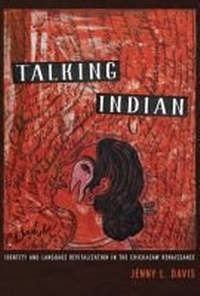
Talking Indian
Identity and Language Revitalization in the Chickasaw Renaissance
Published on 17. April 2018
Book
Hardback
192 pages
978-0-8165-3768-6 (ISBN)
Description
In south-central Oklahoma and much of "Indian Country," using an Indigenous language is colloquially referred to as "talking Indian." Among older Chickasaw community members, the phrase, "to talk Indian" is used more often than the specific language name of Chikashshanompa' or Chickasaw. This colloquialism reflects the strong connections between languages and both individual and communal identities when talking as an Indian is intimately tied up with the heritage language(s) of the community, even as the number of speakers decline.
Today a tribe of over sixty thousand members, the Chickasaw Nation was one of the Native nations removed from their homelands to Oklahoma between 1837 and 1838. Being dispersed from their lands, author Jenny L. Davis explains, contributed to being disconnected from their language over time: by 2010 the number of Chickasaw speakers had radically declined to under seventy-five speakers.
In Talking Indian, Davis-a member of the Chickasaw Nation-offers the first book-length ethnography of language revitalization in a U.S. tribe removed from its homelands. She shows how in the case of the Chickasaw Nation, language programs are intertwined with economic growth that dramatically reshapes the social realities within the tribe. She explains how this economic expansion allows the tribe to use income to fund various language--learning forums, resulting in the creation of well-paid and socially significant roles for Chickasaw speakers. Davis also illustrates how language revitalization efforts are impacted by the growing trend of tribal citizens relocating back to the Nation.
Today a tribe of over sixty thousand members, the Chickasaw Nation was one of the Native nations removed from their homelands to Oklahoma between 1837 and 1838. Being dispersed from their lands, author Jenny L. Davis explains, contributed to being disconnected from their language over time: by 2010 the number of Chickasaw speakers had radically declined to under seventy-five speakers.
In Talking Indian, Davis-a member of the Chickasaw Nation-offers the first book-length ethnography of language revitalization in a U.S. tribe removed from its homelands. She shows how in the case of the Chickasaw Nation, language programs are intertwined with economic growth that dramatically reshapes the social realities within the tribe. She explains how this economic expansion allows the tribe to use income to fund various language--learning forums, resulting in the creation of well-paid and socially significant roles for Chickasaw speakers. Davis also illustrates how language revitalization efforts are impacted by the growing trend of tribal citizens relocating back to the Nation.
Reviews / Votes
Scholars and students interested in the important work of language revitalization and the equally important topic of language and identity will find Talking Indian to be an instructive and indispensable contribution to this emerging field."" - Paul V. Kroskrity, editor of Telling Stories in the Face of Danger: Language Renewal in Native American CommunitiesMore details
Language
English
Place of publication
Tucson
United States
Target group
Professional and scholarly
Illustrations
31 black & white illustrations, 4 tables
Dimensions
Height: 229 mm
Width: 152 mm
Weight
825 gr
ISBN-13
978-0-8165-3768-6 (9780816537686)
Copyright in bibliographic data and cover images is held by Nielsen Book Services Limited or by the publishers or by their respective licensors: all rights reserved.
Schweitzer Classification
Person
Jenny L. Davis is a citizen of the Chickasaw Nation and an assistant professor of anthropology at the University of Illinois at Urbana-Champaign, where she is also the director of the Native American and Indigenous Languages (NAIL) Lab and affiliated faculty in the American Indian Studies and Gender and Women's Studies departments. Her co-edited volume Queer Excursions: Retheorizing Binaries in Language, Gender, and Sexuality won the Association for Queer Anthropology's Ruth Benedict Prize in 2014.