

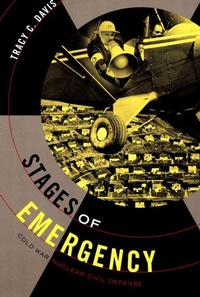
Stages of Emergency
Cold War Nuclear Civil Defense
Will be published approx. on 27. June 2007
Book
Hardback
432 pages
978-0-8223-3959-5 (ISBN)
Description
In an era defined by the threat of nuclear annihilation, Western nations attempted to prepare civilian populations for atomic attack through staged drills, evacuations, and field exercises. In Stages of Emergency the distinguished performance historian Tracy C. Davis investigates the fundamentally theatrical nature of these Cold War civil defense exercises. Asking what it meant for civilians to be rehearsing nuclear war, she provides a comparative study of the civil defense maneuvers conducted by three NATO allies-the United States, Canada, and the United Kingdom-during the 1950s and 1960s. Delving deep into the three countries' archives, she analyzes public exercises involving private citizens-Boy Scouts serving as mock casualties, housewives arranging home protection, clergy training to be shelter managers-as well as covert exercises undertaken by civil servants.Stages of Emergency covers public education campaigns and school programs-such as the ubiquitous "duck and cover" drills-meant to heighten awareness of the dangers of a possible attack, the occupancy tests in which people stayed sequestered for up to two weeks to simulate post-attack living conditions as well as the effects of confinement on interpersonal dynamics, and the British first-aid training in which participants acted out psychological and physical trauma requiring immediate treatment. Davis also brings to light unpublicized government exercises aimed at anticipating the global effects of nuclear war. Her comparative analysis shows how the differing priorities, contingencies, and social policies of the three countries influenced their rehearsals of nuclear catastrophe. When the Cold War ended, so did these exercises, but, as Davis points out in her perceptive afterword, they have been revived-with strikingly similar recommendations-in response to twenty-first-century fears of terrorists, dirty bombs, and rogue states.
Reviews / Votes
"Tracy C. Davis is a leading performance historian, and in Stages of Emergency she applies her considerable skills to a kind of 'play' that permeated the consciousness and determined much social reality in the United States, Canada, and the United Kingdom during the Cold War. The story she tells, and her analysis of it, goes to the very heart of what these societies were and are."-Richard Schechner, author of Performance Studies: An Introduction "Tracy C. Davis's highly original cross-cultural study represents the most perceptive analysis of Cold War-era civil-defense theory and practice written to date. As a theater scholar, she focuses on the 'rehearsal' and performative aspects of civil-defense planning in a way that is brilliantly illuminating."-Paul Boyer, author of By the Bomb's Early Light: American Thought and Culture at the Dawn of the Atomic Age "[An] inspired reading of the cold war. . . . The historical reach of Davis's study, from the defense planning f the early 1950s and 1960s to the dissolution of the Soviet Union in 1991, is as impressive as her ability to move with subtlety between civil defense in the United States and that in Canada or Britain." - Martin Halliwell (Theatre Survey) "Davis presents meticulous discussions throughout the book, with extremely well-endnoted references, helping her to paint clear and in-depth pictures of these various exercises. These stories are surprisingly amusing to read, despite the seriousness of their underlying logic." - Joshua Abrams (TDR: The Drama Review)More details
Language
English
Place of publication
North Carolina
United States
Target group
Professional and scholarly
Product notice
Cloth over boards
Illustrations
58 illustrations
Dimensions
Height: 237 mm
Width: 163 mm
Thickness: 33 mm
Weight
771 gr
ISBN-13
978-0-8223-3959-5 (9780822339595)
Copyright in bibliographic data and cover images is held by Nielsen Book Services Limited or by the publishers or by their respective licensors: all rights reserved.
Schweitzer Classification
Other editions
Additional editions
E-Book
06/2007
1st Edition
De Gruyter
€228.99
Available for download
Person
Tracy C. Davis is Barber Professor of Performing Arts and Professor of English and Theatre at Northwestern University. She is the author of The Economics of the British Stage 1800-1914; George Bernard Shaw and the Socialist Theatre; and Actresses as Working Women: Their Social Identity in Victorian Culture.
Content
Acknowledgments ix
Abbreviations xiii
Introduction 1
Part I: Directing Apocalypse
1. Civil Defense Concepts and Planning 9
2. Rehearsals for Nuclear War 58
Part II: Act Your Part: The Private Citizen on the Public Stage
3. The Psychology of Vulnerability 105
4. Sheltering 127
5. Get Out of Town! 158
6. Communications 181
7. Acting Out Injury 198
Part III: Covert Stages: The "Public Sector" Rehearses in Private
8. Crisis Play 223
9. International Play 247
10. Disaster Welfare 261
11. Continuity of Government 287
12. Computer Play 312
Afterword:Dismantling Civil Defense 331
Appendix: Cold War and Civil Defense Time Line 339
Notes 351
Works Cited 401
Index 429
Abbreviations xiii
Introduction 1
Part I: Directing Apocalypse
1. Civil Defense Concepts and Planning 9
2. Rehearsals for Nuclear War 58
Part II: Act Your Part: The Private Citizen on the Public Stage
3. The Psychology of Vulnerability 105
4. Sheltering 127
5. Get Out of Town! 158
6. Communications 181
7. Acting Out Injury 198
Part III: Covert Stages: The "Public Sector" Rehearses in Private
8. Crisis Play 223
9. International Play 247
10. Disaster Welfare 261
11. Continuity of Government 287
12. Computer Play 312
Afterword:Dismantling Civil Defense 331
Appendix: Cold War and Civil Defense Time Line 339
Notes 351
Works Cited 401
Index 429