

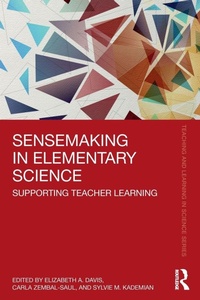
Sensemaking in Elementary Science
Supporting Teacher Learning
1st Edition
Published on 1. November 2019
Book
Paperback/Softback
272 pages
978-1-138-38695-2 (ISBN)
Description
Grounded in empirical research, this book offers concrete pathways to direct attention towards elementary science teaching that privileges sensemaking, rather than isolated activities and vocabulary. Outlining a clear vision for this shift using research-backed tools, pedagogies, and practices to support teacher learning and development, this edited volume reveals how teachers can best engage in teaching that supports meaningful learning and understanding in elementary science classrooms.
Divided into three sections, this book demonstrates the skills, knowledge bases, and research-driven practices necessary to make a fundamental shift towards a focus on students' ideas and reasoning, and covers topics such as:
An introduction to sensemaking in elementary science;
Positioning students at the center of sensemaking;
Planning and enacting investigation-based science discussions;
Designing a practice-based elementary teacher education program;
Reflections on science teacher education and professional development for reform-based elementary science.
In line with current reform efforts, including the Next Generation Science Standards (NGSS), Sensemaking in Elementary Science is the perfect resource for graduate students and researchers in science education, elementary education, teacher education, and STEM education looking to explore effective practice, approaches, and development within the elementary science classroom.
Divided into three sections, this book demonstrates the skills, knowledge bases, and research-driven practices necessary to make a fundamental shift towards a focus on students' ideas and reasoning, and covers topics such as:
An introduction to sensemaking in elementary science;
Positioning students at the center of sensemaking;
Planning and enacting investigation-based science discussions;
Designing a practice-based elementary teacher education program;
Reflections on science teacher education and professional development for reform-based elementary science.
In line with current reform efforts, including the Next Generation Science Standards (NGSS), Sensemaking in Elementary Science is the perfect resource for graduate students and researchers in science education, elementary education, teacher education, and STEM education looking to explore effective practice, approaches, and development within the elementary science classroom.
Reviews / Votes
Rigid school curricula emphasizing and assessing low-level skills perpetuate the wildly damaging assumption that elementary learners are incapable of engaging in substantive intellectual work. Sensemaking in Elementary Science offers an aspirational, yet achievable vision for science teaching and teacher education to guide bold changes in the landscape of elementary science. This book will become a well-worn, go-to resource for those working to make high-quality elementary science a reality.Heidi Carlone, Ph.D., Hooks Distinguished Professor of STEM Education, The University of North Carolina at Greensboro
More details
Series
Language
English
Place of publication
London
United Kingdom
Publishing group
Taylor & Francis Ltd
Target group
College/higher education
Illustrations
25 s/w Abbildungen, 5 s/w Photographien bzw. Rasterbilder, 20 s/w Zeichnungen, 14 s/w Tabellen
14 Tables, black and white; 20 Line drawings, black and white; 5 Halftones, black and white; 25 Illustrations, black and white
Dimensions
Height: 229 mm
Width: 152 mm
Thickness: 16 mm
Weight
429 gr
ISBN-13
978-1-138-38695-2 (9781138386952)
Copyright in bibliographic data and cover images is held by Nielsen Book Services Limited or by the publishers or by their respective licensors: all rights reserved.
Schweitzer Classification
Other editions
Additional editions
Elizabeth A. Davis | Carla Zembal-Saul | Sylvie M. Kademian
Sensemaking in Elementary Science
Supporting Teacher Learning
Book
11/2019
1st Edition
Routledge
€206.70
Shipment within 10-20 days
Elizabeth A. Davis | Carla Zembal-Saul | Sylvie M. Kademian
Sensemaking in Elementary Science
Supporting Teacher Learning
E-Book
10/2019
1st Edition
Routledge
€59.49
Available for download
Elizabeth A. Davis | Carla Zembal-Saul | Sylvie M. Kademian
Sensemaking in Elementary Science
Supporting Teacher Learning
E-Book
10/2019
1st Edition
Routledge
€59.49
Available for download
Persons
Elizabeth A. Davis is Professor of Science Education at University of Michigan, USA.
Carla Zembal-Saul is the Kahn Professor of STEM Education at The Pennsylvania State University, USA.
Sylvie M. Kademian is Lecturer of Science Education at University of Michigan, USA.
Carla Zembal-Saul is the Kahn Professor of STEM Education at The Pennsylvania State University, USA.
Sylvie M. Kademian is Lecturer of Science Education at University of Michigan, USA.
Content
Chapter 2: Focusing on kindergarten girls as science learners: Teacher positioning of students supports science engagement and sensemaking in the classroom, Alicia McDyre
Chapter 3: Portrait of a first grade teacher: Using science practices to leverage young children's sensemaking in science, Amber S. Bismack, University of Michigan & Leigh Ann Haefner
Chapter 4: What's Your Evidence? Revisited: Organizing Data Collection and Analysis to Support Students' Sensemaking, Carla Zembal-Saul, Penn State University & Kimber Hershberger
Chapter 5: Literacy Practices for Sensemaking in Science that Promote Epistemic Alignment, LeeAnna Hooper & Carla Zembal-Saul
Chapter 6: Science, engineering, literacy practices and place-based education: Powerful practices for integration, Jennifer Cody, Mandy Biggers
Response: Considering Issues of Equity and Identity in Elementary Science, Lucy Avraamidou, University of Groningen, The Netherlands
Response: Considering Issues of Science Practice in Elementary Science, Katherine McNeill, Boston College
Chapter 3: Portrait of a first grade teacher: Using science practices to leverage young children's sensemaking in science, Amber S. Bismack, University of Michigan & Leigh Ann Haefner
Chapter 4: What's Your Evidence? Revisited: Organizing Data Collection and Analysis to Support Students' Sensemaking, Carla Zembal-Saul, Penn State University & Kimber Hershberger
Chapter 5: Literacy Practices for Sensemaking in Science that Promote Epistemic Alignment, LeeAnna Hooper & Carla Zembal-Saul
Chapter 6: Science, engineering, literacy practices and place-based education: Powerful practices for integration, Jennifer Cody, Mandy Biggers
Response: Considering Issues of Equity and Identity in Elementary Science, Lucy Avraamidou, University of Groningen, The Netherlands
Response: Considering Issues of Science Practice in Elementary Science, Katherine McNeill, Boston College