

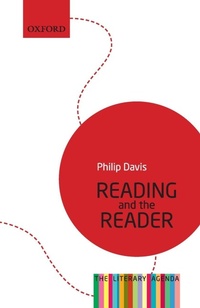
Reading and the Reader
The Literary Agenda
Published on 3. October 2013
Book
Paperback/Softback
160 pages
978-0-19-968318-5 (ISBN)
Description
The Literary Agenda is a series of short polemical monographs about the importance of literature and of reading in the wider world and about the state of literary education inside schools and universities. The category of 'the literary' has always been contentious. What is clear, however, is how increasingly it is dismissed or is unrecognised as a way of thinking or an arena for thought. It is sceptically challenged from within, for example, by the sometimes rival claims of cultural history, contextualized explanation, or media studies. It is shaken from without by even greater pressures: by economic exigency and the severe social attitudes that can follow from it; by technological change that may leave the traditional forms of serious human communication looking merely antiquated. For just these reasons this is the right time for renewal, to start reinvigorated work into the meaning and value of literary reading.
Reading and the Reader offers a defence of reading serious literature, where reading offers a place for inner contemplation, emotion, imagination, and thought-experiment through the energising booster-rocket of literature. It is argued that literature creates a holding-ground in which a dense sense of experience is registered. Such a place is vital to human well-being in the following respects: in sustaining the ability to use and not just suffer one's experience; to be able to think one's thoughts, even those that are customarily unadmitted or felt as anomalous or unworthy; to find room for a realm of speculation in between religions and secularization, in between literature and life. Reading and the Reader, one of the first volumes in the Literary Agenda series, exists to defend the value of reading, to narrow the gaps between the way writers and readers think, to bring literary thinking into the ordinary thinking of the world - especially at a time when the arts and humanities are under some threat. Literature is useful in terms of deep human needs. It offers a form of time-travel - across ages, countries, different minds - that provides alternatives to any conventional worldview.
Reading and the Reader offers a defence of reading serious literature, where reading offers a place for inner contemplation, emotion, imagination, and thought-experiment through the energising booster-rocket of literature. It is argued that literature creates a holding-ground in which a dense sense of experience is registered. Such a place is vital to human well-being in the following respects: in sustaining the ability to use and not just suffer one's experience; to be able to think one's thoughts, even those that are customarily unadmitted or felt as anomalous or unworthy; to find room for a realm of speculation in between religions and secularization, in between literature and life. Reading and the Reader, one of the first volumes in the Literary Agenda series, exists to defend the value of reading, to narrow the gaps between the way writers and readers think, to bring literary thinking into the ordinary thinking of the world - especially at a time when the arts and humanities are under some threat. Literature is useful in terms of deep human needs. It offers a form of time-travel - across ages, countries, different minds - that provides alternatives to any conventional worldview.
Reviews / Votes
This is not some dry work of academic lit crit. Rather, it is a heartfelt celebration of the value of reading. * PD Smith, the guardian *More details
Series
Language
English
Place of publication
Oxford
United Kingdom
Target group
College/higher education
Professional and scholarly
Dimensions
Height: 198 mm
Width: 129 mm
Thickness: 9 mm
Weight
180 gr
ISBN-13
978-0-19-968318-5 (9780199683185)
Copyright in bibliographic data and cover images is held by Nielsen Book Services Limited or by the publishers or by their respective licensors: all rights reserved.
Schweitzer Classification
Other editions
Additional editions
E-Book
10/2013
1st Edition
OUP eBook
€12.49
Available for download
E-Book
10/2013
1st Edition
OUP eBook
€12.49
Available for download
Person
Philip Davis is editor of The Reader magazine and director of a Centre for Research into Reading (CRILS) at the University of Liverpool, as well as being a Professor of English literature. His publications include works on Shakespeare, Samuel Johnson, The Victorians, Bernard Malamud, as well as books on reading itself (The Experience of Reading; Real Voices: On Reading). He is committed to the relation to literature to the wider world and is a member of the The Reader Organization, an outreach charity which brings reading-aloud to shared-reading groups in a variety of settings from dementia wards to facilities for looked-after children, including libraries, drug rehabilitation centres, mental health drop-in clinics and prisons.
Content
Preface ; 1. Not Names but Places ; 2. An Awakened Sense of Being ; 3. The Holding-Ground and the World