

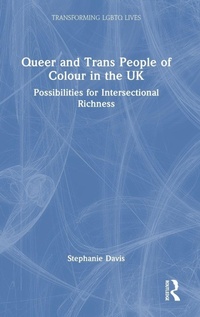
Queer and Trans People of Colour in the UK
Possibilities for Intersectional Richness
1st Edition
Published on 30. December 2022
Book
Hardback
134 pages
978-1-138-34576-8 (ISBN)
Description
This book explores the meanings of Queer and Trans People of Colour (QTPOC) activist groups in the UK, considering the tensions around inclusion and belonging across lesbian, gay, bisexual, trans, and queer (LGBTQ) and of colour communities and wider British society.
Davis draws de-/anti-/post-colonial, Black feminist, and queer theory into critical psychology to publish the first book of its kind in the UK, developing an intersectional understanding of QTPOC subjectivities and identities. The book examines questions of belonging; racial melancholia; decolonising gender and sexualities; and the joys, erotics, and the difficulties of building and finding QTPOC community that can hold and celebrate our intersectional richness.
Offering a radical and critical intervention into psychology, this volume will be of key interest to scholars in Gender Studies and Queer Studies, Psychology and Race, together with activists, community organisers, counsellors, and the third sector.
Davis draws de-/anti-/post-colonial, Black feminist, and queer theory into critical psychology to publish the first book of its kind in the UK, developing an intersectional understanding of QTPOC subjectivities and identities. The book examines questions of belonging; racial melancholia; decolonising gender and sexualities; and the joys, erotics, and the difficulties of building and finding QTPOC community that can hold and celebrate our intersectional richness.
Offering a radical and critical intervention into psychology, this volume will be of key interest to scholars in Gender Studies and Queer Studies, Psychology and Race, together with activists, community organisers, counsellors, and the third sector.
More details
Series
Language
English
Place of publication
London
United Kingdom
Publishing group
Taylor & Francis Ltd
Target group
College/higher education
Professional and scholarly
Academic, Postgraduate, and Undergraduate Advanced
Product notice
sewn/stitched
Cloth over boards
Dimensions
Height: 234 mm
Width: 156 mm
Thickness: 10 mm
Weight
390 gr
ISBN-13
978-1-138-34576-8 (9781138345768)
Copyright in bibliographic data and cover images is held by Nielsen Book Services Limited or by the publishers or by their respective licensors: all rights reserved.
Schweitzer Classification
Other editions
Additional editions
Book
12/2022
1st Edition
Routledge
€50.00
Shipment within 10-20 days
E-Book
12/2022
Routledge
€0.00
Available for download
E-Book
12/2022
Routledge
€0.00
Available for download
Person
Stephanie Davis is a scholar-activist, a Black queer troublemaker, and a Senior Lecturer in Critical Psychology and Race at Nottingham Trent University. She has a specific interest in the intersections of race, gender, and sexuality; critical psychology; decolonial, queer, and Black feminist theory; critical pedagogies; and decolonising academia. She has previously worked in a community development and activist capacity on issues of sexual health with young people and Black and brown communities and on issues facing her local community such as police harassment and gender and sexual diversity. In 2013, she co-founded Rainbow Noir, a social support and organising space for QTPOC in Manchester. Stephanie has previously held Lectureships at the University of Brighton and the University of East London. She was also a Research Officer on the NIHR-funded Queer Futures 2 project which explored how to improve mental health provision for LGBTQ youth in the UK. As an educator she is inspired by bell hooks' 'education as the practice of freedom' and strives to create learning environments with her students that encourage openness, dialogue, debate, and critical thinking. As a scholar-activist she is excited by the possibilities of working both within academia and beyond its boundaries.
Content
Chapter One. Introduction; 2. Exploring QTPOC Lives; 3. Theorising Multiplicity; 4. Belonging; 5. Building Community; 6. Decolonising Gender and Sexuality; 7. Conflict and Harm in Community: The Possibilities for the Reparative and Transformative; 8. Conclusion.