

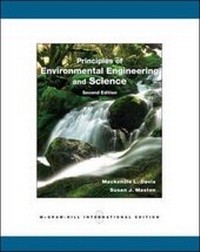
Principles of Environmental Engineering & Science
2nd Edition
Published on 16. February 2008
Book
Paperback/Softback
736 pages
978-0-07-128780-7 (ISBN)
Description
Principles of Environmental Engineering is intended for a course in introductory environmental engineering for sophomore- or junior-level students. The emphasis of this text is on engineering principles rather than on engineering design. Students should understand such calculus topics as differentiation, integrations, and differential equations. Principles of Environmental Engineering places more emphasis on scientific principles, ethics, and safety, and focuses less on engineering design. The text exposes students to a broader range of environmental topics through separate chapters on ecosystems, geological and soil resources, and agricultural effects. This new edition includes a new chapter on Biology, updated science and technology discussions to reflect the latest trends and new case studies in each chapter.
More details
Edition
2nd edition
Language
English
Place of publication
United States
Publishing group
McGraw-Hill Education - Europe
Target group
College/higher education
Illustrations
Illustrations
Dimensions
Height: 254 mm
Width: 203 mm
Thickness: 36 mm
Weight
1604 gr
ISBN-13
978-0-07-128780-7 (9780071287807)
Copyright in bibliographic data and cover images is held by Nielsen Book Services Limited or by the publishers or by their respective licensors: all rights reserved.
Schweitzer Classification
Persons
Mackenzie L. Davis, Ph.D., P.E., BCEE, is an Emeritus Professor of Environmental Engineering at Michigan State University. He received all his degrees from the University of Illinois. From 1968 to 1971 he served as a Captain in the U.S. Army Medical Service Corps. During his military service he conducted air pollution surveys at Army ammunition plants. From 1971 to 1973 he was Branch Chief of the Environmental Engineering Branch at the U.S. Army Construction Engineering Research Laboratory. His responsibilities included supervision of research on air, noise, and water pollution control and solid waste management for Army facilities. In 1973, he joined the faculty at Michigan State University. He has taught and conducted research in the areas of air pollution control and hazardous waste management. His honors and awards include the State-of-the-Art Award from the ASCE, Chapter Honor Member of Chi Epsilon, Sigma Xi, election as a Fellow in the Air and Waste Management Association, and election as a Diplomate in the American Academy of Environmental Engi-neers with certification in hazardous waste management. He has received teaching awards from the American Society of Civil Engineers Student Chapter, Michigan State University College of Engineering, North Central Section of the American Society for Engineering Education, Great Lakes Region of Chi Epsilon, and the Amoco Corporation. In 1998, he received the Lyman A. Ripperton Award for distinguished achievement as an educator from the Air and Waste Management Association. In 2007, he was recognized as the Educational Professional of the Year by the Michigan Water Environment Association. He is a registered professional engineer in Michigan. Dr. Davis is the author of a student and professional edition of Water and Wastewater Engineering and co-author of Introduction to Environmental Engineering with Dr. David Cornwell. In 2003, Dr. Davis retired from Michigan State University.
Susan J. Masten is a Professor in the Department of Civil and Environmental Engineering at Michigan State University. She received her Ph.D. in environmental engineering from Harvard University in 1986. Before joining the faculty at Michigan State University in 1989, she worked for several years in environmental research at the University of Melbourne (Australia) and at the US Environmental Protection Agencys Kerr Laboratory, in Ada, Oklahoma. Professor Mastens research involves the use of chemical oxidants for the remediation of soils, water, and wastewater. Her research is presently focused on the use of ozone for reducing the concentration of disinfection by-products in drinking water, controlling fouling in membranes, and reducing the toxicity of ozonation by-products formed from the ozonation of polycyclic aromatic hydrocarbons and pesticides. Dr. Masten is a member of the following professional organizations: American Water Works Association, Association of Environmental Engineering and Science Professors (AEESP), and American Chemical Society. She has served as the chair of the AEESP Publications Committee since 2013. Professor Masten was a Lilly Teaching Fellow during the 19941995 academic year. She is also the recipient of the Withrow Distinguished Scholar Award, College of Engineering, MSU, March 1995, and the Teacher-Scholar Award, Michigan State University, February 1996, and the Withrow Teaching Award in 2012 and 2018. Dr. Masten was also a member of the Faculty Writing Project, Michigan State University, May 1996. In 2001, she was awarded the Association of Environmental Engineering and Science Professors/Wiley Interscience Outstanding Educator Award, and in 2013, she was awarded the Lyman A. Ripperton Environmental Educator Award by the Air and Waste Management Association. Professor Masten was awarded an Erskine Fellowship in 2018 from the University of Canterbury, Christchurch, NZ. Dr. Masten is a registered professional engineer in the state of Michigan.
Susan J. Masten is a Professor in the Department of Civil and Environmental Engineering at Michigan State University. She received her Ph.D. in environmental engineering from Harvard University in 1986. Before joining the faculty at Michigan State University in 1989, she worked for several years in environmental research at the University of Melbourne (Australia) and at the US Environmental Protection Agencys Kerr Laboratory, in Ada, Oklahoma. Professor Mastens research involves the use of chemical oxidants for the remediation of soils, water, and wastewater. Her research is presently focused on the use of ozone for reducing the concentration of disinfection by-products in drinking water, controlling fouling in membranes, and reducing the toxicity of ozonation by-products formed from the ozonation of polycyclic aromatic hydrocarbons and pesticides. Dr. Masten is a member of the following professional organizations: American Water Works Association, Association of Environmental Engineering and Science Professors (AEESP), and American Chemical Society. She has served as the chair of the AEESP Publications Committee since 2013. Professor Masten was a Lilly Teaching Fellow during the 19941995 academic year. She is also the recipient of the Withrow Distinguished Scholar Award, College of Engineering, MSU, March 1995, and the Teacher-Scholar Award, Michigan State University, February 1996, and the Withrow Teaching Award in 2012 and 2018. Dr. Masten was also a member of the Faculty Writing Project, Michigan State University, May 1996. In 2001, she was awarded the Association of Environmental Engineering and Science Professors/Wiley Interscience Outstanding Educator Award, and in 2013, she was awarded the Lyman A. Ripperton Environmental Educator Award by the Air and Waste Management Association. Professor Masten was awarded an Erskine Fellowship in 2018 from the University of Canterbury, Christchurch, NZ. Dr. Masten is a registered professional engineer in the state of Michigan.
Content
1 Introduction2 Chemistry3 Biology4 Materials and Energy Balances5 Ecosystems6 Risk Perception, Assessment and Management7 Hydrology8 Sustainable Energy, Mineral and Soil Resources9 Water Quality Management10 Water Treatment11 Wastewater Treatment12 Air Pollution13 Solid Waste Management14 Hazardous Waste Management15 Noise Pollution16 Ionizing RadiationAppendix A: Properties of Air, Water, and Selected Chemicals