

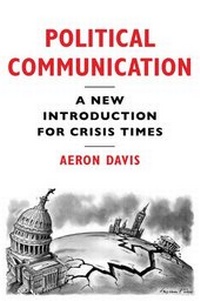
Political Communication
A New Introduction for Crisis Times
1st Edition
Published on 26. April 2019
Book
Hardback
288 pages
978-1-5095-2899-8 (ISBN)
Description
We are living in a period of great uncertainty. Votes for Brexit and Trump, along with widespread political volatility, are not only causing turmoil; they are signs that many long-predicted tipping points in media and politics have been reached. Such changes have worrying implications for democracies everywhere.
In this text, Aeron Davis bridges old and new to map the shifts and analyse what they mean for our aging democracies. Why are volatile, polarized electorates no longer prepared to support established political parties? Why are large parts of the legacy media either dying or dismissed as 'fake news'? How is social media rapidly rewriting the rules? And why do some democratic leaders look more like dictators, and pollsters and economists more like fortune tellers? These questions and more are addressed in the book.
Political Communication: A New Introduction for Crisis Times both introduces and challenges the established literature. It will appeal to advanced students, scholars and anyone else trying to understand the precarious state of today's media and political landscape.
In this text, Aeron Davis bridges old and new to map the shifts and analyse what they mean for our aging democracies. Why are volatile, polarized electorates no longer prepared to support established political parties? Why are large parts of the legacy media either dying or dismissed as 'fake news'? How is social media rapidly rewriting the rules? And why do some democratic leaders look more like dictators, and pollsters and economists more like fortune tellers? These questions and more are addressed in the book.
Political Communication: A New Introduction for Crisis Times both introduces and challenges the established literature. It will appeal to advanced students, scholars and anyone else trying to understand the precarious state of today's media and political landscape.
Reviews / Votes
'Liberal democracy is in the midst of a crisis in which media of all kinds are implicated in complex and multiple ways. Aeron Davis's book helps us understand why. This is essential reading for students of political communication.'Andrew Chadwick, Loughborough University and author of The Hybrid Media System: Politics and Power
'This remarkable book brings political communication up to date by tracing the field from early models of press systems and the public sphere to the present era of democratic disruption. The comparative perspective is refreshing and well done. The insightful political analyses make core concepts come alive and point to new frameworks for understanding digital media and the disinformation age. Davis has written a classic.'
Lance Bennett, University of Washington
More details
Other editions
New editions
Book
12/2023
2nd Edition
Polity Press
€65.00
Shipment within 15-20 days
Additional editions
E-Book
05/2019
1st Edition
Polity Press
€18.99
Available for download
Book
04/2019
1st Edition
Polity Press
Unfortunately, price unknown
Article exhausted; check for reprint
Person
Aeron Davis is Professor of Political Communication and Co-Director of the Political Economy Research Centre at Goldsmiths, University of London.
Content
Acknowledgements
Part 1: Introductory Frameworks
1 Introduction
2 Evaluating Democratic Politics and Communication
3 Political Communication and Crisis in Established Democracies
Part 2: Institutional Politics and Mass Media
4 Political Parties and Elections
5 Political Reporting and the Future of (Fake) News
6 Media-Source Relations, Mediatization and Populist Politics
Part 3: Interest Groups and Citizens
7 Citizens, Media Effects and Public Participation
8 Organised Interests, Power and the Policy Process
Part 4: Challenges and Disruptions to Democracy
9 Economics, the Economy and Media
10 Digital Media and Online Political Communication
11 Globalisation, the State and International Political Communication
12 Conclusions: Post-Truth, Post-Public Sphere and Post-Democracy
References
Index
Part 1: Introductory Frameworks
1 Introduction
2 Evaluating Democratic Politics and Communication
3 Political Communication and Crisis in Established Democracies
Part 2: Institutional Politics and Mass Media
4 Political Parties and Elections
5 Political Reporting and the Future of (Fake) News
6 Media-Source Relations, Mediatization and Populist Politics
Part 3: Interest Groups and Citizens
7 Citizens, Media Effects and Public Participation
8 Organised Interests, Power and the Policy Process
Part 4: Challenges and Disruptions to Democracy
9 Economics, the Economy and Media
10 Digital Media and Online Political Communication
11 Globalisation, the State and International Political Communication
12 Conclusions: Post-Truth, Post-Public Sphere and Post-Democracy
References
Index