

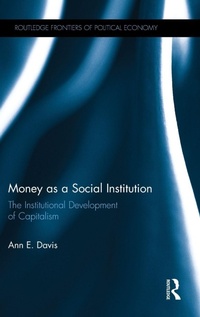
Money as a Social Institution
The Institutional Development of Capitalism
1st Edition
Published on 8. June 2017
Book
Hardback
194 pages
978-1-138-94586-9 (ISBN)
Description
Money is usually understood as a valuable object, the value of which is attributed to it by its users and which other users recognize. It serves to link disparate institutions, providing a disguised whole and prime tool for the "invisible hand" of the market.
This book offers an interpretation of money as a social institution. Money provides the link between the household and the firm, the worker and his product, making that very division seem natural and money as imminently practical. Money as a Social Institution begins in the medieval period and traces the evolution of money alongside consequent implications for the changing models of the corporation and the state. This is then followed with double-entry accounting as a tool of long-distance merchants and bankers, then the monitoring of the process of production by professional corporate managers. Davis provides a framework of analysis for examining money historically, beyond the operation of those particular institutions, which includes the possibility of conceptualizing and organizing the world differently.
This volume is of great importance to academics and students who are interested in economic history and history of economic thought, as well as international political economics and critique of political economy.
This book offers an interpretation of money as a social institution. Money provides the link between the household and the firm, the worker and his product, making that very division seem natural and money as imminently practical. Money as a Social Institution begins in the medieval period and traces the evolution of money alongside consequent implications for the changing models of the corporation and the state. This is then followed with double-entry accounting as a tool of long-distance merchants and bankers, then the monitoring of the process of production by professional corporate managers. Davis provides a framework of analysis for examining money historically, beyond the operation of those particular institutions, which includes the possibility of conceptualizing and organizing the world differently.
This volume is of great importance to academics and students who are interested in economic history and history of economic thought, as well as international political economics and critique of political economy.
More details
Series
Language
English
Place of publication
London
United Kingdom
Publishing group
Taylor & Francis Ltd
Target group
College/higher education
Illustrations
4 s/w Abbildungen, 4 s/w Zeichnungen, 15 s/w Tabellen
15 Tables, black and white; 4 Line drawings, black and white; 4 Illustrations, black and white
Dimensions
Height: 240 mm
Width: 161 mm
Thickness: 16 mm
Weight
485 gr
ISBN-13
978-1-138-94586-9 (9781138945869)
Copyright in bibliographic data and cover images is held by Nielsen Book Services Limited or by the publishers or by their respective licensors: all rights reserved.
Schweitzer Classification
Other editions
Additional editions
Book
04/2019
1st Edition
Routledge
€60.00
Shipment within 15-20 days
E-Book
07/2017
Routledge
€52.49
Available for download
E-Book
07/2017
Routledge
€52.49
Available for download
Person
Ann E. Davis is Associate Professor of Economics at Marist College, USA. She serves as the Chair of the Department of Economics, Accounting, and Finance, and was the founding director of the Marist College Bureau of Economic Research, 1990-2005. She was the Director of the National Endowment for Humanities Summer Institute on the "Meanings of Property," June 2014, and is the author of The Evolution of the Property Relation, 2015.
Content
Chapter One. Introduction and Selected Review of the Literature
Chapter Two. Money as a Social Institution
Chapter Three. The Economy as Labor Exchange Mediated by Money
Chapter Four. Long-Term History of Money and the Market
Chapter Five. Money and the Evolution of Institutions and Knowledge
Chapter Six. Fetishism and Financialization
Chapter Seven. Money and Abstraction
Chapter Eight. Conclusion
Chapter Two. Money as a Social Institution
Chapter Three. The Economy as Labor Exchange Mediated by Money
Chapter Four. Long-Term History of Money and the Market
Chapter Five. Money and the Evolution of Institutions and Knowledge
Chapter Six. Fetishism and Financialization
Chapter Seven. Money and Abstraction
Chapter Eight. Conclusion