

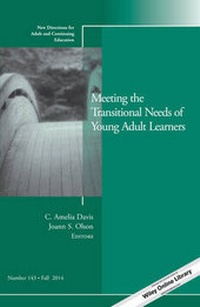
Meeting the Transitional Needs of Young Adult Learners
New Directions for Adult and Continuing Education, Number 143
Published on 2. October 2014
Book
Paperback/Softback
104 pages
978-1-118-94419-6 (ISBN)
Description
This is the first New Directions volume related to young adult learners since 1984. Then, as now, young adults are an important segment of the adult population but have received scant attention in the adult education literature.
Increasingly, youths and young adults are enrolling in adult education programs and in doing so are changing the meaning of adulthood. Given the significant demographic, technological, and cultural shifts during the past 30 years, there is an increasing need for practitioners and program planners to reconsider what constitutes "adult" and "adult education." An understanding of the changing meaning of adulthood is fundamental to developing programs and policies that will address the needs of younger learners, and we believe it is time for an updated discussion among adult educators and scholars in other disciplines.
This sourcebook is designed to reignite the discussion related to meeting the educational needs of young adults along with a timely and interdisciplinary discussion that highlights the transitional needs of young adult learners.
This is the 143rd volume of the Jossey Bass series New Directions for Adult and Continuing Education. Noted for its depth of coverage, it explores issues of common interest to instructors, administrators, counselors, and policymakers in a broad range of education settings, such as colleges and universities, extension programs, businesses, libraries, and museums.
Increasingly, youths and young adults are enrolling in adult education programs and in doing so are changing the meaning of adulthood. Given the significant demographic, technological, and cultural shifts during the past 30 years, there is an increasing need for practitioners and program planners to reconsider what constitutes "adult" and "adult education." An understanding of the changing meaning of adulthood is fundamental to developing programs and policies that will address the needs of younger learners, and we believe it is time for an updated discussion among adult educators and scholars in other disciplines.
This sourcebook is designed to reignite the discussion related to meeting the educational needs of young adults along with a timely and interdisciplinary discussion that highlights the transitional needs of young adult learners.
This is the 143rd volume of the Jossey Bass series New Directions for Adult and Continuing Education. Noted for its depth of coverage, it explores issues of common interest to instructors, administrators, counselors, and policymakers in a broad range of education settings, such as colleges and universities, extension programs, businesses, libraries, and museums.
More details
Series
Language
English
Place of publication
New York
United States
Publishing group
John Wiley & Sons Inc
Target group
Professional and scholarly
Dimensions
Height: 229 mm
Width: 151 mm
Thickness: 7 mm
Weight
145 gr
ISBN-13
978-1-118-94419-6 (9781118944196)
Copyright in bibliographic data and cover images is held by Nielsen Book Services Limited or by the publishers or by their respective licensors: all rights reserved.
Schweitzer Classification
Other editions
Additional editions
C. Amelia Davis | Joann S. Olson
Meeting the Transitional Needs of Young Adult Learners
New Directions for Adult and Continuing Education, Number 143
E-Book
09/2014
Jossey-Bass
€22.99
Available for download
C. Amelia Davis | Joann S. Olson
Meeting the Transitional Needs of Young Adult Learners
New Directions for Adult and Continuing Education, Number 143
E-Book
09/2014
Jossey-Bass
€22.99
Available for download
Persons
Issue Editors:
C. Amelia Davis is an assistant professor of educational research in the Department of Curriculum, Foundations, and Reading in the College of Education at Georgia Southern University.
Joann S. Olson is an assistant professor and program coordinator in the adult and higher education program at the University of Houston-Victoria.
Series Coeditors-in-chief:
Susan Imel is director of the Eric Clearinghouse on Adult, Career, and Vocational Education, Ohio State University.
Jovita M. Ross-Gordon is an associate professor in the College of Education at Southwest Texas University, San Marcos.
C. Amelia Davis is an assistant professor of educational research in the Department of Curriculum, Foundations, and Reading in the College of Education at Georgia Southern University.
Joann S. Olson is an assistant professor and program coordinator in the adult and higher education program at the University of Houston-Victoria.
Series Coeditors-in-chief:
Susan Imel is director of the Eric Clearinghouse on Adult, Career, and Vocational Education, Ohio State University.
Jovita M. Ross-Gordon is an associate professor in the College of Education at Southwest Texas University, San Marcos.
Content
EDITORS' NOTES 1
C. Amelia Davis, Joann S. Olson
1. Conceptualizing Transitions to Adulthood 5
Johanna Wyn
This opening chapter lays the groundwork for this volume by providing an overview of adult development theories as they relate to the transition to young adulthood along with a discussion of the blurring between youth and adult due to the ambiguity encountered when trying to define adulthood.
2. Culture, Conditions, and the Transition to Adulthood 17
Brendaly Drayton
An individual's culture shapes both the definition of adult and the experience of the transition to adulthood. Furthermore, the transition to adulthood may serve as a time when an individual's cultural identity is more consciously defined and more personally salient. This chapter explores the intersection of culture and adulthood.
3. Vulnerable Youth and Transitions to Adulthood 29
Rongbing Xie, Bisakha (Pia) Sen, E. Michael Foster
This chapter discusses recent research conducted that identified challenges youth in the mental health system, the foster care system, and the juvenile justice system face in their transition to adulthood due to limited support systems.
4. Young Adulthood, Transitions, and Dis/ability 39
Jessica Nina Lester
A discussion focusing on the social transitions to adulthood and independent living of an often forgotten population in adult education, young adults labeled with (dis)abilities.
5. Becoming an Adult in a Community of Faith 51
Steven B. Frye
The vitality and ongoing existence of any community of faith- regardless of the specific religious tradition-depends on incorporating the "next generation" as full participants. This chapter focuses on how the transition to adulthood is transacted within various religious traditions and the extent to which that transition is a place where nonformal learning takes place.
6. Youths Transitioning as Adult Learners 63
C. Amelia Davis
This chapter conceptualizes transitions with a focus on Adult Basic Education/GED students as they transition from high school to adult education.
7. Transitions From Formal Education to the Workplace 73
Joann S. Olson
This chapter frames the transition to adulthood in the context of the moving from formal educational settings (e.g., high school, postsecondary education) to the often less-structured learning that occurs in workplace settings.
8. Themes and Issues in Programming for Young Adults 83
Joann S. Olson, C. Amelia Davis
In this final chapter, recurring themes from the preceding chapters are identified and discussed as they pertain to program planning and instructional practice.
INDEX 89
C. Amelia Davis, Joann S. Olson
1. Conceptualizing Transitions to Adulthood 5
Johanna Wyn
This opening chapter lays the groundwork for this volume by providing an overview of adult development theories as they relate to the transition to young adulthood along with a discussion of the blurring between youth and adult due to the ambiguity encountered when trying to define adulthood.
2. Culture, Conditions, and the Transition to Adulthood 17
Brendaly Drayton
An individual's culture shapes both the definition of adult and the experience of the transition to adulthood. Furthermore, the transition to adulthood may serve as a time when an individual's cultural identity is more consciously defined and more personally salient. This chapter explores the intersection of culture and adulthood.
3. Vulnerable Youth and Transitions to Adulthood 29
Rongbing Xie, Bisakha (Pia) Sen, E. Michael Foster
This chapter discusses recent research conducted that identified challenges youth in the mental health system, the foster care system, and the juvenile justice system face in their transition to adulthood due to limited support systems.
4. Young Adulthood, Transitions, and Dis/ability 39
Jessica Nina Lester
A discussion focusing on the social transitions to adulthood and independent living of an often forgotten population in adult education, young adults labeled with (dis)abilities.
5. Becoming an Adult in a Community of Faith 51
Steven B. Frye
The vitality and ongoing existence of any community of faith- regardless of the specific religious tradition-depends on incorporating the "next generation" as full participants. This chapter focuses on how the transition to adulthood is transacted within various religious traditions and the extent to which that transition is a place where nonformal learning takes place.
6. Youths Transitioning as Adult Learners 63
C. Amelia Davis
This chapter conceptualizes transitions with a focus on Adult Basic Education/GED students as they transition from high school to adult education.
7. Transitions From Formal Education to the Workplace 73
Joann S. Olson
This chapter frames the transition to adulthood in the context of the moving from formal educational settings (e.g., high school, postsecondary education) to the often less-structured learning that occurs in workplace settings.
8. Themes and Issues in Programming for Young Adults 83
Joann S. Olson, C. Amelia Davis
In this final chapter, recurring themes from the preceding chapters are identified and discussed as they pertain to program planning and instructional practice.
INDEX 89