

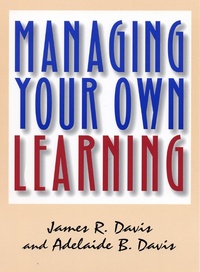
Managing Your Own Learning
Published on 13. March 2000
Book
Paperback/Softback
240 pages
978-1-57675-067-4 (ISBN)
Description
As the pace of change in the workplace continues to accelerate, individuals are under more pressure to learn new things than ever before. While most people realize they have more to learn, many have trouble translating that anxious need into purposeful action. Managing Your Own Learning demonstrates how to analyze previous learning, design an action plan for future learning, expand opportunities for learning, and use libraries and the Internet effectively to become a lifelong learner.
James and Adelaide Davis detail seven major ways of learning: learning new skills, learning from presentations, learning to think, learning to solve problems and make decisions, learning in groups, learning through virtual realities, and learning from experience. They also provide useful guidelines for maximizing results by becoming an effective, active participant in learning. They explain, for example, how learning in a group can be enhanced by knowing how a group works and considering factors such as group size, cohesion, task and process behavior, and participant roles, as well as the things that can go wrong in groups, such as conflict and apathy.
For each of the seven ways of learning, the authors tell what is unique about it, how learning actually takes place, and how it can be augmented in each situation. They reveal how the theory behind each way of learning originated, what researchers have learned about it, and what the individual's role is as a participant. And at the end of each chapter, they include a list of ten things that anyone can do to get the most from that particular type of learning.
No matter what our previous experiences with learning may have been, we all must become self-directed learners if we are to succeed in this new era. Managing Your Own Learning provides step-by-step, proven advice on how to succeed in the 21st century workplace by becoming a proactive, goal-directed, perpetual learner.
James and Adelaide Davis detail seven major ways of learning: learning new skills, learning from presentations, learning to think, learning to solve problems and make decisions, learning in groups, learning through virtual realities, and learning from experience. They also provide useful guidelines for maximizing results by becoming an effective, active participant in learning. They explain, for example, how learning in a group can be enhanced by knowing how a group works and considering factors such as group size, cohesion, task and process behavior, and participant roles, as well as the things that can go wrong in groups, such as conflict and apathy.
For each of the seven ways of learning, the authors tell what is unique about it, how learning actually takes place, and how it can be augmented in each situation. They reveal how the theory behind each way of learning originated, what researchers have learned about it, and what the individual's role is as a participant. And at the end of each chapter, they include a list of ten things that anyone can do to get the most from that particular type of learning.
No matter what our previous experiences with learning may have been, we all must become self-directed learners if we are to succeed in this new era. Managing Your Own Learning provides step-by-step, proven advice on how to succeed in the 21st century workplace by becoming a proactive, goal-directed, perpetual learner.
More details
Language
English
Place of publication
San Francisco
United States
Target group
College/higher education
Professional and scholarly
Product notice
Paperback (trade)
Unsewn / adhesive bound
Dimensions
Height: 229 mm
Width: 155 mm
Thickness: 18 mm
Weight
327 gr
ISBN-13
978-1-57675-067-4 (9781576750674)
Schweitzer Classification
Other editions
Additional editions
James R. Davis | Adelaide B. Davis
Managing Your Own Learning
E-Book
04/2022
Berrett-Koehler Publishers
€18.18
Available for download
E-Book
02/2000
1st Edition
Berrett-Koehler Publishers
€15.09
Available for download
Person
JAMES R. DAVIS is a Professor of higher education and adult studies at the University of Denver. He holds degrees from Oberlin College and Yale University and a Ph.D. from Michigan State University in higher education administration. Jim teaches courses on characteristics of adult learners, training, teaching adults, program planning and administration, leadership, and the uses of technology in instruction. He has served in numerous administrative posts, including assistant to the provost, director of the center for academic quality, director of the school of education—all at the University of Denver—and as academic dean at the historically black college, Wilberforce University, Wilberforce, Ohio.
ADELAIDE B.DAVIS served as a training analyst to COPASA MG, a government-sponsored public water and sanitation company in Brazil. She taught human resources management at the Universidade Federal de Minas Gerais in Belo Horizonte, where she also earned her masters degree in administration with a specialization in human resource management. She planned and facilitated numerous training workshops for her company and spoke at several conferences and annual meetings in Brazil.
ADELAIDE B.DAVIS served as a training analyst to COPASA MG, a government-sponsored public water and sanitation company in Brazil. She taught human resources management at the Universidade Federal de Minas Gerais in Belo Horizonte, where she also earned her masters degree in administration with a specialization in human resource management. She planned and facilitated numerous training workshops for her company and spoke at several conferences and annual meetings in Brazil.
Content
Acknowledgments
Introduction: The Age of Perpetual Learning
Part One PREPARATION FOR LEARNING
1. Taking Charge: Developing a Plan for Learning
2. Knowing Yourself as a Learner: Estimating Your Potential
3. Redefining Learning: Examining Your Attitudes About Learning
Part Two SEVEN WAYS OF LEARNING
Introduction to the Seven Ways of Learning
4. Learning New Skills: Behavioral Learning
5. Learning From Presentations: Cognitive Learning
6. Learning to Think: Inquiry Learning
7. Learning to Solve Problems and Make Decisions: Using Mental Models for Learning
8. Learning in Groups: Collaborative Learning
9. Improving Performance: Learning Through Virtual Realities
10. Learning From Experience: Holistic Learning
Part Three MAXIMIZING LEARNING
11. High-Impact Learning: Using the Seven Ways of Learning to Get Results
12. Sources of Information: Finding What You Need
13. Becoming a Perpetual Learner: Expanding Your Opportunities for Learning
Notes
Index
About the Authors
Introduction: The Age of Perpetual Learning
Part One PREPARATION FOR LEARNING
1. Taking Charge: Developing a Plan for Learning
2. Knowing Yourself as a Learner: Estimating Your Potential
3. Redefining Learning: Examining Your Attitudes About Learning
Part Two SEVEN WAYS OF LEARNING
Introduction to the Seven Ways of Learning
4. Learning New Skills: Behavioral Learning
5. Learning From Presentations: Cognitive Learning
6. Learning to Think: Inquiry Learning
7. Learning to Solve Problems and Make Decisions: Using Mental Models for Learning
8. Learning in Groups: Collaborative Learning
9. Improving Performance: Learning Through Virtual Realities
10. Learning From Experience: Holistic Learning
Part Three MAXIMIZING LEARNING
11. High-Impact Learning: Using the Seven Ways of Learning to Get Results
12. Sources of Information: Finding What You Need
13. Becoming a Perpetual Learner: Expanding Your Opportunities for Learning
Notes
Index
About the Authors