

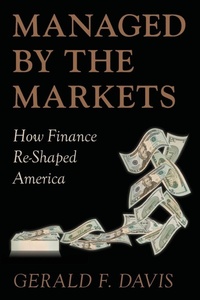
Managed by the Markets
How Finance Re-Shaped America
Published on 11. August 2011
Book
Paperback/Softback
324 pages
978-0-19-969192-0 (ISBN)
Description
The current economic crisis reveals just how central finance has become to American life. Problems with obscure securities created on Wall Street radiated outward to threaten the retirement security of pensioners in Florida and Arizona, the homes and college savings of families in Detroit and Southern California, and ultimately the global economy itself. The American government took on vast new debt to bail out the financial system, while the government-owned investment funds of Kuwait, Abu Dhabi, Malaysia, and China bought up much of what was left of Wall Street. How did we get into this mess, and what does it all mean?
Managed by the Markets explains how finance replaced manufacturing at the center of the American economy and how its influence has seeped into daily life.
From corporations operated to create shareholder value, to banks that became portals to financial markets, to governments seeking to regulate or profit from footloose capital, to households with savings, pensions, and mortgages that rise and fall with the market, life in post-industrial America is tied to finance to an unprecedented degree. Managed by the Markets provides a guide to how we got here and unpacks the consequences of linking the well-being of society too closely to financial markets.
Managed by the Markets explains how finance replaced manufacturing at the center of the American economy and how its influence has seeped into daily life.
From corporations operated to create shareholder value, to banks that became portals to financial markets, to governments seeking to regulate or profit from footloose capital, to households with savings, pensions, and mortgages that rise and fall with the market, life in post-industrial America is tied to finance to an unprecedented degree. Managed by the Markets provides a guide to how we got here and unpacks the consequences of linking the well-being of society too closely to financial markets.
Reviews / Votes
a valuable, timely and gripping analysis by Gerald F. Davis... Davis's book should be required reading for anyone, whether academic, practitioner, or policy maker, who needs to think critically about finance which, rather than a mechanistic set of transactions, is presented in the book as a social phenomenon that is invading our lives. * Nihel Chabrak, Berkeley Electronic Press *More details
Language
English
Place of publication
Oxford
United Kingdom
Target group
College/higher education
Professional and scholarly
Dimensions
Height: 234 mm
Width: 156 mm
Thickness: 18 mm
Weight
503 gr
ISBN-13
978-0-19-969192-0 (9780199691920)
Copyright in bibliographic data and cover images is held by Nielsen Book Services Limited or by the publishers or by their respective licensors: all rights reserved.
Schweitzer Classification
Other editions
Additional editions
Book
03/2009
Oxford University Press
€83.70
Shipment within 15-20 days
E-Book
03/2009
OUP eBook
€18.49
Available for download
Person
Jerry Davis is the Wilbur K. Pierpont Collegiate Professor of Management at the University of Michigan's Ross School of Business. Davis received his PhD from Stanford University and has previously taught at Northwestern University and Columbia University. He has published widely in management, sociology, and finance. Recent books include Social Movements and Organization Theory (with Doug McAdam, W. Richard Scott, and Mayer N. Zald; Cambridge University Press, 2005) and Organizations and Organizing: Rational, Natural, and Open System Perspectives (with W. Richard Scott; Pearson Prentice Hall, 2007). He is currently Associate Editor of Administrative Science Quarterly and Co-Director of the Interdisciplinary Committee on Organization Studies (ICOS) at the University of Michigan.
Content
Preface ; 1. The New Financial Capitalism ; 2. Financial Markets and Corporate Governance ; 3. From Institution to Nexus: How the Corporation Got, then Lost, its Soul ; 4. From Banks to Markets: How Securitization Ended the "Wonderful Life" ; 5. From Sovereign to Vendor-State: How Delaware and Liberia Became the McDonalds and Nike of Corporate Law ; 6. From Employee and Citizen to Investor: How Talent, Friends, and Homes Became "capital" ; 7. Conclusion: A Society of Investors?