

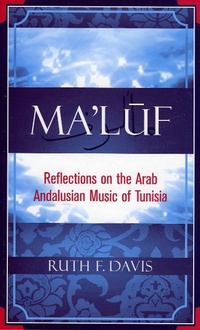
Ma'luf
Reflections on the Arab Andalusian Music of Tunisia
Published on 25. February 2005
Book
Hardback
136 pages
978-0-8108-5138-2 (ISBN)
Description
Ma'luf is an Arabic word meaning 'familiar' or 'customary'. In Tunisia, it is the term used for the indigenous Arab Andalusian musical tradition. Like the related musical traditions of Morocco, Algeria, and Libya, the ma'luf originated in the Islamic courts and cities of medieval Iberia (Al-Andalus) and is associated with the migrations of Muslim and Jewish refugees into North Africa in the wake of the Christian reconquest.
This is the first English-language book on Tunisian music or any national tradition of Arab Andalusian music, and it is the only book in any language to survey the recent history of the ma'luf since its modern revival in the early 20th century. Drawing from and expanding upon her extensive body of published writings, this book presents key aspects of Davis's original research on the ma'luf, including its musical aesthetics, personalities, institutions and myths, through a century of modernization and change from the early twentieth century to the present day.
The text is enriched by original photographs, musical examples, and song texts in Arabic and English translation, including a complete transcription of a twenty-minute performance of a nuba - the principal genre of Arab Andalusian music.
This is the first English-language book on Tunisian music or any national tradition of Arab Andalusian music, and it is the only book in any language to survey the recent history of the ma'luf since its modern revival in the early 20th century. Drawing from and expanding upon her extensive body of published writings, this book presents key aspects of Davis's original research on the ma'luf, including its musical aesthetics, personalities, institutions and myths, through a century of modernization and change from the early twentieth century to the present day.
The text is enriched by original photographs, musical examples, and song texts in Arabic and English translation, including a complete transcription of a twenty-minute performance of a nuba - the principal genre of Arab Andalusian music.
Reviews / Votes
This volume serves as a good example of how one can apply reflective methods to ethnomusicology. Recommended. Upper-division undergraduates and above. * Choice Reviews * A delight to read ... the clarity of Davis's writing opens doors for many. The confluence of historical sources and the author's sensitive ethnographic study of contemporary practices enriches the texture of the music itself. Ma'luf provides a non-European perspective on nationalism that has long been wanting in studies of modernity. The book fully deserves to become a standard text in the study of music in the Middle East/North Africa. -- Philip V. Bohlman, Mary Werkman Distinguished Service Professor of Music and the Humanities, The University of Chicago This is an important work that provides a critical, clear and concise analysis of the impact of Tunisian cultural nationalism on, and through, the medium of music. -- Richard C. Jankowsky * Ethnomusicology Forum * The musical form, like related Arab musical traditions in Morocco, Algeria, and Libya, is alleged to have been brought to North Africa by Muslims and Jews fleeing the Christian reconquest of Spain from the 10th to the 17th centuries. Davis (ethnomusicology, U. of Cambridge) examines the music in such terms as Arab musical aesthetics; modernization, Westernization, and Egyptianization; the use of notation in oral tradition; musical nationalism and cultural policy; concepts of art and popular; and relations between traditional music and the mass media. * Reference and Research Book News *More details
Language
English
Place of publication
Lanham, MD
United States
Product notice
Laminated cover
Dimensions
Height: 225 mm
Width: 146 mm
Thickness: 17 mm
Weight
340 gr
ISBN-13
978-0-8108-5138-2 (9780810851382)
Copyright in bibliographic data and cover images is held by Nielsen Book Services Limited or by the publishers or by their respective licensors: all rights reserved.
Schweitzer Classification
Person
Ruth F. Davis is Senior Lecturer in Ethnomusicology at the University of Cambridge and a Fellow of Corpus Christi College Cambridge.
Content
Part 1 Preface
Part 2 Note
Chapter 3 1 The Nuba and the Arab Garden
Chapter 4 2 The Baron Rodophe d'Erlanger
Chapter 5 3 The Rashidiyya Institute: From Oral to Written Tradition
Chapter 6 4 Cultural Policy and the Ma'luf of Testour
Chapter 7 5 The Ma'luf, Popular Song and the Mass Media
Chapter 8 6 Voices of the Nineties
Part 9 References
Part 10 Index
Part 11 About the Author
Part 2 Note
Chapter 3 1 The Nuba and the Arab Garden
Chapter 4 2 The Baron Rodophe d'Erlanger
Chapter 5 3 The Rashidiyya Institute: From Oral to Written Tradition
Chapter 6 4 Cultural Policy and the Ma'luf of Testour
Chapter 7 5 The Ma'luf, Popular Song and the Mass Media
Chapter 8 6 Voices of the Nineties
Part 9 References
Part 10 Index
Part 11 About the Author