

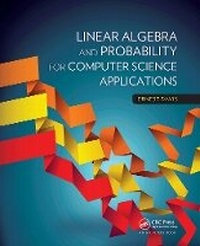
Linear Algebra and Probability for Computer Science Applications
1st Edition
Published on 14. October 2024
Book
Paperback/Softback
432 pages
978-1-032-92003-0 (ISBN)
Description
Based on the author's course at NYU, Linear Algebra and Probability for Computer Science Applications gives an introduction to two mathematical fields that are fundamental in many areas of computer science. The course and the text are addressed to students with a very weak mathematical background. Most of the chapters discuss relevant MATLAB (R) functions and features and give sample assignments in MATLAB; the author's website provides the MATLAB code from the book.
After an introductory chapter on MATLAB, the text is divided into two sections. The section on linear algebra gives an introduction to the theory of vectors, matrices, and linear transformations over the reals. It includes an extensive discussion on Gaussian elimination, geometric applications, and change of basis. It also introduces the issues of numerical stability and round-off error, the discrete Fourier transform, and singular value decomposition. The section on probability presents an introduction to the basic theory of probability and numerical random variables; later chapters discuss Markov models, Monte Carlo methods, information theory, and basic statistical techniques. The focus throughout is on topics and examples that are particularly relevant to computer science applications; for example, there is an extensive discussion on the use of hidden Markov models for tagging text and a discussion of the Zipf (inverse power law) distribution.
Examples and Programming Assignments
The examples and programming assignments focus on computer science applications. The applications covered are drawn from a range of computer science areas, including computer graphics, computer vision, robotics, natural language processing, web search, machine learning, statistical analysis, game playing, graph theory, scientific computing, decision theory, coding, cryptography, network analysis, data compression, and signal processing.
Homework Problems
Comprehensive problem sections include traditional calculation exercises, thought problems such as proofs, and programming assignments that involve creating MATLAB functions.
After an introductory chapter on MATLAB, the text is divided into two sections. The section on linear algebra gives an introduction to the theory of vectors, matrices, and linear transformations over the reals. It includes an extensive discussion on Gaussian elimination, geometric applications, and change of basis. It also introduces the issues of numerical stability and round-off error, the discrete Fourier transform, and singular value decomposition. The section on probability presents an introduction to the basic theory of probability and numerical random variables; later chapters discuss Markov models, Monte Carlo methods, information theory, and basic statistical techniques. The focus throughout is on topics and examples that are particularly relevant to computer science applications; for example, there is an extensive discussion on the use of hidden Markov models for tagging text and a discussion of the Zipf (inverse power law) distribution.
Examples and Programming Assignments
The examples and programming assignments focus on computer science applications. The applications covered are drawn from a range of computer science areas, including computer graphics, computer vision, robotics, natural language processing, web search, machine learning, statistical analysis, game playing, graph theory, scientific computing, decision theory, coding, cryptography, network analysis, data compression, and signal processing.
Homework Problems
Comprehensive problem sections include traditional calculation exercises, thought problems such as proofs, and programming assignments that involve creating MATLAB functions.
More details
Language
English
Place of publication
London
United Kingdom
Target group
College/higher education
Postgraduate
Product notice
Paperback (trade)
Unsewn / adhesive bound
Dimensions
Height: 235 mm
Width: 191 mm
Weight
820 gr
ISBN-13
978-1-032-92003-0 (9781032920030)
Copyright in bibliographic data and cover images is held by Nielsen Book Services Limited or by the publishers or by their respective licensors: all rights reserved.
Schweitzer Classification
Other editions
Additional editions
E-Book
05/2012
1st Edition
CRC Press
€78.99
Available for download
E-Book
05/2012
CRC Press
€78.99
Available for download
Book
05/2012
1st Edition
A K Peters
€128.50
Shipment within 15-20 days
Person
Ernest Davis is a computer science professor in the Courant Institute of Mathematical Sciences at New York University. He earned a Ph.D. in computer science from Yale University. Dr. Davis is a member of the American Association of Artificial Intelligence and is a reviewer for many journals. His research primarily focuses on spatial and physical reasoning.
Content
MATLAB. LINEAR ALGEBRA: Vectors. Matrices. Vector Spaces. Algorithms. Geometry. Change of Basis, DFT, and SVD. PROBABILITY: Probability. Numerical Random Variables. Markov Models. Confidence Intervals. Monte Carlo Methods. Information and Entropy. Maximum Likelihood Estimation. References. Notation. Index.