

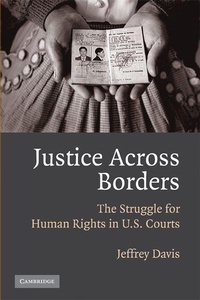
Justice Across Borders
The Struggle for Human Rights in U.S. Courts
Published on 2. June 2008
Book
Paperback/Softback
318 pages
978-0-521-70240-9 (ISBN)
Description
This book studies the struggle to enforce international human rights law in federal courts. In 1980, a federal appeals court ruled that a Paraguayan family could sue a Paraguayan official under the Alien Tort Statute - a dormant provision of the 1789 Judiciary Act - for torture committed in Paraguay. Since then, courts have been wrestling with this step toward a universal approach to human rights law. Davis examines attempts by human rights groups to use the law to enforce human rights norms. He explains the separation of powers issues arising when victims sue the United States or when the United States intervenes to urge dismissal of a claim and analyses the controversies arising from attempts to hold foreign nations, foreign officials, and corporations liable under international human rights law. While Davis's analysis is driven by social science methods, its foundation is the dramatic human story from which these cases arise.
Reviews / Votes
"In Justice Across Borders, Jeffrey Davis makes an indispensable and innovative contribution to the study of human rights and the growing literature on international justice. Mixing detailed case studies with quantitative analysis, Davis reveals the transformative role of litigation in the search for justice. He also reminds us that individuals - from survivors of mass atrocities to the public interest lawyers who represent them - play an essential role in this search."--William J. Aceves, Associate Dean for Academic Affairs, California Western School of Law, and author of The Anatomy of Torture: A Documentary History of Filartiga v. Pena-Irala "Justice Across Borders makes a tremendous contribution to the field of human rights. It moves beyond a strictly legalistic approach to human rights and exposes the full range of actors and the complex politics informing the development of human rights jurisprudence in U.S. courts. Well researched and tightly argued, the book offers particularly strong analysis of NGO involvement and executive branch involvement, and yet it deserves to be read from cover to cover by both students and practitioners seeking to understand the historical development of human rights claims in U.S. courts. The human rights field is moving towards increasing use of courts. Justice Across Borders will prove to be a useful text for years to come."
--Julie Mertus, Professor of Human Rights and co-director, Ethics, Peace & Global Affairs Program, American University "A compelling account of how a little-known statute from 1789 spawned a human rights revolution, and a nuanced analysis of the forces that have driven -- and opposed -- that transformation."
--David Cole, Professor of Law, Georgetown University Law Center, author of Less Safe, Less Free: Why America Is Losing the War on Terror "...extensive and anecdotal reports of the emotional responses of ATS plaintiffs and their lawyers, and of counsel for defendants as well, provides interesting historical context,..."
--Steven M. Schneebaum, The John Hopkins University, Human Rights & Human Welfare "...an in-depth and fascinating examination of human rights litigation in American courts using the Alien Tort Statute (ATS) or Alien Tort Claims (ACTA)...a detailed, well-researched, carefully analyzed, and cogently argued book; it answers pivotal questions on how ATS has become a new tool in overcoming territorial limitations in pursuing international human rights violations very thoroughly and in a high readable and engaging manner...surely this book will make the reading list at several universities and draw the attention of those interested in human rights law and litigation."
--The Law and Politics Book Review, Srini Sitaraman, Government and International Relations, Clark University
More details
Language
English
Place of publication
Cambridge
United Kingdom
Target group
Professional and scholarly
Product notice
Paperback (trade)
Illustrations
29 Tables, unspecified; 2 Halftones, unspecified; 6 Line drawings, unspecified
Dimensions
Height: 229 mm
Width: 152 mm
Thickness: 17 mm
Weight
463 gr
ISBN-13
978-0-521-70240-9 (9780521702409)
Copyright in bibliographic data and cover images is held by Nielsen Book Services Limited or by the publishers or by their respective licensors: all rights reserved.
Schweitzer Classification
Other editions
Additional editions
E-Book
06/2008
1st Edition
Cambridge University Press
€32.49
Available for download
Book
06/2008
Cambridge University Press
€75.50
Shipment within 15-20 days
Person
Professor Davis has taught constitutional law, comparative law, and judicial politics courses for more than six years and has won several teaching awards. He has published articles on human rights accountability, judicial decision-making, and judicial fairness in several journals. In addition, Professor Davis has conducted research and analysis on a volunteer basis for two international human rights organizations. Before beginning his academic career, Professor Davis practised law as a state Assistant Attorney General, as an attorney for the Atlanta School Board, and as the Legal Aide to the Speaker of the Georgia House of Representatives.
Content
1. The seeds of legal accountability; 2. Competing forces in the struggle for accountability; 3. Human rights entrepreneurs: NGOs and the ATS revolution; 4. Separation of powers and human rights cases; 5. No safe haven: human rights cases challenging foreign countries and nationals; 6. Holding corporations accountable for human rights violations; 7. Sorting through the ashes: testing findings and predictions through quantitative analysis; 8. Impact and conclusion.