

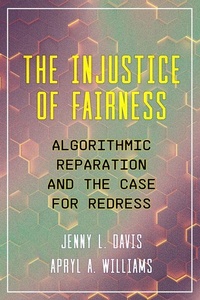
The Injustice of Fairness
Algorithmic Reparation and the Case for Redress
1st Edition
Published on 2. June 2026
Book
Paperback/Softback
174 pages
978-0-520-41829-5 (ISBN)
Description
The Injustice of Fairness shifts the foundation of algorithmic ethics, displacing "fairness" with repair and redress. A substantial and growing field, algorithmic ethics aims to mitigate harms and realize social good. The fairness paradigm dominates this field across AI, machine learning, and other data-driven domains. So far, efforts toward fairness have been unsuccessful, with algorithmic harms that propagate and persist. Jenny L. Davis and Apryl A. Williams explain why algorithmic fairness perpetually fails and present "algorithmic reparation" in its place.
The stakes are high because algorithms are everywhere-from law to love, healthcare to housing, education to media, and beyond. More than lines of code or mathematical operations, algorithms carry history, configure the present, and are actively shaping the future. Set against a backdrop of societal instability and technological transformation, The Injustice of Fairness offers a careful critique, original framework, and blueprint for social change with algorithms as entry points and levers.
The stakes are high because algorithms are everywhere-from law to love, healthcare to housing, education to media, and beyond. More than lines of code or mathematical operations, algorithms carry history, configure the present, and are actively shaping the future. Set against a backdrop of societal instability and technological transformation, The Injustice of Fairness offers a careful critique, original framework, and blueprint for social change with algorithms as entry points and levers.
More details
Edition
First Edition
Language
English
Place of publication
Berkerley
United States
Target group
Professional and scholarly
Product notice
Paperback (trade)
Illustrations
3 tables, 1 b-w figure
Dimensions
Height: 139 mm
Width: 216 mm
Thickness: 15 mm
Weight
232 gr
ISBN-13
978-0-520-41829-5 (9780520418295)
Copyright in bibliographic data and cover images is held by Nielsen Book Services Limited or by the publishers or by their respective licensors: all rights reserved.
Schweitzer Classification
Other editions
Additional editions

E-Book
06/2026
1st Edition
Naval Institute Press
€28.99
Available for download
Persons
Jenny L. Davis is Gertrude Conaway Vanderbilt Chair and Professor of Sociology at Vanderbilt University and Honorary Professor of Sociology at the Australian National University. Blending sociology with tech studies, she explores the ways design shapes society and society shapes design. Her previous book, How Artifacts Afford, decodes how politics and power are embedded in everyday technologies.
Apryl A. Williams is Associate Professor of Digital Studies and Communication at the University of Michigan and Faculty Associate at Harvard University's Berkman Klein Center for Internet & Society. Her previous book, Not My Type, offers a powerful critique of how technology replicates and amplifies real-world social inequities in digital culture.
Apryl A. Williams is Associate Professor of Digital Studies and Communication at the University of Michigan and Faculty Associate at Harvard University's Berkman Klein Center for Internet & Society. Her previous book, Not My Type, offers a powerful critique of how technology replicates and amplifies real-world social inequities in digital culture.
Content
Contents
Introduction
Part One
1. What's Wrong with Fairness?
2. Toward a Reparative Research Program
Part Two
Interlude: Speculative Design for Reparative Algorithmic Futures
3. Speculative Design I: Pik | A Reparative Dating App for Black Women and Femmes
4. Speculative Design II: The Power-to-Prove Legal Paradigm
Part Three
5. Obstacles and Inroads
Conclusion
Acknowledgments
Notes
Bibliography
Index
Introduction
Part One
1. What's Wrong with Fairness?
2. Toward a Reparative Research Program
Part Two
Interlude: Speculative Design for Reparative Algorithmic Futures
3. Speculative Design I: Pik | A Reparative Dating App for Black Women and Femmes
4. Speculative Design II: The Power-to-Prove Legal Paradigm
Part Three
5. Obstacles and Inroads
Conclusion
Acknowledgments
Notes
Bibliography
Index