

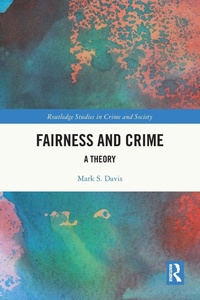
Fairness and Crime
A Theory
1st Edition
Published on 30. July 2025
Book
Paperback/Softback
180 pages
978-1-032-63885-0 (ISBN)
Description
Criminology, the discipline that informs our understanding of crime and justice, is facing an identity crisis. Long dominated by sociology's view of crime and its causes, criminology has recently witnessed the rise of a new cadre of academics who feel free to explore other explanations. Fairness and Crime: A Theory offers a comprehensive new perspective on criminal behavior that will reinvigorate the field and help us understand why we consider some acts criminal as well as why and how society should respond to those acts.
In this book, Mark S. Davis connects the challenges of understanding crime and administering justice to common norms that guide behavior in everyday life. He contends that the exchanges society defines as criminal work basically the way all other exchanges, and when offenders rob banks, bilk investors, or fabricate scientific data, they engage in a violation of fairness norms. Davis offers a theory that is informed by insights from game theory research, anthropology, law, industrial/organizational psychology, personality/social psychology, and sociology. He utilizes examples drawn from everyday life to illustrate the theory's concepts in detail.
Fairness and Crime: A Theory provides a platform from which to explore the purposes of the criminal justice system. What are we trying to accomplish when we prosecute criminal suspects? While one answer is that we are trying to vindicate the moral order and deter future offending, another is that we are attempting to restore equity for victims caused by offenders' exploitative or retaliatory behavior. Davis contends that addressing unfairness is what the criminal justice system should be about. In rehabilitation, we should be trying to inculcate fairness norms where they are absent or where they have been compromised.
In this book, Mark S. Davis connects the challenges of understanding crime and administering justice to common norms that guide behavior in everyday life. He contends that the exchanges society defines as criminal work basically the way all other exchanges, and when offenders rob banks, bilk investors, or fabricate scientific data, they engage in a violation of fairness norms. Davis offers a theory that is informed by insights from game theory research, anthropology, law, industrial/organizational psychology, personality/social psychology, and sociology. He utilizes examples drawn from everyday life to illustrate the theory's concepts in detail.
Fairness and Crime: A Theory provides a platform from which to explore the purposes of the criminal justice system. What are we trying to accomplish when we prosecute criminal suspects? While one answer is that we are trying to vindicate the moral order and deter future offending, another is that we are attempting to restore equity for victims caused by offenders' exploitative or retaliatory behavior. Davis contends that addressing unfairness is what the criminal justice system should be about. In rehabilitation, we should be trying to inculcate fairness norms where they are absent or where they have been compromised.
Reviews / Votes
Fairness and Crime presents readers with an intriguing perspective on the concept of "fairness" as it relates to aspects of the law, social reaction, and the subsequent definition of crime and crime causation. The author organizes the book in a concise manner that is compelling, convincing, and quite easy to follow. A journey through the text allows us to explore the diverse theoretical underpinning of criminal behavior through a critical lens and analysis of crime control in various dimensions of the criminal justice system, leading to a conclusive perspective of fairness as an integral component of this study.-Aida Y. Hass, Professor of Criminology & Criminal Justice, Missouri State University
More details
Series
Language
English
Place of publication
London
United Kingdom
Publishing group
Taylor & Francis Ltd
Target group
College/higher education
Postgraduate, Undergraduate Advanced, and Undergraduate Core
Illustrations
1 s/w Abbildung, 1 s/w Zeichnung, 1 s/w Tabelle
1 Tables, black and white; 1 Line drawings, black and white; 1 Illustrations, black and white
Dimensions
Height: 229 mm
Width: 152 mm
Thickness: 11 mm
Weight
307 gr
ISBN-13
978-1-032-63885-0 (9781032638850)
Copyright in bibliographic data and cover images is held by Nielsen Book Services Limited or by the publishers or by their respective licensors: all rights reserved.
Schweitzer Classification
Other editions
Additional editions
E-Book
03/2024
1st Edition
Routledge
€60.49
Available for download
Book
03/2024
1st Edition
Routledge
€205.30
Shipment within 15-20 days
E-Book
03/2024
1st Edition
Routledge
€60.49
Available for download
Person
Mark S. Davis is a social scientist whose interests include self- and other-directed violence, research misconduct, criminological theory, and criminal justice policy. His scholarship has appeared in such journals as the Journal of Research on Adolescence, Social Psychiatry and Psychiatric Epidemiology, Journal of Criminal Justice, and Science and Engineering Ethics. He is the author of The Concise Dictionary of Crime and Justice, 2nd Edition, and The Role of State Agencies in Translational Criminology: Connecting Research to Policy, and coauthor (with Bonnie Berry) of Routledge's Scholarly Crimes and Misdemeanors: Violations of Fairness and Trust in the Academic World. Mark holds a PhD in sociology from The Ohio State University.
Content
1. Crime in Contemporary Society 2. The Challenges of Crime Control 3. Criminology's Crises of Identity and Relevance 4. Behavioral Options in Social Exchange 5. The Importance of Fairness in Social Life 6. Fairness and Crime: A Theory 7. Fairness Theory and The Criminal Justice System 8. Fairness: A Theory for Insight, A Theory for Change