

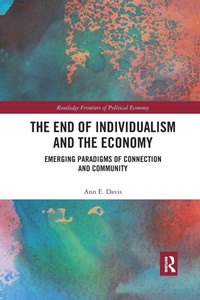
The End of Individualism and the Economy
Emerging Paradigms of Connection and Community
1st Edition
Published on 30. September 2021
Book
Paperback/Softback
244 pages
978-1-032-17468-6 (ISBN)
Description
Individualism has been one of the driving forces in the rise of modern capitalism, and methodological individualism has been dominant in social science for many years. In this paradigm the economy is seen as a machine to routinize production and improve efficiency, and the discipline of economics has come to focus on control and automation. Recent innovations in natural and social sciences, however, indicate a shift in thinking away from individualism and towards interconnectedness.
The End of Individualism and the Economy: Emerging Paradigms of Connection and Community traces the origins of "the individual" in history, philosophy, economics, and social science. Drawing from linguistic philosophy, there is increasing attention to language as a social substrate for all institutions, including money and the market. One irony is that the "individual" is a key term, related to distinct institutions and associated expertise; that is, "the individual" is social. The book explores the influence of individualism in the subversion of class consciousness, the view of impersonality as a virtue, and the rise of financialization. The founding assumption of economics, the rational autonomous individual with exogenous tastes, undercuts social solidarity and blocks awareness of interconnections and interdependencies. The text looks forward and embraces the new paradigms and alternative forms of governance, economics, and science which can be developed based on collectives and communities, with new values, frameworks, and world views.
This work is suitable for academics, students, scholars, and researchers with an interest in economic and social collectives and methodological individualism, as well as those studying the connections between economics and other disciplines in the social and natural sciences.
The End of Individualism and the Economy: Emerging Paradigms of Connection and Community traces the origins of "the individual" in history, philosophy, economics, and social science. Drawing from linguistic philosophy, there is increasing attention to language as a social substrate for all institutions, including money and the market. One irony is that the "individual" is a key term, related to distinct institutions and associated expertise; that is, "the individual" is social. The book explores the influence of individualism in the subversion of class consciousness, the view of impersonality as a virtue, and the rise of financialization. The founding assumption of economics, the rational autonomous individual with exogenous tastes, undercuts social solidarity and blocks awareness of interconnections and interdependencies. The text looks forward and embraces the new paradigms and alternative forms of governance, economics, and science which can be developed based on collectives and communities, with new values, frameworks, and world views.
This work is suitable for academics, students, scholars, and researchers with an interest in economic and social collectives and methodological individualism, as well as those studying the connections between economics and other disciplines in the social and natural sciences.
More details
Series
Language
English
Place of publication
London
United Kingdom
Publishing group
Taylor & Francis Ltd
Target group
College/higher education
Postgraduate and Undergraduate
Illustrations
15 s/w Abbildungen
15 Illustrations, black and white
Dimensions
Height: 234 mm
Width: 156 mm
Thickness: 13 mm
Weight
380 gr
ISBN-13
978-1-032-17468-6 (9781032174686)
Copyright in bibliographic data and cover images is held by Nielsen Book Services Limited or by the publishers or by their respective licensors: all rights reserved.
Schweitzer Classification
Other editions
Additional editions
Book
02/2020
1st Edition
Routledge
€215.77
Shipment within 10-20 days
E-Book
02/2020
1st Edition
Routledge
€59.49
Available for download
Person
Ann E. Davis is Associate Professor of Economics at Marist College, USA, and author of Money as a Social Institution: The Institutional Development of Capitalism (Routledge, 2017).
Content
(1) The Individual as a Key Term (2) Property and Reification (3) The Public/Private Divide (4) The Shaping of the Modern Liberal State (5) The Economics of "Autophagy": Implications of the Economy as "Machine" (6) Methods of Social Science (7) "Unique Individuals" (8) The Property Paradigm (9) Contradictions (10) Backlash (11) Alternatives (12) Conclusions