

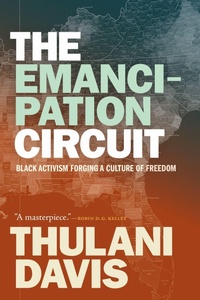
The Emancipation Circuit
Black Activism Forging a Culture of Freedom
Published on 30. June 2022
Book
Paperback/Softback
464 pages
978-1-4780-1819-3 (ISBN)
Description
In The Emancipation Circuit Thulani Davis provides a sweeping rethinking of Reconstruction by tracing how the four million people newly freed from bondage created political organizations and connections that mobilized communities across the South. Drawing on the practices of community they developed while enslaved, freedpeople built new settlements and created a network of circuits through which they imagined, enacted, and defended freedom. This interdisciplinary history shows that these circuits linked rural and urban organizations, labor struggles, and political culture with news, strategies, education, and mutual aid. Mapping the emancipation circuits, Davis shows the geography of ideas of freedom---circulating on shipping routes, via army maneuvers, and with itinerant activists---that became the basis for the first mass Black political movement for equal citizenship in the United States. In this work, she reconfigures understandings of the evolution of southern Black political agendas while outlining the origins of the enduring Black freedom struggle from the Jim Crow era to the present.
Reviews / Votes
"In this spectacular book Thulani Davis presents a framework for not only rewriting the Civil War and Reconstruction, but for understanding the entire history of the Black freedom movement extending into the twentieth century. As groundbreaking as W. E. B. Du Bois's Black Reconstruction, The Emancipation Circuit is a masterpiece." - Robin D. G. Kelley, author of (Hammer and Hoe: Alabama Communists during the Great Depression) "The Emancipation Circuit offers a powerful reimagining of the networks that helped to secure Black freedom during the Civil War and Reconstruction: It is a history about enslaved people's efforts to free themselves and about their local struggles to give substance to their legal emancipation, as well as a mapping of the geography that enabled their achievements and the circuits that spread their political goals like pollen in the wind. . . . The Emancipation Circuit reminds today's activists that any organizing for Black freedom must be multifaceted and must pursue local aims while traveling along preexisting networks to become a broader collective effort." - Elias Rodriques (The Nation) "Thulani Davis's The Emancipation Circuit is an important contribution to Black social and political thought that helps center Black women and Black resistance of United States history and social movements." - Krystal Batelaan (Ethnic and Racial Studies) "The Emancipation Circuit provides a convincing analysis of the spatial history of emancipation ... a valuable reference for future research." - Keith D. McCall (Journal of Southern History) "By documenting the emergence of Black political, religious, and labor organizations, the development of channels for transmission of ideas and news, and conflicts and tensions, The Emancipation Circuit adds nuance to our understanding of the development of Black political thought and shows how its unique attributes continue to influence Black politics today." - Kevin R. Johnson (Journal of American History) "The Emancipation Circuit is an exciting and important book. Demonstrating an adroit dexterity with the secondary literature, Davis has provided future historians with a roadmap that for far too long has hid in plain sight. Bringing a poet's eye to the quotidian details of the Civil War-era Black world, Thulani Davis provides an innovative reinterpretation of the world freedpeople and Black northerners made together." - Robert D. Bland (Journal of African American History)More details
Language
English
Place of publication
North Carolina
United States
Target group
Professional and scholarly
Product notice
Paperback (trade)
Illustrations
36 maps, including 34 in color
Dimensions
Height: 228 mm
Width: 153 mm
Thickness: 31 mm
Weight
674 gr
ISBN-13
978-1-4780-1819-3 (9781478018193)
Copyright in bibliographic data and cover images is held by Nielsen Book Services Limited or by the publishers or by their respective licensors: all rights reserved.
Schweitzer Classification
Other editions
Additional editions
E-Book
04/2022
1st Edition
De Gruyter
€228.99
Available for download
Person
Thulani Davis is a professor and a Nellie Y. McKay Fellow in the Afro-American Studies Department at the University of Wisconsin-Madison and author of My Confederate Kinfolk: A Twenty-first Century Freedwoman Discovers Her Roots. A poet and longtime writer for theater, film, and journalism, Davis has been a recipient of a Lila Wallace-Readers Digest Writers Award, a PEW Foundation National Theatre Artist Residency, and a Charles H. Revson Fellowship on the Future of New York City.
Content
List of Maps xi
List of Tables xiii
Acknowledgments xv
Introduction: Black Political Thought as Shaped in the South 1
1. Flight: Movement Matters 19
2. The Emancipation Circuit: A Road Map 44
3. Virginia: Assembly 80
4. North Carolina: Custody 109
5. South Carolina: Majority 133
6. Georgia: Mobilization 165
7. Florida: Faction 196
8. Alabama: Redemption 217
9. Louisiana: Societies 243
10. Mississippi: Bulldoze 269
11. Arkansas: Minority 294
Conclusion: What Lives On Is Black Political Thought 321
Notes 345
Table Source Notes 393
Bibliography 397
Index 427
List of Tables xiii
Acknowledgments xv
Introduction: Black Political Thought as Shaped in the South 1
1. Flight: Movement Matters 19
2. The Emancipation Circuit: A Road Map 44
3. Virginia: Assembly 80
4. North Carolina: Custody 109
5. South Carolina: Majority 133
6. Georgia: Mobilization 165
7. Florida: Faction 196
8. Alabama: Redemption 217
9. Louisiana: Societies 243
10. Mississippi: Bulldoze 269
11. Arkansas: Minority 294
Conclusion: What Lives On Is Black Political Thought 321
Notes 345
Table Source Notes 393
Bibliography 397
Index 427