

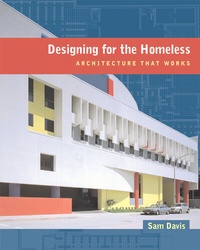
Designing for the Homeless
Architecture That Works
1st Edition
Published on 29. November 2004
Book
Hardback
174 pages
978-0-520-23525-0 (ISBN)
Description
Written by an architect who has been designing and building affordable housing for thirty years, this well-illustrated book is both a call to create well-designed places for the homeless and a review of innovative and successful building designs that now serve diverse communities across the United States. Sam Davis argues for safe and functional architectural designs and programs that symbolically reintegrate the homeless into society in buildings that offer beauty, security, and hope to those most in need. Davis presents a new perspective, considering the personal concerns of the homeless, the social costs of homelessness, and organizational and design issues. He examines problems of community fit and site planning, building design and orga-nization, and interior layout and suggests how to weigh costs and optimize expenditures. He asks and answers a range of challenging questions: What is possible and desirable when designing a new facility for the homeless? Should it be elegant or unassuming? What types of spaces should be included? How should it look and what should it feel like? Should it be more like a house or more like a dormitory?
What is the proper balance between function, quality of construction, and architectural delight? Designing for the Homeless recounts how various communities have addressed the problem of housing the homeless, beginning with one of the most ambitious plans, the St. Vincent de Paul Village in San Diego, which opened in 1987. Davis vividly recounts the plight of those who become homeless. His practical knowledge, familiarity with solutions to date, and vision for the future--all expressed clearly and convincingly--make this innovative book an indispensable resource for architects, public policy analysts, and anyone concerned about housing the homeless.
What is the proper balance between function, quality of construction, and architectural delight? Designing for the Homeless recounts how various communities have addressed the problem of housing the homeless, beginning with one of the most ambitious plans, the St. Vincent de Paul Village in San Diego, which opened in 1987. Davis vividly recounts the plight of those who become homeless. His practical knowledge, familiarity with solutions to date, and vision for the future--all expressed clearly and convincingly--make this innovative book an indispensable resource for architects, public policy analysts, and anyone concerned about housing the homeless.
Reviews / Votes
"Davis lays out a compelling case for us all, especially designers, to get involved in solutions for the problem of homelessness. He discusses the plight of the homeless in terms that make them real, and his chapter on the costs of homelessness lays out the argument for involvement in very practical terms." - Michael Underhill, Professor, School of Architecture at Arizona State University"More details
Edition
First Edition
Language
English
Place of publication
Berkerley
United States
Target group
Professional and scholarly
Product notice
Cloth over boards
Illustrations
50 b-w photographs, 42 line illustrations, 1 table
Dimensions
Height: 254 mm
Width: 203 mm
Thickness: 15 mm
Weight
726 gr
ISBN-13
978-0-520-23525-0 (9780520235250)
Copyright in bibliographic data and cover images is held by Nielsen Book Services Limited or by the publishers or by their respective licensors: all rights reserved.
Schweitzer Classification
Person
Sam Davis is Professor of Architecture at the University of California, Berkeley. He is the author of The Architecture of Affordable Housing (California, 1995) and the editor of The Form of Housing (1977).
Content
Preface
Acknowledgments
Introduction
1 WHOSE PROBLEM IS IT?
2 THE ARCHITECT AND HOMELESSNESS
3 SOME COSTS OF HOMELESSNESS
4 THE ARCHITECTURAL PROGRAM
5 DESIGN
Afterword
Notes
Illustration Credits
Index
Acknowledgments
Introduction
1 WHOSE PROBLEM IS IT?
2 THE ARCHITECT AND HOMELESSNESS
3 SOME COSTS OF HOMELESSNESS
4 THE ARCHITECTURAL PROGRAM
5 DESIGN
Afterword
Notes
Illustration Credits
Index