

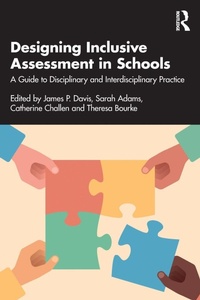
Designing Inclusive Assessment in Schools
A Guide to Disciplinary and Interdisciplinary Practice
1st Edition
Published on 21. October 2024
Book
Paperback/Softback
156 pages
978-1-032-72871-1 (ISBN)
Description
Written by teachers and teacher educators, this book presents practice-focused ideas and provocative questions to help teachers plan for inclusive curriculum and assessment within key learning areas in school education.
Providing content on specific disciplines including geography, history, mathematics, science, English, and the Arts, this book supports teachers with hands-on examples for creating inclusive assessment practices in schools. There are additional sections on interdisciplinary perspectives delivering practical strategies for assessing students who use English as an additional language, being inclusive in relation to gender and sexual diversity, using a variety of technologies to promote inclusivity, and applying inclusive assessment in rural, regional, and remote contexts. Each chapter is designed around problems encountered by teachers, practical responses, and recommendations for practice. The authors address Australian Indigenous perspectives, gender and diversity, rural and remote school systems, and translanguaging for multicultural contexts.
Engaging and easy to read, this book is essential reading for pre- and in-service teachers seeking to make an impactful contribution to inclusive education in their classrooms.
Providing content on specific disciplines including geography, history, mathematics, science, English, and the Arts, this book supports teachers with hands-on examples for creating inclusive assessment practices in schools. There are additional sections on interdisciplinary perspectives delivering practical strategies for assessing students who use English as an additional language, being inclusive in relation to gender and sexual diversity, using a variety of technologies to promote inclusivity, and applying inclusive assessment in rural, regional, and remote contexts. Each chapter is designed around problems encountered by teachers, practical responses, and recommendations for practice. The authors address Australian Indigenous perspectives, gender and diversity, rural and remote school systems, and translanguaging for multicultural contexts.
Engaging and easy to read, this book is essential reading for pre- and in-service teachers seeking to make an impactful contribution to inclusive education in their classrooms.
More details
Language
English
Place of publication
London
United Kingdom
Publishing group
Taylor & Francis Ltd
Target group
College/higher education
Professional and scholarly
Postgraduate, Professional Practice & Development, and Undergraduate Advanced
Illustrations
8 s/w Zeichnungen, 3 s/w Tabellen, 1 s/w Photographie bzw. Rasterbild, 9 s/w Abbildungen
3 Tables, black and white; 8 Line drawings, black and white; 1 Halftones, black and white; 9 Illustrations, black and white
Dimensions
Height: 234 mm
Width: 156 mm
Thickness: 9 mm
Weight
266 gr
ISBN-13
978-1-032-72871-1 (9781032728711)
Copyright in bibliographic data and cover images is held by Nielsen Book Services Limited or by the publishers or by their respective licensors: all rights reserved.
Schweitzer Classification
Other editions
Additional editions
James P. Davis | Sarah Adams | Catherine Challen
Designing Inclusive Assessment in Schools
A Guide to Disciplinary and Interdisciplinary Practice
Book
10/2024
1st Edition
Routledge
€195.70
Shipment within 10-20 days
James P. Davis | Sarah Adams | Catherine Challen
Designing Inclusive Assessment in Schools
A Guide to Disciplinary and Interdisciplinary Practice
E-Book
10/2024
1st Edition
Routledge
€35.49
Available for download
James P. Davis | Sarah Adams | Catherine Challen
Designing Inclusive Assessment in Schools
A Guide to Disciplinary and Interdisciplinary Practice
E-Book
10/2024
1st Edition
Routledge
€35.49
Available for download
Persons
James P. Davis is an Associate Professor in STEM and Entrepreneurial Education, Academic Lead Engagement (Research) in the School of Teacher Education and Leadership, as well as the Lead for the QUT STEM Education Research Group. James is also a former Program Leader for Engagement and Learning in the QUT Centre for Inclusive Education, and a current executive committee member of the Australian Teacher Education Association (ATEA).
Sarah Adams is a Lecturer in Geography Education, School of Teacher Education and Leadership, Queensland University of Technology, Australia.
Catherine Challen is a Senior Lecturer in Maths Education, School of Teacher Education and Leadership, Queensland University of Technology, Australia.
Theresa Bourke is a Professor and Head of School at the Queensland University of Technology, Australia. She is the current President of the Australian Teacher Education Association (ATEA).
Sarah Adams is a Lecturer in Geography Education, School of Teacher Education and Leadership, Queensland University of Technology, Australia.
Catherine Challen is a Senior Lecturer in Maths Education, School of Teacher Education and Leadership, Queensland University of Technology, Australia.
Theresa Bourke is a Professor and Head of School at the Queensland University of Technology, Australia. She is the current President of the Australian Teacher Education Association (ATEA).
Content
Introduction 1. Inclusive assessment in action Part I - Disciplinary practices 2. Unlocking history for all: Achieving inclusivity in the history classroom through Assessment for Learning (AfL) 3. Designing inclusive Assessment for Learning in English Language Arts 4. Daily Discourse: Empowering every student in mathematics through Assessment for Learning 5. Supporting children's spatial understanding through technology: The importance of dialogical exchange analysed through inclusive research 6. A place for all: Inclusive practices in Arts assessment 7. Learning and assessment in school science: Assistive technologies for diverse learners 8. Inclusive practice and geographical assessment: Practical tips to increase task accessibility Part II - Interdisciplinary practices 9. Indigenous perspectives in assessment: Applying a place-based approach 10. Queer(y)ing primary assessment: Bodies, genders, and sexuality diversity 11. Embracing translanguaging in designing inclusive assessments with learners of English as an additional language or dialect 12. Spotlighting rural and remote inclusive assessment: Systemic perspectives from the field Part III - Future practice 13. Inclusive classroom assessment and social justice