

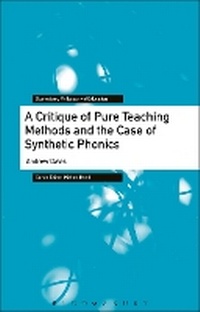
A Critique of Pure Teaching Methods and the Case of Synthetic Phonics
Published on 30. May 2019
Book
Paperback/Softback
200 pages
978-1-350-11094-6 (ISBN)
Description
A Critique of Pure Teaching Methods and the Case of Synthetic Phonics examines how research into the effectiveness of teaching methods can and should relate to what takes place in the classroom. The discussion brings to light some important features of the way we classify teaching activities. The classifications are unlike those we use in natural science - for instance, how we classify drug dosages. This point has very important implications for what should be considered the appropriate relationships between educational research and classroom practice.
Andrew Davis applies the results of this discussion to the teaching of early reading, focussing in particular on the approach known as synthetic phonics. He provides a philosophical investigation into the nature of reading, and into the concepts that feature in approaches to teaching it, such as the idea of building words from letter sounds, the nature of words themselves and reading for meaning. He concludes with a discussion of why this matters so much, reflecting on how stories and books can be part of a child's emerging identity within the family. He explores how values of family life should be weighed against the importance of achievements in school, and argues for the claim that school reading policies of certain kinds may have a destructive impact if they are felt to trump the private interests of children and their families.
Andrew Davis applies the results of this discussion to the teaching of early reading, focussing in particular on the approach known as synthetic phonics. He provides a philosophical investigation into the nature of reading, and into the concepts that feature in approaches to teaching it, such as the idea of building words from letter sounds, the nature of words themselves and reading for meaning. He concludes with a discussion of why this matters so much, reflecting on how stories and books can be part of a child's emerging identity within the family. He explores how values of family life should be weighed against the importance of achievements in school, and argues for the claim that school reading policies of certain kinds may have a destructive impact if they are felt to trump the private interests of children and their families.
Reviews / Votes
A thought-provoking critique of the current system and its deficiencies and definitely worthy of serious attention. * Educational Review * This philosophical text ably addresses a controversial area of teaching and learning in a lively and engaging fashion. It will be welcomed by thoughtful people committed to exploring how to help young children learn to read and enjoy reading. With colourful examples presented in a scholarly manner, the text will appeal to students, teachers and academics with a propensity for questioning the status quo. * Carrie Winstanley, Professor, School of Education, Roehampton University, London *More details
Series
Language
English
Place of publication
London
United Kingdom
Publishing group
Bloomsbury Publishing PLC
Target group
College/higher education
Professional and scholarly
Dimensions
Height: 234 mm
Width: 154 mm
Thickness: 14 mm
Weight
300 gr
ISBN-13
978-1-350-11094-6 (9781350110946)
Copyright in bibliographic data and cover images is held by Nielsen Book Services Limited or by the publishers or by their respective licensors: all rights reserved.
Schweitzer Classification
Other editions
Additional editions
E-Book
11/2017
1st Edition
Bloomsbury Academic
€38.49
Available for download
E-Book
11/2017
1st Edition
Bloomsbury Academic
€38.49
Available for download
Person
Andrew Davis is Honorary Research Fellow in the School of Education at Durham University, UK. He is an authority on assessment, philosophy and psychology of mathematical learning and primary mathematics. There has been widespread media coverage of his 2014 IMPACT pamphlet 'To Read or Not to Read: Decoding Synthetic Phonics'.
Content
Introduction
1. Teaching Methods Classifications
2. Teaching, Learning and Constructivism
3. Philosophical Investigations into Reading
4. The Impact of Imposing Teaching Methods
Conclusions
References
Index
1. Teaching Methods Classifications
2. Teaching, Learning and Constructivism
3. Philosophical Investigations into Reading
4. The Impact of Imposing Teaching Methods
Conclusions
References
Index