

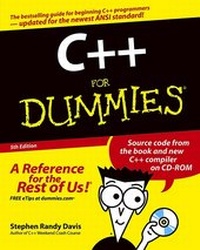
C++ For Dummies
5th Edition
Published on 7. May 2004
Book
Paperback/Softback
432 pages
978-0-7645-6852-7 (ISBN)
Description
C++ is one of the most widely used programming languages with over 3.6 million programmers and growing. Now in its fifth edition, this bestselling book teaches C++ from the ground-up. It will give the reader the tools to become functional programmers, while intermediate programmers can use the information to fine-tune their skills.
Reviews / Votes
"...remains a strong contender among object-oriented programming languages". (Library Journal, October 1, 2004)More details
Edition
5., Auflage
Language
English
Place of publication
Foster City
United States
Publishing group
John Wiley & Sons Inc
Edition type
Revised edition
Illustrations
Illustrations
Dimensions
Height: 23.3 cm
Width: 18.7 cm
Thickness: 22 mm
Weight
680 gr
ISBN-13
978-0-7645-6852-7 (9780764568527)
Schweitzer Classification
Other editions
New editions
Stephen R. Davis
C++ For Dummies
Book
05/2009
6th Edition
Wiley
€25.90
Article exhausted; check for reprint
Previous edition

Stephen R. Davis
C++ For Dummies
Book
07/2000
4th Edition
Hungry Minds Inc,U.S.
€44.75
Article exhausted; check for reprint
Person
Stephen Randy Davis is the best-selling author of numerous books and articles including "C++ for Dummies", "C++ Weekend Crash Course", "C# for Dummies" and "C# Weekend Crash Course". Mr. Davis has been programming for over 30 years. He currently works for L-3 Communications in the area of Homeland Defense.
Content
Introduction.
Part I: Introduction to C++ Programming.
Chapter 1: Writing Your First C++ Program.
Chapter 2: Declaring Variables Constantly.
Chapter 3: Performing Mathematical Operations.
Chapter 4: Performing Logical Operations.
Chapter 5: Controlling Program Flow.
Part II: Becoming a Functional C++ Programmer.
Chapter 6: Creating Functions.
Chapter 7: Storing Sequences in Arrays.
Chapter 8: Taking a First Look at C++ Pointers.
Chapter 9: Taking a Second Look at C++ Pointers.
Chapter 10: Debugging C++.
Part III: Introduction to Classes.
Chapter 11: Examining Object-Oriented Programming.
Chapter 12: Adding Class to C++.
Chapter 13: Making Classes Work.
Chapter 14: Point and Stare at Objects.
Chapter 15: Protecting Members: Do Not Disturb.
Chapter 16: "Why Do You Build Me Up, Just to Tear Me Down, Baby?"
Chapter 17: Making Constructive Arguments.
Chapter 18: Copying the Copy Copy Copy Constructor.
Chapter 19: Static Members: Can Fabric Softener Help?
Part IV: Inheritance.
Chapter 20: Inheriting a Class.
Chapter 21: Examining Virtual Member Functions: Are They for Real?
Chapter 22: Factoring Classes.
Part V: Optional Features.
Chapter 23: A New Assignment Operator, Should You Decide to Accept It.
Chapter 24: Using Stream I/O.
Chapter 25: Handling Errors -- Exceptions.
Chapter 26: Inheriting Multiple Inheritance.
Chapter 27: Tempting C++ Templates.
Chapter 28: Standardizing on the Standard Template Library.
Part VI: The Part of Tens.
Chapter 29: Ten Ways to Avoid Adding Bugs to Your Program.
Chapter 30: The Ten Most Important Optional Features of Dev-C++.
Appendix: About the CD.
Bonus Chapters on the CD-ROM!
Bonus Chapter 1: A Functional Budget Program.
Bonus Chapter 2: Using Visual C++.NET.
Index.
Part I: Introduction to C++ Programming.
Chapter 1: Writing Your First C++ Program.
Chapter 2: Declaring Variables Constantly.
Chapter 3: Performing Mathematical Operations.
Chapter 4: Performing Logical Operations.
Chapter 5: Controlling Program Flow.
Part II: Becoming a Functional C++ Programmer.
Chapter 6: Creating Functions.
Chapter 7: Storing Sequences in Arrays.
Chapter 8: Taking a First Look at C++ Pointers.
Chapter 9: Taking a Second Look at C++ Pointers.
Chapter 10: Debugging C++.
Part III: Introduction to Classes.
Chapter 11: Examining Object-Oriented Programming.
Chapter 12: Adding Class to C++.
Chapter 13: Making Classes Work.
Chapter 14: Point and Stare at Objects.
Chapter 15: Protecting Members: Do Not Disturb.
Chapter 16: "Why Do You Build Me Up, Just to Tear Me Down, Baby?"
Chapter 17: Making Constructive Arguments.
Chapter 18: Copying the Copy Copy Copy Constructor.
Chapter 19: Static Members: Can Fabric Softener Help?
Part IV: Inheritance.
Chapter 20: Inheriting a Class.
Chapter 21: Examining Virtual Member Functions: Are They for Real?
Chapter 22: Factoring Classes.
Part V: Optional Features.
Chapter 23: A New Assignment Operator, Should You Decide to Accept It.
Chapter 24: Using Stream I/O.
Chapter 25: Handling Errors -- Exceptions.
Chapter 26: Inheriting Multiple Inheritance.
Chapter 27: Tempting C++ Templates.
Chapter 28: Standardizing on the Standard Template Library.
Part VI: The Part of Tens.
Chapter 29: Ten Ways to Avoid Adding Bugs to Your Program.
Chapter 30: The Ten Most Important Optional Features of Dev-C++.
Appendix: About the CD.
Bonus Chapters on the CD-ROM!
Bonus Chapter 1: A Functional Budget Program.
Bonus Chapter 2: Using Visual C++.NET.
Index.