

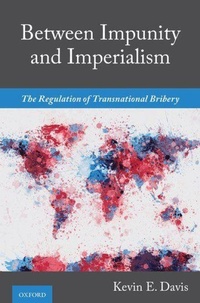
Between Impunity and Imperialism
The Regulation of Transnational Bribery
Published on 10. October 2019
Book
Hardback
344 pages
978-0-19-007080-9 (ISBN)
Description
When people pay bribes to foreign public officials, how should the law respond? This question has been debated ever since the enactment of the U.S. Foreign Corrupt Practices Act of 1977, and some of the key arguments can be traced back to Cicero in the last years of the Roman Republic and Edmund Burke in late eighteenth-century England. In recent years, the U.S. and other members of the OECD have joined forces to make anti-bribery law one of the most prominent sources of liability for firms and individuals who operate across borders. The modern regime is premised on the idea that transnational bribery is a serious problem which invariably merits a vigorous legal response. The shape of that response can be summed up in the phrase "every little bit helps," which in practice means that: prohibitions on bribery should capture a broad range of conduct; enforcement should target as broad a range of actors as possible; sanctions should be as stiff as possible; and as many agencies as possible should be involved in the enforcement process. An important challenge to the OECD paradigm, labelled here the "anti-imperialist critique," accepts that transnational bribery is a serious problem but questions the conventional responses. This book uses a series of high-profile cases to illustrate key elements of transnational bribery law in action, and analyzes the law through the lenses of both the OECD paradigm and the anti-imperialist critique. It ultimately defends a distinctively inclusive and experimentalist approach to transnational bribery law.
Reviews / Votes
No other book on corruption that I know of zeroes in on the questions of how to combat foreign bribery in our times in such a thoughtful and comprehensive way. Not only should every prosecutor and international organization official engaged in the fight against transnational bribery read this book, but so should anyone who is interested in the policy issues or has had a brush with the current system from a private sector vantage point. * Lucinda Low, Partner, Steptoe & Johnson * Kevin Davis has written a truly unconventional book, he dares put in question the established U.S. and OECD standards against foreign bribery. He makes it clear that we are fighting foreign bribery in our own interest. All believers in the U.S. FCPA and in the OECD Convention on foreign bribery should read this book. * Mark Pieth, Professor of Criminal Law and Criminology, University of Basel * Transnational bribery is a serious global problem, but as Kevin Davis argues, in his provocative and wide ranging critique, domestic and international law enforcement is often misdirected. Different societies have distinctive vulnerabilities that are not reflected in present-day enforcement priorities. A more effective response would look beyond prevention and deterrence to assess the costs and benefits of alternative strategies in diverse settings. * Susan Rose -Ackerman, Henry R. Luce Professor Emeritus of Law and Political Science, Yale University *More details
Language
English
Place of publication
New York
United States
Target group
College/higher education
Product notice
sewn/stitched
Cloth over boards
Dimensions
Height: 243 mm
Width: 168 mm
Thickness: 32 mm
Weight
607 gr
ISBN-13
978-0-19-007080-9 (9780190070809)
Copyright in bibliographic data and cover images is held by Nielsen Book Services Limited or by the publishers or by their respective licensors: all rights reserved.
Schweitzer Classification
Other editions
Additional editions
E-Book
07/2019
OUP eBook
€46.99
Available for download
E-Book
07/2019
OUP eBook
€60.99
Available for download
Person
Kevin E. Davis is Beller Family Professor of Business Law at New York University School of Law.
Content
- Chapter 1: Introduction
- Chapter 2: Imperial anti-corruption law
- Chapter 3: The birth of modern transnational bribery law
- Chapter 4: The modern regime
- Chapter 5: Criteria for evaluation
- Chapter 6: What is bribery?
- Chapter 7: Prohibitions that extend beyond bribery
- Chapter 8: When should organizations be liable for foreign bribery?
- Chapter 9: How should transnational bribery law be enforced?
- Chapter 10: How should responsibility for regulation be allocated?
- Chapter 11: Concluding thoughts