

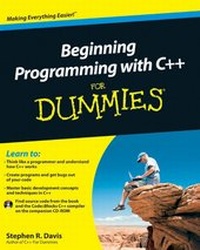
Beginning Programming with C++ For Dummies
1st Edition
Published on 13. August 2010
Book
Paperback/Softback
456 pages
978-0-470-61797-7 (ISBN)
Description
An ideal starting point to get a strong grasp of the fundamentals of C++
C++ is an object-oriented programming language commonly adopted by would-be programmers. This book explores the basic development concepts and techniques of C++ and explains the "how" and "why" of C++ programming from the ground up.
You'll discover what goes into creating a program, as well as how to put the various pieces together, deal with standard programming challenges, handle debugging, and make it all work.
* Details the basics of C++ programming and explores the "how" and "why" of this object-oriented language
* Addresses the various components that go into creating a program with C++
* Walks you through common challenges of C++ programming
Assuming no prior experience, Beginning Programming with C++ For Dummies is a fun and friendly guide to learning the C++ language.
Note: CD-ROM/DVD and other supplementary materials are not included as part of eBook file.
C++ is an object-oriented programming language commonly adopted by would-be programmers. This book explores the basic development concepts and techniques of C++ and explains the "how" and "why" of C++ programming from the ground up.
You'll discover what goes into creating a program, as well as how to put the various pieces together, deal with standard programming challenges, handle debugging, and make it all work.
* Details the basics of C++ programming and explores the "how" and "why" of this object-oriented language
* Addresses the various components that go into creating a program with C++
* Walks you through common challenges of C++ programming
Assuming no prior experience, Beginning Programming with C++ For Dummies is a fun and friendly guide to learning the C++ language.
Note: CD-ROM/DVD and other supplementary materials are not included as part of eBook file.
More details
Edition
1., Auflage
Language
English
Place of publication
Chichester
United Kingdom
Publishing group
John Wiley and Sons Ltd
Target group
Professional and scholarly
Illustrations
Illustrations
Dimensions
Height: 23.5 cm
Width: 18.8 cm
Thickness: 26 mm
Weight
689 gr
ISBN-13
978-0-470-61797-7 (9780470617977)
Schweitzer Classification
Other editions
New editions
Stephen R. Davis
Beginning Programming with C++ For Dummies
Book
12/2014
2nd Edition
Wiley
€32.50
Shipment within 15-20 days
Person
Stephen R. Davis is a programmer and the bestselling author of several books on the C languages, including C# For Dummies, C++ Weekend Crash Course, and all editions of C++ For Dummies. He currently works for L-3 Communications in the area of Homeland Defense.
Content
Introduction.
Part I: Let's Get Started.
Chapter 1: What Is a Program?
Chapter 2: Installing Code:Blocks.
Chapter 3: Writing Your First Program.
Part II: Writing a Program: Decisions, Decisions.
Chapter 4: Integer Expressions.
Chapter 5: Character Expressions.
Chapter 6: if I Could Make My Own Decisions.
Chapter 7: Switching Paths.
Chapter 8: Debugging Your Programs, Part 1.
Part III: Becoming a Functional Programmer.
Chapter 9: while Running in Circles.
Chapter 10: Looping for the Fun of It.
Chapter 11: Functions, I Declare!
Chapter 12: Dividing Programs into Modules.
Chapter 13: Debugging Your Programs, Part 2.
Part IV: Data Structures.
Chapter 14: Other Numerical Variable Types.
Chapter 15: Arrays.
Chapter 16: Arrays with Character.
Chapter 17: Pointing the Way to C++ Pointers.
Chapter 18: Taking a Second Look at C++ Pointers.
Chapter 19: Programming with Class.
Chapter 20: Debugging Your Programs, Part 3.
Part V: Object-Oriented Programming.
Chapter 21: What Is Object-Oriented Programming?
Chapter 22: Structured Play: Making Classes Do Things.
Chapter 23: Pointers to Objects.
Chapter 24: Do Not Disturb: Protected Members.
Chapter 25: Getting Objects Off to a Good Start.
Chapter 26: Making Constructive Arguments.
Chapter 27: Coping with the Copy Constructor.
Part VI: Advanced Strokes.
Chapter 28: Inheriting a Class.
Chapter 29: Are Virtual Functions for Real?
Chapter 30: Overloading Assignment Operators.
Chapter 31: Performing Streaming I/O.
Chapter 32: I Take Exception!
Part VII: The Part of Tens.
Chapter 33: Ten Ways to Avoid Bugs.
Chapter 34: Ten Features Not Covered in This Book.
Appendix: About the CD.
Index.
Part I: Let's Get Started.
Chapter 1: What Is a Program?
Chapter 2: Installing Code:Blocks.
Chapter 3: Writing Your First Program.
Part II: Writing a Program: Decisions, Decisions.
Chapter 4: Integer Expressions.
Chapter 5: Character Expressions.
Chapter 6: if I Could Make My Own Decisions.
Chapter 7: Switching Paths.
Chapter 8: Debugging Your Programs, Part 1.
Part III: Becoming a Functional Programmer.
Chapter 9: while Running in Circles.
Chapter 10: Looping for the Fun of It.
Chapter 11: Functions, I Declare!
Chapter 12: Dividing Programs into Modules.
Chapter 13: Debugging Your Programs, Part 2.
Part IV: Data Structures.
Chapter 14: Other Numerical Variable Types.
Chapter 15: Arrays.
Chapter 16: Arrays with Character.
Chapter 17: Pointing the Way to C++ Pointers.
Chapter 18: Taking a Second Look at C++ Pointers.
Chapter 19: Programming with Class.
Chapter 20: Debugging Your Programs, Part 3.
Part V: Object-Oriented Programming.
Chapter 21: What Is Object-Oriented Programming?
Chapter 22: Structured Play: Making Classes Do Things.
Chapter 23: Pointers to Objects.
Chapter 24: Do Not Disturb: Protected Members.
Chapter 25: Getting Objects Off to a Good Start.
Chapter 26: Making Constructive Arguments.
Chapter 27: Coping with the Copy Constructor.
Part VI: Advanced Strokes.
Chapter 28: Inheriting a Class.
Chapter 29: Are Virtual Functions for Real?
Chapter 30: Overloading Assignment Operators.
Chapter 31: Performing Streaming I/O.
Chapter 32: I Take Exception!
Part VII: The Part of Tens.
Chapter 33: Ten Ways to Avoid Bugs.
Chapter 34: Ten Features Not Covered in This Book.
Appendix: About the CD.
Index.