

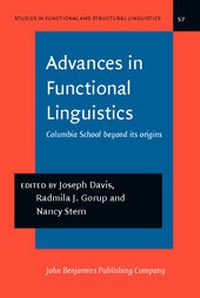
Advances in Functional Linguistics
Columbia School beyond its origins
Published on 20. December 2006
Book
Hardback
344 pages
978-90-272-1566-6 (ISBN)
Description
This collection carries the functionalist Columbia School of linguistics forward with contributions on linguistic theory, semiotics, phonology, grammar, lexicon, and anthropology. Columbia School linguistics views language as a symbolic tool whose structure is shaped both by its communicative function and by the characteristics of its users, and considers contextual, pragmatic, physical, and psychological factors in its analyses. This volume builds upon three previous Columbia School anthologies and further explores issues raised in them, including fundamental theoretical and analytical questions. And it raises new issues that take Columbia School "beyond its origins." The contributions illustrate both consistency since the school's inception over thirty years ago and innovation spurred by groundbreaking analysis. The volume will be of interest to all functional linguists and historians of linguistics. Languages analyzed include Byelorussian, English, Japanese, Serbo-Croatian, Spanish, and Swahili.
More details
Series
Language
English
Place of publication
Amsterdam
Netherlands
Target group
Professional and scholarly
Dimensions
Height: 245 mm
Width: 164 mm
Weight
810 gr
ISBN-13
978-90-272-1566-6 (9789027215666)
Copyright in bibliographic data and cover images is held by Nielsen Book Services Limited or by the publishers or by their respective licensors: all rights reserved.
Schweitzer Classification
Other editions
Additional editions
Joseph Davis | Radmila J. Gorup | Nancy Stern
Advances in Functional Linguistics
Columbia School beyond its origins
E-Book
12/2006
1st Edition
John Benjamins Publishing Company
€155.99
Available for download
Persons
Content
1. List of Contributors; 2. Introduction: Consistency and Change in Columbia School Linguistics (by Davis, Joseph); 3. Linguistic Theory; 4. Columbia School and Saussure's langue (by Reid, Wallis); 5. Diver's Theory (by Huffman, Alan); 6. Phonology; 7. Phonology as human behavior: Inflectional systems in English (by Tobin, Yishai); 8. Phonological processes of Japanese based on the theory of phonology as human behavior (by Tobin, Yishai); 9. Phonology as human behavior: A combinatory phonology of Byelorussian (by Dreer, Igor); 10. Phonology as human behavior: The case of Peninsular Spanish (by Dekker, Adriaan); 11. Functional motivations for the sound patterns of English non-lexical Interjections (by Joue, Gina); 12. Phonology without the phoneme (by Davis, Joseph); 13. Grammar and lexicon; 14. Tell me about yourself: A unified account of English-self pronouns (by Stern, Nancy); 15. Se without deixis (by Gorup, Radmila J.); 16. The difference between zero and nothing: Swahili noun class prefixes 5 and 9/10 (by Contini-Morava, Ellen); 17. A semantic analysis of Swahili suffix li (by Leonard, Robert A.); 18. The structure of the Japanese inferential system: A functional analysis of daroo, rashii, soo-da, and yooda (by Riggs, Hidemi Sugi); 19. Structuring cues of conjunctive yet, but, and still: A monosemic approach (by Crupi, Charlene); 20. Beyond Language; 21. The case for articulatory gestures - not sounds - as the physical embodiment of speech signs (by Eccardt, Thomas); 22. Meaning in nonlinguistic systems: Observations, remarks, and hypotheses on food, architecture, and honor in Kenya (by Leonard, Robert A.); 23. Index of names; 24. Subject index