

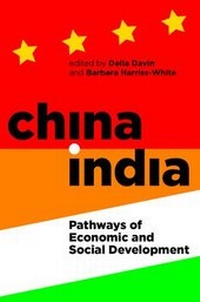
China-India
Pathways of Economic and Social Development
Published on 13. March 2014
Book
Hardback
220 pages
978-0-19-726567-3 (ISBN)
Description
China and India: the world's most populous countries whose rapidly developing economies are shaping global politics for the 21st century. Many studies have characterised their differences. This book's approach is unusual in that the chapters are less concerned with 'lags' and 'competition', on which most comparative writing on China and India focuses, and more concerned with the structure of the differences between their trajectories.
The themes developed are international and domestic economic development, the labour force, the social consequences of demographic change, and the impact of both economy and society on the environment. Each theme is examined in a pair of chapters which give authoritative analysis of the similarities and differences between the two countries. Probing behind the obvious contrasts, the essays disclose important ways in which the two countries are alike in facing the problems produced in large, formerly agrarian societies by rapid economic development and interaction with the global economy.
China-India: Pathways of Economic and Social Development will be of interest to scholars in social sciences, political researchers, policy makers and journalists.
The themes developed are international and domestic economic development, the labour force, the social consequences of demographic change, and the impact of both economy and society on the environment. Each theme is examined in a pair of chapters which give authoritative analysis of the similarities and differences between the two countries. Probing behind the obvious contrasts, the essays disclose important ways in which the two countries are alike in facing the problems produced in large, formerly agrarian societies by rapid economic development and interaction with the global economy.
China-India: Pathways of Economic and Social Development will be of interest to scholars in social sciences, political researchers, policy makers and journalists.
More details
Series
Language
English
Place of publication
Oxford
United Kingdom
Target group
College/higher education
Professional and scholarly
Illustrations
11 figures
Dimensions
Height: 242 mm
Width: 168 mm
Thickness: 22 mm
Weight
580 gr
ISBN-13
978-0-19-726567-3 (9780197265673)
Copyright in bibliographic data and cover images is held by Nielsen Book Services Limited or by the publishers or by their respective licensors: all rights reserved.
Schweitzer Classification
Persons
Edited by Delia Davin, Emeritus Professor of Chinese Studies, University of Leeds, and Barbara Harriss-White, Emeritus Professor of Development Studies, Oxford UniversityContributors: Peter J Buckley, OBE, is Professor of International Business and Founder Director of the Centre for International Business, University of Leeds.Stuart Corbridge is Professor of International Development at the London School of Economics and Political Science.Delia Davin FBA is emeritus professor of Chinese Studies at the University of Leeds. John Harriss is Professor, and Director, School for International Studies, Simon Fraser University, Vancouve).Barbara Harriss-White FBA is Emeritus Professor of Development Studies and Senior Research Fellow at Oxford University, former Director of Queen Elizabeth House and founder director of Oxford's Contemporary South Asian Studies Programme.Patricia Jeffery is Professor of Sociology at University of Edinburgh.Craig Jeffrey is Professor of Development Geography at the School ofGeography and the Environment, Oxford University and a Fellow of St.John's College, Oxford. Vijay Joshi is an Emeritus Fellow of Merton College, Oxford. Devesh Kapur is Madan Lal Sobti Associate Professor for the Study of Contemporary India and Director, Center for Advanced Study of India, University of Pennsylvania. Li Minqi is Associate Professor of Economics at University of Utah. Ravi Rajan is Senior Research Fellow at the Asia Research Institute at the National University of Singapore, on sabbatical from the University of California, Santa Cruz. He is also a Visiting Senior Fellow at The Energy and Resources Institute (TERI), New Delhi, and Visiting Professor at TERI University. Carl Riskin is Distinguished Professor of Economics at Queens College, City University of New York, and Senior Research Scholar at Columbia University's Weatherhead East Asian Institute.Kunal Sen is Professor of Development Economics in the Institute of Development Policy and Management (IDPM), and an Associate Director of the Brooks World Poverty Institute (BWPI), University of Manchester, UK. Dorothy J. Solinger is Professor of Political Science at the University of California, Irvine
Content
Introduction
I China and India: The Domestic Economy
1: Carl Riskin: China: development, Inequality and Imbalance
2: Kunal Sen: The Indian Economy in the Post-Reform Period: Growth without Structural Transformation?
II China, India and the International Economy
3: Peter J. Buckley: The Challenges of China and the International Economy
4: Vijay Joshi and Devesh Kapur: India and the World Economy
III Changing demographic profiles
5: Delia Davin: The social impact of demographic change in China
6: Patricia Jeffery, Professor of Sociology, University of Edinburgh: India: the social consequences of demographic change.
IV Migration and regimes of labour
7: Dorothy J. Solinger: The Modalities of Geographical Mobility in China and their Impacts, 1980-2010
8: Stuart Corbridge, John Harriss and Craig Jeffrey: 'Lopsided', 'Failed', or 'Tortuous': India's Problematic Transition and its Implications for Labour
V The Environment: crises and responses
9: Minqi Li: China: Energy, Environment, and Limits to Growth
10: Ravi Rajan: Environment and Development in India
I China and India: The Domestic Economy
1: Carl Riskin: China: development, Inequality and Imbalance
2: Kunal Sen: The Indian Economy in the Post-Reform Period: Growth without Structural Transformation?
II China, India and the International Economy
3: Peter J. Buckley: The Challenges of China and the International Economy
4: Vijay Joshi and Devesh Kapur: India and the World Economy
III Changing demographic profiles
5: Delia Davin: The social impact of demographic change in China
6: Patricia Jeffery, Professor of Sociology, University of Edinburgh: India: the social consequences of demographic change.
IV Migration and regimes of labour
7: Dorothy J. Solinger: The Modalities of Geographical Mobility in China and their Impacts, 1980-2010
8: Stuart Corbridge, John Harriss and Craig Jeffrey: 'Lopsided', 'Failed', or 'Tortuous': India's Problematic Transition and its Implications for Labour
V The Environment: crises and responses
9: Minqi Li: China: Energy, Environment, and Limits to Growth
10: Ravi Rajan: Environment and Development in India