

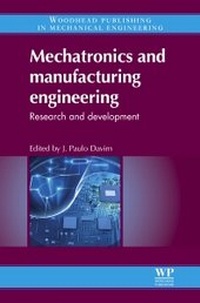
Mechatronics and Manufacturing Engineering
Research and Development
Published on 10. January 2012
Book
Hardback
388 pages
978-0-85709-150-5 (ISBN)
Description
This book, the first in the Woodhead Publishing Reviews: Mechanical Engineering Series, is a collection of high quality articles (full research articles, review articles and cases studies) with a special emphasis on research and development in mechatronics and manufacturing engineering. Mechatronics is the blending of mechanical, electronic, and computer engineering into an integrated design. Today, mechatronics has a significant and increasing impact on engineering with emphasis on the design, development and operation of manufacturing engineering systems. The main objective of this interdisciplinary engineering field is the study of automata from an engineering perspective, thinking on the design of products and manufacturing processes and systems. Mechatronics and manufacturing systems are well established and executed within a great number of industries including aircraft, automotive and aerospace industries; machine tools, moulds and dies product manufacturing, computers, electronics, semiconductor and communications, and biomedical.
More details
Series
Language
English
Place of publication
Cambridge
United Kingdom
Publishing group
Elsevier Science & Technology
Target group
Professional and scholarly
Dimensions
Height: 234 mm
Width: 156 mm
Weight
730 gr
ISBN-13
978-0-85709-150-5 (9780857091505)
Copyright in bibliographic data and cover images is held by Nielsen Book Services Limited or by the publishers or by their respective licensors: all rights reserved.
Schweitzer Classification
Other editions
Additional editions
Book
08/2016
Woodhead Publishing Ltd
€182.91
Shipment within 15-20 days
E-Book
01/2012
Woodhead Publishing
€185.00
Available for download
Person
Prof. (Dr.) J. Paulo Davim is a Full Professor at the University of Aveiro, Portugal, with over 35 years of experience in Mechanical, Materials, and Industrial Engineering. He holds multiple distinguished academic titles, including a PhD in Mechanical Engineering and a DSc from London Metropolitan University. He has published over 300 books and 600 articles, with more than 36,500 citations. He is ranked among the world's top 2% scientists by Stanford University and holds leadership positions in numerous international journals, conferences, and research projects. J. Paulo Davim received the Ph.D. degree in Mechanical Engineering in 1997, the M.Sc. degree in Mechanical Engineering (materials and manufacturing processes) in 1991, the Mechanical Engineering degree (5 years) in 1986, from the University of Porto (FEUP), the Aggregate title (Full Habilitation) from the University of Coimbra in 2005 and the D.Sc. from London Metropolitan University in 2013. He is Eur Ing by FEANI-Brussels and Senior Chartered Engineer by the Portuguese Institution of Engineers with a MBA and Specialist title in Engineering and Industrial Management. Currently, he is Professor at the Department of Mechanical Engineering of the University of Aveiro, Portugal. He has more than 30 years of teaching and research experience in Manufacturing, Materials and Mechanical Engineering with special emphasis in Machining & Tribology. He has also interest in Management & Industrial Engineering and Higher Education for Sustainability & Engineering Education. He has guided large numbers of postdoc, Ph.D. and masters students as well as coordinated & participated in several research projects. He has received several scientific awards. He has worked as evaluator of projects for international research agencies as well as examiner of Ph.D. thesis for many universities. He is the Editor in Chief of several international journals, Guest Editor of journals, books Editor, book Series Editor and Scientific Advisory for many international journals and conferences. Presently, he is an Editorial Board member of 25 international journals and acts as reviewer for more than 80 prestigious Web of Science journals. In addition, he has also published as editor (and co-editor) more than 100 books and as author (and co-author) more than 10 books, 80 book chapters and 400 articles in journals and conferences (more than 200 articles in journals indexed in Web of Science core collection/h-index 45+/6000+ citations and SCOPUS/h-index 52+/8000+ citations).
Content
List of figures
List of tables
Preface
About the contributors
Chapter 1: Implementation of light-scattering instrumentation: innovation, design and development
Abstract:
Glossary
1.1 Introduction
1.2 Application and need
1.3 Innovation
1.3.1 Innovation strategies
1.4 Do the right thing
1.5 Funding
1.6 The prototype
1.7 How to keep ahead of the competition - design in saleability!
1.8 The evolutionary history of the NS4910 protein aggregation monitor (PAM)
1.9 Conclusions
1.11 Acknowledgements
Chapter 2: Planar micromanipulation on microconveyor platforms: recent developments
Abstract:
2.1 Introduction
2.2 Microconveyor platforms for micromanipulation
2.3 Manipulation of parts on microconveyor platforms: an integrated approach for programmable force field design and platform programming
2.4 Future research directions and conclusions
Chapter 3: Single-axis arm designed with an ultrasonic motor: basic active/passive joint torque control
Abstract:
3.1 Introduction
3.2 Single-axis arm designed with an ultrasonic motor
3.3 Control system
3.4 Example of application
3.5 Conclusions
Chapter 4: Signal processing for tool condition monitoring: from wavelet analysis to sparse decomposition
Abstract:
4.1 Overview of tool condition monitoring and signal processing issues
4.2 Signal space, linear system and Fourier transform
4.3 Wavelet analysis
4.4 Sparse coding
4.5 Applications
4.6 Conclusions
Chapter 5: ANN modelling of fractal dimension in machining
Abstract:
5.1 Introduction
5.2 Basic considerations
5.3 CNC end milling
5.4 CNC turning
5.5 Cylindrical grinding
5.6 Electrical discharge machining
5.7 Conclusion
Chapter 6: Predicting forces and damage in drilling of polymer composites: soft computing techniques
Abstract:
6.1 Drilling of polymer composites
6.2 Soft computing techniques
Chapter 7: Minimising burr size in drilling: integrating response surface methodology with particle swarm optimisation
Abstract:
7.1 Introduction
7.2 Response surface methodology
7.3 Particle swarm optimisation
7.4 Experimental details
7.5 Results and discussion
7.6 Conclusions
Chapter 8: Single-point incremental forming of polymers
Abstract:
8.1 Introduction
8.2 Theoretical framework
8.3 Experimental background
8.4 Results and discussion
8.5 Conclusions
8.6 Acknowledgment
Index
List of tables
Preface
About the contributors
Chapter 1: Implementation of light-scattering instrumentation: innovation, design and development
Abstract:
Glossary
1.1 Introduction
1.2 Application and need
1.3 Innovation
1.3.1 Innovation strategies
1.4 Do the right thing
1.5 Funding
1.6 The prototype
1.7 How to keep ahead of the competition - design in saleability!
1.8 The evolutionary history of the NS4910 protein aggregation monitor (PAM)
1.9 Conclusions
1.11 Acknowledgements
Chapter 2: Planar micromanipulation on microconveyor platforms: recent developments
Abstract:
2.1 Introduction
2.2 Microconveyor platforms for micromanipulation
2.3 Manipulation of parts on microconveyor platforms: an integrated approach for programmable force field design and platform programming
2.4 Future research directions and conclusions
Chapter 3: Single-axis arm designed with an ultrasonic motor: basic active/passive joint torque control
Abstract:
3.1 Introduction
3.2 Single-axis arm designed with an ultrasonic motor
3.3 Control system
3.4 Example of application
3.5 Conclusions
Chapter 4: Signal processing for tool condition monitoring: from wavelet analysis to sparse decomposition
Abstract:
4.1 Overview of tool condition monitoring and signal processing issues
4.2 Signal space, linear system and Fourier transform
4.3 Wavelet analysis
4.4 Sparse coding
4.5 Applications
4.6 Conclusions
Chapter 5: ANN modelling of fractal dimension in machining
Abstract:
5.1 Introduction
5.2 Basic considerations
5.3 CNC end milling
5.4 CNC turning
5.5 Cylindrical grinding
5.6 Electrical discharge machining
5.7 Conclusion
Chapter 6: Predicting forces and damage in drilling of polymer composites: soft computing techniques
Abstract:
6.1 Drilling of polymer composites
6.2 Soft computing techniques
Chapter 7: Minimising burr size in drilling: integrating response surface methodology with particle swarm optimisation
Abstract:
7.1 Introduction
7.2 Response surface methodology
7.3 Particle swarm optimisation
7.4 Experimental details
7.5 Results and discussion
7.6 Conclusions
Chapter 8: Single-point incremental forming of polymers
Abstract:
8.1 Introduction
8.2 Theoretical framework
8.3 Experimental background
8.4 Results and discussion
8.5 Conclusions
8.6 Acknowledgment
Index