

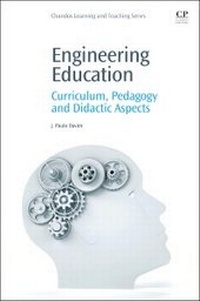
Engineering Education
Curriculum, Pedagogy and Didactic Aspects
Published on 5. September 2014
Book
Paperback/Softback
220 pages
978-1-84334-687-6 (ISBN)
Description
Information about engineering education is highly relevant for improving communication between professors, researchers and students in engineering schools, institutions, laboratories and industry. Technological change is fundamental to the development of education systems. Engineering Education emphasises curriculum development, pedagogy and didactic aspects of engineering education, covering relevant aspects from more classical engineering courses such as mechanical, manufacturing, industrial, chemical, environmental, civil and systems courses, to more contemporary courses including nano-engineering and bioengineering along with information on sustainable development in the context of engineering education.
More details
Series
Language
English
Place of publication
Witney
United Kingdom
Publishing group
Woodhead Publishing Ltd
Target group
College/higher education
Dimensions
Height: 234 mm
Width: 156 mm
Weight
280 gr
ISBN-13
978-1-84334-687-6 (9781843346876)
Copyright in bibliographic data and cover images is held by Nielsen Book Services Limited or by the publishers or by their respective licensors: all rights reserved.
Schweitzer Classification
Other editions
Additional editions
E-Book
10/2014
Chandos Publishing
€58.95
Available for download
Person
Prof. (Dr.) J. Paulo Davim is a Full Professor at the University of Aveiro, Portugal, with over 35 years of experience in Mechanical, Materials, and Industrial Engineering. He holds multiple distinguished academic titles, including a PhD in Mechanical Engineering and a DSc from London Metropolitan University. He has published over 300 books and 600 articles, with more than 36,500 citations. He is ranked among the world's top 2% scientists by Stanford University and holds leadership positions in numerous international journals, conferences, and research projects.
Content
List of figures and tables
Figures
Tables
Preface
About the editor and contributors
Chapter 1
Chapter 2
Chapter 3
Chapter 4
Chapter 5
Chapter 6
1: The influences of personality traits on academic performance through imaginative capability: the differences between engineering and science
Abstract
Introduction
Engineering and science
Engineering imagination and scientific imagination
The effects of personality traits on imagination
Method
Results
Discussion
Conclusion
Acknowledgements
2: Developing a personalized and adapted curriculum for engineering education through an ambient intelligence environment
Abstract
Introduction
Ambient intelligence environments
Brain dominance and thinking styles
Research model
Prototype design
Results, interpretation, and recommendations
Research model validation
Conclusion
3: Evaluation to support stakeholder-centered design and continuous quality improvement in higher education services
Abstract
Introduction
Evaluation and self-evaluation in the Italian higher education context
The conceptual approach to evaluating education service performance
Fuzzy ServQual-based methodology for reliable service evaluation
Evaluation of Palermo Management Engineering Program education services
Conclusion
Appendix
4: Software engineering education: from dysfunction to core competency
Abstract
Introduction
Phase I: Addressing the talent shortage problem
Phase II: improving software engineering core competency
Conclusion
Acknowledgment
5: The most central occupation requirements for engineering jobs: engineering education implications
Abstract
Introduction
The O*NET database
Methodological approach and results
Conclusion
6: Energy engineering: an emerging discipline
Abstract
Introduction
The need for energy engineering courses
The development of undergraduate courses
The development of postgraduate courses
Assessment and practical work in academic courses
Perspectives for energy engineering courses and their graduates
Conclusion
Index
Figures
Tables
Preface
About the editor and contributors
Chapter 1
Chapter 2
Chapter 3
Chapter 4
Chapter 5
Chapter 6
1: The influences of personality traits on academic performance through imaginative capability: the differences between engineering and science
Abstract
Introduction
Engineering and science
Engineering imagination and scientific imagination
The effects of personality traits on imagination
Method
Results
Discussion
Conclusion
Acknowledgements
2: Developing a personalized and adapted curriculum for engineering education through an ambient intelligence environment
Abstract
Introduction
Ambient intelligence environments
Brain dominance and thinking styles
Research model
Prototype design
Results, interpretation, and recommendations
Research model validation
Conclusion
3: Evaluation to support stakeholder-centered design and continuous quality improvement in higher education services
Abstract
Introduction
Evaluation and self-evaluation in the Italian higher education context
The conceptual approach to evaluating education service performance
Fuzzy ServQual-based methodology for reliable service evaluation
Evaluation of Palermo Management Engineering Program education services
Conclusion
Appendix
4: Software engineering education: from dysfunction to core competency
Abstract
Introduction
Phase I: Addressing the talent shortage problem
Phase II: improving software engineering core competency
Conclusion
Acknowledgment
5: The most central occupation requirements for engineering jobs: engineering education implications
Abstract
Introduction
The O*NET database
Methodological approach and results
Conclusion
6: Energy engineering: an emerging discipline
Abstract
Introduction
The need for energy engineering courses
The development of undergraduate courses
The development of postgraduate courses
Assessment and practical work in academic courses
Perspectives for energy engineering courses and their graduates
Conclusion
Index