

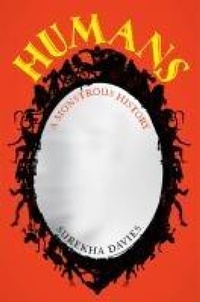
Humans
A Monstrous History
1st Edition
Published on 4. February 2025
Book
Hardback
336 pages
978-0-520-38809-3 (ISBN)
Description
"Surekha Davies invites readers to imagine the lives of historical monsters and to empathize with their often-wretched treatment." - Science Magazine
A history of how humans have created monsters out of one another-from our deepest fears-and what these monsters tell us about humanity's present and future.
Monsters are central to how we think about the human condition. Join award-winning historian of science Dr. Surekha Davies as she reveals how people have defined the human in relation to everything from apes to zombies, and how they invented race, gender, and nations along the way. With rich, evocative storytelling that braids together ancient gods and generative AI, Frankenstein's monster and E.T., Humans: A Monstrous History shows how monster-making is about control: it defines who gets to count as normal.
In an age when corporations increasingly see people as obstacles to profits, this book traces the long, volatile history of monster-making and charts a better path for the future. The result is a profound, effervescent, empowering retelling of the history of the world for anyone who wants to reverse rising inequality and polarization. This is not a history of monsters, but a history through monsters.
A history of how humans have created monsters out of one another-from our deepest fears-and what these monsters tell us about humanity's present and future.
Monsters are central to how we think about the human condition. Join award-winning historian of science Dr. Surekha Davies as she reveals how people have defined the human in relation to everything from apes to zombies, and how they invented race, gender, and nations along the way. With rich, evocative storytelling that braids together ancient gods and generative AI, Frankenstein's monster and E.T., Humans: A Monstrous History shows how monster-making is about control: it defines who gets to count as normal.
In an age when corporations increasingly see people as obstacles to profits, this book traces the long, volatile history of monster-making and charts a better path for the future. The result is a profound, effervescent, empowering retelling of the history of the world for anyone who wants to reverse rising inequality and polarization. This is not a history of monsters, but a history through monsters.
Reviews / Votes
"Wide-ranging, weirdly fascinating." * The Ink * "Davies invites readers to imagine the lives of historical monsters and to empathize with their often-wretched treatment." * Science Magazine * "Davies's book is a radical and timely plea to renew our focus on the humanities. At a time when biology and other sciences are making great strides in understanding how we are put together, chemically and physically, Humans makes clear how vital it is that we invest in understanding how we are put together culturally." * The Chronicle of Higher Education * "Humans documents the curious ways we have thought about who counts as human throughout history, from Pliny's belief that extreme environments created monstrous people to the 18th-century Swedish botanist Carl Linnaeus's four subtypes of humans. Most significant for our time, however, are Davies' thoughts on nation states - the way ideas about race and birthrights are used for dark political ends - and on how AI might end up monstering us." * The New Statesman * "Engaging . . . As the historian of science, art and ideas concludes: 'Monsters are portals. Monsters are us. Let's get to work.'" * Nature * "Surekha Davies' Humans traces the long, volatile history of monster-making to chart a better path for the future. Along the way, Davies reveals how people have defined the human in relation to everything from apes to zombies, and how they invented race, gender, and nations." * Arab News * "The monsters at the heart of this stimulating new book do not hide under beds or coil around the edges of maps. They do not harass passers-by with riddles. As the mirror on the cover suggests, Surekha Davies's monsters are us - in her view, perhaps the best of us." * The TLS * "Embracing the label of monster can afford us all some respite from the pressures of fitting neatly into the categories that have been assigned to us. . . . embracing the monster can remind us that there is no one way to be human." * The Oxonian Review * "Wide-ranging, eclectic and creative, it's more about how we create monsters - and who we create them from - than it is about monsters them-selves. Davies visits the freak show, but it's the audience and the proprietors she's interested in looking at." * Fortean Times *More details
Edition
First Edition
Language
English
Place of publication
Berkerley
United States
Target group
Professional and scholarly
Product notice
Cloth over boards
Illustrations
10 color plates, 40 b-w figures
Dimensions
Height: 232 mm
Width: 155 mm
Thickness: 28 mm
Weight
620 gr
ISBN-13
978-0-520-38809-3 (9780520388093)
Copyright in bibliographic data and cover images is held by Nielsen Book Services Limited or by the publishers or by their respective licensors: all rights reserved.
Schweitzer Classification
Other editions
Additional editions
E-Book
02/2025
1st Edition
Naval Institute Press
€29.49
Available for download
Person
Dr. Surekha Davies is a British author, speaker, and historian of science, art, and ideas. Her first book, Renaissance Ethnography and the Invention of the Human, won the Morris D. Forkosch Prize for the best first book in intellectual history from the Journal of the History of Ideas and the Roland H. Bainton Prize in History and Theology. She has written essays and reviews about the histories of biology, anthropology, and monsters in the Times Literary Supplement, Nature, Science, and Aeon.
Content
List of Illustrations
Introduction
1 * On the Ecology of Monsters
2 * Human or Animal?
3 * Race-Nations
4 * Race-Nations II
5 * Gender, Sex, and Monstrous Births
6 * Monstrous Performance and Display
7 * Gods, Magic, and the Supernatural
8 * Machines
9 * Extraterrestrials
10 * Monstrofuturism
Epilogue
Acknowledgments
Notes
Bibliography
Index
Introduction
1 * On the Ecology of Monsters
2 * Human or Animal?
3 * Race-Nations
4 * Race-Nations II
5 * Gender, Sex, and Monstrous Births
6 * Monstrous Performance and Display
7 * Gods, Magic, and the Supernatural
8 * Machines
9 * Extraterrestrials
10 * Monstrofuturism
Epilogue
Acknowledgments
Notes
Bibliography
Index