

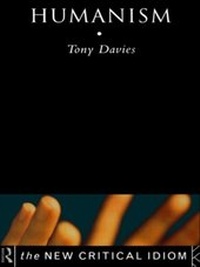
Humanism
Published on 7. November 1996
Book
Paperback/Softback
160 pages
978-0-415-11052-5 (ISBN)
Description
Seemingly an appeal to simple, shared humanity, humanism has proved over the last two hundred years one of the most contentious and divisive of concepts. It has provoked a succession of often bitter altercations and engages with some of the profoundest themes - religious, sexual, political - of modern life and thought. Starting with the nineteenth century educationalists and historians, Tony Davies's study traces the emergence of the figure of Man' in the writings of the humanists of the fifteenth and sixteenth centuries and the free-thinkers and philosophies of the seventeenth and eighteenth. He explores the issues at stake in the bruising encounters between humanism and a succession of intransigent antihumanisms. Humanism is an essential guide to one of the key concepts in cultural and literary thought.
More details
Series
Language
English
Place of publication
London
United Kingdom
Publishing group
Taylor & Francis Ltd
Target group
College/higher education
Undergraduate
Product notice
Paperback (UK-B)
Dimensions
Height: 198 mm
Width: 129 mm
Weight
181 gr
ISBN-13
978-0-415-11052-5 (9780415110525)
Copyright in bibliographic data and cover images is held by Nielsen Book Services Limited or by the publishers or by their respective licensors: all rights reserved.
Schweitzer Classification
Other editions
New editions
Person
University of Birmingham, UK
Content
Contents. Introduction. Towards a Definition. 1. The Invention of Humanity Romantic Humanism Humanism in England `Renaissance Man': a 19th-century Creation The Birth of Modernity The Rights of Man The Religion of Humanity 2. From Humanism to Antihumanism Nietzsche: Humanism as Metaphor and Illusion Liberal Humanism, Modernism and Antihumanism The Twilight of Humanism, Socialist Humanism and Theoretical Antihumanism The Death of Man 3. Humanists Before Humanism: the Renaissance Humanist Printing Eloquence and Identity Gender Trouble Humanist Reading Pico and `Renaissance Humanism' 4. Humanism and Enlightenment Nature and Science Humanism and Religion Enlightenment Conclusion. On the Word Postscript. Bibliography. Index.
Seemingly an appeal to simple, shared humanity, humanism has proved over the last two hundred years one of the most contentious and divisive of concepts. It has provoked a succession of bitter altercations and engages with some of the profoundest themes - religious, sexual, political - of modern life and thought.
Starting with the nineteenth century educationalists and historians, Tony Davies's study traces the emergence of the figure of 'Man' in the writings of the humanists of the fifteenth and sixteenth centuries and the free-thinkers and philosophies of the seventeenth and eighteenth. He explores the issues at stake in the bruising encounters between humanism and a succession of intransigent antihumanisms.
'Humanism' is an essential guide to one of the key concepts in cultural and literary thought.
Tony Davies offers students a clear, introductory guide to the complexities of humanism, one of the most contentious and divisive of concepts, outlining:
- An introduction to origins and definitions
- The emergence of 'Man' in fifteenth century writing and later philosophies
- A critique of the religion of humanity
- Religious, sexual and political themes of modern life and thought
- Critical debate between humanism, modernism and antihumanism
- Key figures, from Pico, Erasmus, and Milton to Nietzsche, Heidegger and Foucault in detail
- Includes further reading
A clear account of the major issues and debates, from classical to modern literature and drama. Key names discussed in this wide-ranging survey include Nietzsche, Heidegger, Foucault, Pico, Erasmus, Marx and Milton.
Seemingly an appeal to simple, shared humanity, humanism has proved over the last two hundred years one of the most contentious and divisive of concepts. It has provoked a succession of bitter altercations and engages with some of the profoundest themes - religious, sexual, political - of modern life and thought.
Starting with the nineteenth century educationalists and historians, Tony Davies's study traces the emergence of the figure of 'Man' in the writings of the humanists of the fifteenth and sixteenth centuries and the free-thinkers and philosophies of the seventeenth and eighteenth. He explores the issues at stake in the bruising encounters between humanism and a succession of intransigent antihumanisms.
'Humanism' is an essential guide to one of the key concepts in cultural and literary thought.
Tony Davies offers students a clear, introductory guide to the complexities of humanism, one of the most contentious and divisive of concepts, outlining:
- An introduction to origins and definitions
- The emergence of 'Man' in fifteenth century writing and later philosophies
- A critique of the religion of humanity
- Religious, sexual and political themes of modern life and thought
- Critical debate between humanism, modernism and antihumanism
- Key figures, from Pico, Erasmus, and Milton to Nietzsche, Heidegger and Foucault in detail
- Includes further reading
A clear account of the major issues and debates, from classical to modern literature and drama. Key names discussed in this wide-ranging survey include Nietzsche, Heidegger, Foucault, Pico, Erasmus, Marx and Milton.