

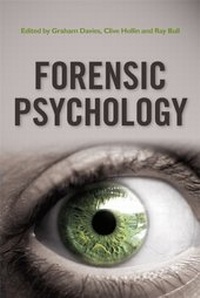
Forensic Psychology
1st Edition
Published on 16. May 2008
Book
Paperback/Softback
372 pages
978-0-470-05833-6 (ISBN)
Description
This book is written for undergraduate students of psychology and covers all the main topics in the forensic field, from the committing of the crime, through arrests, the trial process and what happens after sentencing. It is both broad enough to give a comprehensive coverage, and detailed enough to do justice to each aspect. Arranged in four parts, leading experts in the research field have commissioned experienced teachers to provide a teaching resource that is up to date and easy to use on courses.
In Part 1, The Anatomy of Crime, definitions and measurements as well as theories of why crime is committed are covered; in Part 2, Investigating Crime, interviewing victims, witnesses and suspects, detecting deception and identifying perpetrators are included; Part 3, The Trial Process includes detailed coverage of judicial processes, safeguarding witnesses, evidence, and the role of experts in a number of contexts. A final part, After Sentencing, includes a discussion of the role of sentencing and working with offenders.
More details
Edition
1., Auflage
Language
English
Place of publication
Chichester
United Kingdom
Publishing group
John Wiley and Sons Ltd
Target group
Professional and scholarly
Dimensions
Height: 24.4 cm
Width: 16.8 cm
Thickness: 21 mm
Weight
706 gr
ISBN-13
978-0-470-05833-6 (9780470058336)
Schweitzer Classification
Other editions
New editions
Book
10/2017
3rd Edition
Wiley
Unfortunately, price unknown
Article exhausted; check for reprint
Book
04/2012
2nd Edition
Wiley
€55.90
Article exhausted; check for reprint
Persons
Graham M. Davies is Professor Emeritus of Psychology at the University of Leicester, UK and holds honorary professorships at the universities of Birmingham and Coventry. His most recent book, edited with Mark Kebbell, is Practical Psychology for Forensic Investigations and Prosecutions (2006, John Wiley & Sons). He is editor of the journal Applied Cognitive Psychology. He has published extensively on eyewitness testimony in children and adults and the support of vulnerable witnesses at court and appears regularly as an expert witness. He is a former president of the Society for Applied Research in Memory and Cognition and of the European Association for Psychology and Law and he also sits as a Magistrate on the Melton, Belvoir and Rutland bench. Clive R. Hollin is Professor of Criminological Psychology in the School of Psychology at the University of Leicester, UK. He wrote the best-selling textbook Psychology and Crime: An Introduction to Criminological Psychology (1989, Routledge). His most recent book, edited with Emma Palmer, is Offending Behaviour Programmes: Development, Application and Controversies (2006, John Wiley & Sons). He is co-editor of the journal Psychology, Crime & Law. Alongside his various university appointments, he has worked as a psychologist in prisons, special hospitals, and regional secure units. In 1998 he received the Senior Award for Distinguished Contribution to the Field of Legal, Criminological and Forensic Psychology from the British Psychological Society. Ray Bull is Professor of Forensic Psychology at the University of Leicester. His most recent book, which he co-wrote with colleagues from the Forensic Group at Leicester, is Criminal Psychology: A Beginners' Guide (2007, One World). His main research interest lies in investigative interviewing, on which he has published extensively and presented invited lectures in many parts of the world and acts regularly as an expert witness. In 2005, he received the rare honour (for civilian) of a Commendation from the Metropolitan Police Service for "Innovation and professionalism whilst assisting a complex rape investigation which supported a successful prosecution". In 2006, Ray was invited by the Association of Chief Police Officers of England and Wales to be a member of eh Approval Pane for selecting regional interview advisors: experienced police officer who advise other son how to conduct interviews in serous cases.
Content
CONTENTS
Preface
Dedication
About the Editors
Introduction
Part 1: The Anatomy of Crime
Chapter 1: Crime and Its Causes -- Joanna Jemel
Chapter 2: Contemporary Psychological Contributions to Understanding Crime -- Emma Palmer
Part 2: Investigating Crime
Chapter 3: Identifying Perpetrators -- Tim Valentine Chapter 4: Interviewing Vulnerable Witnesses -- Robyn Holliday, Charles Brainerd and Valerie Reyna
Chapter 5: Interviewing Suspects -- Ulf Holmberg and Ola Kronkvist
Chapter 6: Detecting Deception -- Pär Anders Granhag and Maria Hartwig
Part 3: The Trial Process
Chapter 7: Judicial Processes -- Jacqueline M. Wheatcroft
Chapter 8: Safeguarding Witnesses -- Helen L. Westcott
Chapter 9: Witness Evidence -- Julie Blackwell-Young
Chapter 10: Role of the Expert Witness -- Brian R. Clifford
Part 4: After Sentencing
Chapter 11: What's the Point of Sentencing? -- James McGuire
Chapter 12: Psychological Skills in Working with Offenders -- Ruth Hatcher