

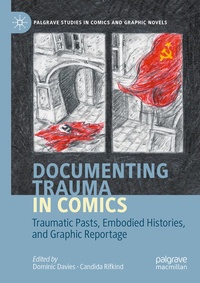
Documenting Trauma in Comics
Traumatic Pasts, Embodied Histories, and Graphic Reportage
1st Edition
Published on 22. May 2021
Book
Paperback/Softback
368 pages
978-3-030-38000-7 (ISBN)
Description
Why are so many contemporary comics and graphic narratives written as memoirs or documentaries of traumatic events? Is there a specific relationship between the comics form and the documentation and reportage of trauma? How do the interpretive demands made on comics readers shape their relationships with traumatic events? And how does comics' documentation of traumatic pasts operate across national borders and in different cultural, political, and politicised contexts?
The sixteen chapters and three comics included in Documenting Trauma in Comics set out to answer exactly these questions. Drawing on a range of historically and geographically expansive examples, the contributors bring their different perspectives to bear on the tangled and often fraught intersections between trauma studies, comics studies, and theories of documentary practices and processes. The result is a collection that shows how comics is not simply related to trauma, but a generative force that has become central to its remembrance, documentation, and study.
The sixteen chapters and three comics included in Documenting Trauma in Comics set out to answer exactly these questions. Drawing on a range of historically and geographically expansive examples, the contributors bring their different perspectives to bear on the tangled and often fraught intersections between trauma studies, comics studies, and theories of documentary practices and processes. The result is a collection that shows how comics is not simply related to trauma, but a generative force that has become central to its remembrance, documentation, and study.
More details
Product info
Paperback
Series
Edition
1st ed. 2020
Language
English
Place of publication
Cham
Switzerland
Publishing group
Springer International Publishing
Target group
Professional and scholarly
Illustrations
28 s/w Abbildungen, 23 farbige Abbildungen
23 Illustrations, color; 28 Illustrations, black and white; XXI, 345 p. 51 illus., 23 illus. in color.
Dimensions
Height: 210 mm
Width: 148 mm
Thickness: 20 mm
Weight
476 gr
ISBN-13
978-3-030-38000-7 (9783030380007)
DOI
10.1007/978-3-030-37998-8
Schweitzer Classification
Other editions
Additional editions
Dominic Davies | Candida Rifkind
Documenting Trauma in Comics
Traumatic Pasts, Embodied Histories, and Graphic Reportage
Book
05/2020
Palgrave Macmillan
€117.69
Shipment within 7-9 days
Persons
Dominic Davies is a Lecturer in English at City, University of London. He holds a DPhil and British Academy Postdoctoral Fellowship from the University of Oxford. He is the author and editor of several books, articles, and chapters, and his most recent monograph is Urban Comics: Infrastructure & the Global City in Contemporary Graphic Narratives (2019).
Candida Rifkind is a Professor in the Department of English, University of Winnipeg, Canada. In addition to over a dozen journal articles and book chapters in comics studies, she co-edited Canadian Graphic: Picturing Life Narratives (2016) and is co-editor of the Wilfrid Laurier UP book series Crossing Lines: Transcultural/Transnational Comics Studies.
ContributorsHaya Alfarhan, King's College London, UKAna Baeza Ruiz, University of Leeds, UK Hillary Chute, Northeastern University, USA Michael Goodrum, Canterbury Christ Church University, UK Ian Hague, London College of Communication, UK Alexandra Lloyd, University of Oxford, UK Sarah McNicol, Manchester Metropolitan University, UKNina Mickwitz London College of Communication, UK Bruce Mutard, Independent Artist, Australia Katalin Orbán, Eötvös Loránd University, Hungary Emma Parker, University of Leeds, UK Johannes C. P. Schmid, University of Hamburg, Germany A. P. Payal, University of Delhi, India Rituparna Sengupta, Indian Institute of Technology, Delhi, India Nicola Streeten, London College of Communication, UK Eszter Szép, Eötvös Loránd University, Hungary E. Dawson Varughese, Snr Fellow, Manipal Centre for Humanities, Manipal Academy of Higher Education (MAHE), Manipal, IndiaContent
Introduction: Documenting Trauma: Comics and the Politics of Memory; Dominic DaviesSection 1: Tropes of Trauma1. "Real News From My Brain": Trauma Tropes Today and Tomorrow; Katalin Orbán2. Materialising Trauma in Comics; Ian Hague3. Accessing Trauma in Art Spiegelman's Breakdowns: Portrait of the Artist as a Young %@&*!; Laura Findlay4. The Past That Will Not Die: Zombies & Haiti in Horror Comics of the 1950s; Michael GoodrumComic: Billy, Me and You - And Me; Nicola StreetenSection 2: Embodied Histories5. Charlotte Salomon's Life? or Theatre? as Graphic Life-Narrative; Emma Parker6. Exploring the Body in Alyona Kamyshevskaya's Moi Seks; Didar Kul-Mukhammed7. Becoming Unbecoming and the Visibility of Trauma; Ana Baeza Ruis and Louisa Parker (Una)8. Discourses of Trauma and Representation in Miriam Katin's Comics; Eszter SzépComic: 'Subjects of Trauma'; UnaSection 3: Graphic Reportage9. Comics as Refugee Stories; Nina Mickwitz10. Migrant Detention Comics and the Aesthetic Technologies of Compassion; Candida Rifkind11. "Where do Memory and Truth Meet?" Contrasting Memoir and Documentary in the Comics of Sarah Glidden; Johannes Schmid12. Exploring Trauma and Social Haunting Through Community Comics Creation; Sarah McNicolComic: 'First Person Third'; Bruce MutardSection 4: Traumatic Pasts13. Restoring Memory, Restorying Partition; Payal Anil Padmanabhan and Rituparna Sengupta14. Visual Detention: Reclaiming Human Rights through Memory in Leila Abdelrazaq's Baddawi; Haya Alfarhan15. Emotional History and Legacies of War in Recent German Comics and Graphic Novels; Alexandra Lloyd16. Traumatic Moments: Retrospective "Seeing" of Violation, Rupture and Injury in Three Post-millennial Indian Graphic Narratives; E. Dawson VarugheseAfterword; Hillary Chute