

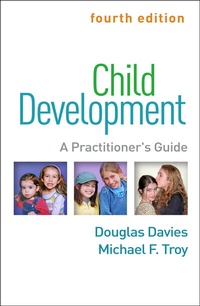
Child Development, Fourth Edition
A Practitioner's Guide
4th Edition
Published on 13. May 2020
Book
Hardback
512 pages
978-1-4625-4299-4 (ISBN)
Description
Now in a revised and updated fourth edition, this trusted text and professional resource provides a developmental framework for clinical practice. The authors examine how children's trajectories are shaped by transactions among family relationships, brain development, and the social environment. Risk and resilience factors in each of these domains are highlighted. Covering infancy, toddlerhood, the preschool years, and middle childhood, the text explores how children of different ages typically behave, think, and relate to others. Developmentally informed approaches to assessment and intervention are illustrated by vivid case examples. Observation exercises and quick-reference summaries of each developmental stage facilitate learning.
New to This Edition
Incorporates a decade's worth of advances in knowledge about attachment, neurodevelopment, developmental psychopathology, intervention science, and more.
Toddler, preschool, and school-age development are each covered in two succinct chapters rather than one, making the book more student friendly.
Updated throughout by new coauthor Michael F. Troy, while retaining Douglas Davies's conceptual lens and engaging style.
New to This Edition
Incorporates a decade's worth of advances in knowledge about attachment, neurodevelopment, developmental psychopathology, intervention science, and more.
Toddler, preschool, and school-age development are each covered in two succinct chapters rather than one, making the book more student friendly.
Updated throughout by new coauthor Michael F. Troy, while retaining Douglas Davies's conceptual lens and engaging style.
Reviews / Votes
"In this fourth edition, Troy has built on Davies's excellent work and has added valuable information and insight for clinicians who believe development matters. Without a firm grasp of a child's developmental challenges and strengths, clinical interventions often become something imposed, rather than something offered and used. Troy's additions integrate current research and expand our understanding of children's resources and abilities, making this an invaluable resource for all professionals committed to supporting children as they grow and manage adversities."--Anne R. Gearity, PhD, Department of Psychiatry, University of Minnesota"Child Development, Fourth Edition, not only covers fundamental concepts, but also includes the best current research findings. What results is a book about developmental psychology that is very applicable to a variety of fields. This is a useful text for social work and clinical nursing courses in Human Behavior and the Social Environment, as well as psychology courses in Child Development. The detailed Table of Contents enables the reader to navigate to the content most germane to the task at hand, which makes this a practical reference for faculty, researchers, and practitioners."--Peter J. Pecora, PhD, Managing Director of Research Services, Casey Family Programs, and Professor, School of Social Work, University of Washington
"This exceptional text combines principles of child development with foundations for practice. It has been my essential resource for nearly a decade in teaching advanced social work students and early-career clinicians. Davies's text is unique in that it depicts the impact of development on child behavior and the impact of trauma on development, followed by vital practice principles for each developmental stage. I am delighted that Troy has updated the fourth edition with current research as well as changes in DSM-5, and also that the discussion of trauma is not limited to DSM-5 criteria. This text explains and supports assessment and intervention for the developmental impact of disrupted attachment and chronic trauma throughout childhood, helping me to prepare students for practice in a variety of settings, and readying students for lifelong learning of trauma-informed and evidence-based protocols."--Karen Flint Stipp, PhD, LCSW, School of Social Work, Illinois State University
"My master's-level clinical psychology students have found this text very valuable either as an introduction to developmental psychology or as a refresher. The practice chapters give students concrete examples of how clinicians use developmental theory and findings to guide conceptualization, diagnosis, and treatment of childhood pathology."--Lisa Comparini, PhD, Department of Psychology and Sociology, Texas A&M-University Corpus Christi-
More details
Series
Edition
4th edition
Language
English
Place of publication
New York
United States
Publishing group
Guilford Publications
Target group
College/higher education
Professional and scholarly
Practitioners and students in social work, clinical child and school psychology, psychiatry, family therapy, counseling, and nursing. Serves as a text in undergraduate- and graduate-level courses such as Human Behavior and the Social Environment, Human Development, and Child Counseling and Psychotherapy.
Dimensions
Height: 242 mm
Width: 165 mm
Thickness: 30 mm
Weight
870 gr
ISBN-13
978-1-4625-4299-4 (9781462542994)
Copyright in bibliographic data and cover images is held by Nielsen Book Services Limited or by the publishers or by their respective licensors: all rights reserved.
Schweitzer Classification
Other editions
Additional editions
E-Book
03/2020
4th Edition
The Guilford Press
€80.49
Available for download
Previous edition

Book
09/2010
3rd Edition
Guilford Publications
€86.84
Article exhausted; check for reprint
Persons
Douglas Davies, MSW, PhD, until his death in 2015, was Lecturer at the School of Social Work, University of Michigan. An infant mental health specialist, he published numerous clinical articles on intervention with toddlers and parents, traumatized children, and child cancer survivors. Dr. Davies's most recent practice was devoted to reflective supervision of mental health clinicians and child care consultants, consultation to agencies, and training of clinicians on topics in child development and child therapy. He was inducted into the National Academies of Practice as a distinguished social work practitioner, and received the Selma Fraiberg Award from the Michigan Association for Infant Mental Health.
Michael F. Troy, PhD, LP, is a clinical psychologist at Children's Minnesota, where he is Medical Director of Behavioral Health Services and Associate Medical Director of Children's Neuroscience Institute. Dr. Troy's clinical and academic interests include diagnostic classification issues in developmental psychopathology, models of therapeutic assessment, psychological assessment of adolescents at risk for major psychopathology, and teaching child clinical psychology as part of hospital and community medical education programs.
Michael F. Troy, PhD, LP, is a clinical psychologist at Children's Minnesota, where he is Medical Director of Behavioral Health Services and Associate Medical Director of Children's Neuroscience Institute. Dr. Troy's clinical and academic interests include diagnostic classification issues in developmental psychopathology, models of therapeutic assessment, psychological assessment of adolescents at risk for major psychopathology, and teaching child clinical psychology as part of hospital and community medical education programs.
Content
I. Contexts of Development: A Transactional Approach
1. Attachment as a Context for Development
2. Brain Development
3. Risk and Protective Factors: The Child, Family, and Community Contexts
4. Analysis of Risk and Protective Factors: Practice Applications
II. The Course of Child Development
5. Infant Development
6. Practice with Infants
7. Toddler Development: Core Domains
8. Toddler Development: Integrated Domains
9. Practice with Toddlers
10. Preschool Development: Core Domains
11. Preschool Development: Integrated Domains
12. Practice with Preschoolers
13. Middle Childhood Development: Core Domains
14. Middle Childhood Development: Integrated Domains
15. Practice with School-Age Children
16. Conclusion: Developmental Knowledge and Practice
1. Attachment as a Context for Development
2. Brain Development
3. Risk and Protective Factors: The Child, Family, and Community Contexts
4. Analysis of Risk and Protective Factors: Practice Applications
II. The Course of Child Development
5. Infant Development
6. Practice with Infants
7. Toddler Development: Core Domains
8. Toddler Development: Integrated Domains
9. Practice with Toddlers
10. Preschool Development: Core Domains
11. Preschool Development: Integrated Domains
12. Practice with Preschoolers
13. Middle Childhood Development: Core Domains
14. Middle Childhood Development: Integrated Domains
15. Practice with School-Age Children
16. Conclusion: Developmental Knowledge and Practice