

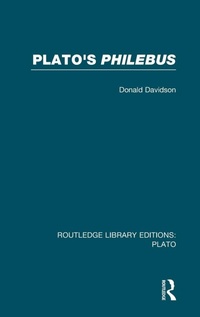
Plato's Philebus (RLE: Plato)
Plato)
1st Edition
Published on 10. September 2012
Book
Hardback
484 pages
978-0-415-63225-6 (ISBN)
Description
The Philebus is hard to reconcile with standard interpretations of Plato's philosophy and in this pioneering work Donald Davidson, seeks to take the Philebus at face value and to reassess Plato's late philosophy in the light of the results. The author maintains that the approach to ethics in the Philebus represents a considerable return to the methodology of the earlier dialogues. He emphasizes Plato's reversion to the Socratic elenchus and connects it with the startling reappearance of Socrates as the leading voice in the Philebus.
More details
Series
Language
English
Place of publication
London
United Kingdom
Publishing group
Taylor & Francis Ltd
Target group
College/higher education
Professional and scholarly
General, Postgraduate, Professional, and Undergraduate
Dimensions
Height: 240 mm
Width: 161 mm
Thickness: 31 mm
Weight
889 gr
ISBN-13
978-0-415-63225-6 (9780415632256)
Copyright in bibliographic data and cover images is held by Nielsen Book Services Limited or by the publishers or by their respective licensors: all rights reserved.
Schweitzer Classification
Other editions
Additional editions
Donald Davidson
Plato's Philebus (RLE: Plato)
E-Book
11/2012
1st Edition
Routledge
€251.99
Available for download
Person
Donald Davidson
Content
Introduction. Part 1: The Problem 1. The Subject of the Philebus 2. Analysis of Philebus' and Socrates' Positions. Part 2: The Art of Dialectic 1. The Three Aspects of Dialectic 2. Analytic Hedonism 3. The One and the Many 4. Statement of Difficulties 5. The Art of Dialectic 6. Collection 7. Division 8. Examples of the Use of Dialectic 9. Combination. Part 3: Three Criteria of the Good 1. Collection in the Philebus 2. The Three Criteria 3. The Good is Desired 4. The Good is Sufficient 5. The Good is Complete. Part 4: The Four Principles of Combination 1. Function 2. Outline of Interpretation 3. Relation of this Classification to the One and the Many 4. The Unlimited 5. The Limit 6. The Mixture 7. The Cause of the Mixture 8. The Ideas in relation to this Classification. Part 5: The Analysis of Pleasure 1. Division in the Philebus 2. The Origin of Simple Bodily Pleasure 3. Simple Pleasures of the Mind 4. Mixture of Pleasures of the Body and the Mind 5. Mixed Pleasures of the Body 6. Mixed Pleasures of the Mind 7. Pure Pleasures of the Body 8. Pure Pleasures of the Mind. Part 6: The Analysis of Mind 1. The Basis of the Division 2. Division According to the Degree of Accuracy 3. Division of Theory and Practice. Part 7: The Final Synthesis 1. Combination in the Philebus 2. Evaluation of the Parts 3. Selection of the Parts 4. Mixing the Parts 5. Final List of Goods. Bibliography