

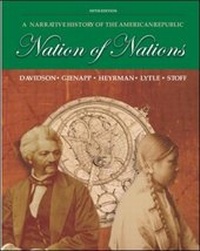
Nation of Nations
A Narrative History of the American Republic
5th Edition
Published on 16. August 2004
Book
Hardback
2 pages
978-0-07-287098-5 (ISBN)
Description
Known for its friendly narrative style and careful blending of social and political history, Nation of Nations offers a balanced approach to teaching the American history survey course. The story presented by the authors reflects their belief that to understand fully the American past it must be linked to events worldwide. As a result of this approach, Nation of Nations has become the leader in the integration of global material. It is an integration that is done in a sensible and thoughtful way: displayed in essays, timelines, the epilogue, and throughout the narrative.
More details
Edition
5th edition
Language
English
Place of publication
United States
Publishing group
McGraw-Hill Education - Europe
Illustrations
Illustrations
Dimensions
Height: 262 mm
Width: 213 mm
Thickness: 36 mm
Weight
1824 gr
ISBN-13
978-0-07-287098-5 (9780072870985)
Copyright in bibliographic data and cover images is held by Nielsen Book Services Limited or by the publishers or by their respective licensors: all rights reserved.
Schweitzer Classification
Persons
James West Davidson received his B.A. from Haverford College and his Ph.D. from Yale University. A historian who has pursued a full-time writing career, he is the author of numerous books, among them After the Fact: The Art of Historical Detection (with Mark H. Lytle), The Logic of Millennial Thought: Eighteenth Century New England, and Great Heart: The History of a Labrador Adventure (with John Rugge). He is co-editor with Michael Stiff of the Oxford New Narratives in American History, in which his most recent book appears: 'They Say': Ida B. Wells and the Reconstruction of Race.
William E. Gienapp has a PhD from the University of California, Berkeley. He taught at the University of Wyoming before moving to Harvard University, where he was Professor of History. In 1988, he received the Avery O. Craven Award for his book, The Origins of the Republican Party, 1852-1856. His essay, The Antebellum Era, appeared in the Encyclopedia of Social History (1992).
Christine Leigh Heyrman is Associate Professor of History at the University of Delaware. She received a Ph.D. in American Studies from Yale University and is the author of Commerce and Culture: The Maritime Communities of Colonial Massachusetts, 1690-1750. Her book exploring the evolution of religious culture in the Southern U.S., entitled Southern Cross: The Beginnings of the Bible Belt, was awarded the Bancroft Prize in 1998.
Mark H. Lytle received his Ph.D. from Yale University and is Professor of History and Environmental Studies. he has served two years as Mary Ball Washington Professor of American History at University College, Dublin, in Ireland. His publications include The Origins of the Iranian-American Alliance, 1941-1953, After the Fact: The Art of Historical Detection (with James West Davidson), America's Uncivil Wars: The Sixties Era from Elvis to the Fall of Richard Nixon, and, most recently, The Gentle Subversive: Rachel Carson, Silent Spring, and the Rise of the Environmental Movement. He is co-editor of a joint issue of the journals of Diplomatic History and Environmental History dedicated to the field of environmental diplomacy.
Michael B. Stoff is Associate Professor of History and Director of the Plan II Honors Program at the University of Texas at Austin. The recipient of a Ph.D. from Yale University, he has been honored many times for his teaching, most recently with election to the Academy of Distinguished Teachers. He is the author of Oil, War, and American Security: The Search for a National Policy on Foreign Oil,1941-1947, co-editor (with Jonathan Fanton and R. Hal Williams) of The Manhattan Project: A Documentary Introduction to the Atomic Age, and series co-editor (with James West Davidson) of the Oxford New Narratives in American History. He is currently working on a narrative on the bombing of Nagasaki.
William E. Gienapp has a PhD from the University of California, Berkeley. He taught at the University of Wyoming before moving to Harvard University, where he was Professor of History. In 1988, he received the Avery O. Craven Award for his book, The Origins of the Republican Party, 1852-1856. His essay, The Antebellum Era, appeared in the Encyclopedia of Social History (1992).
Christine Leigh Heyrman is Associate Professor of History at the University of Delaware. She received a Ph.D. in American Studies from Yale University and is the author of Commerce and Culture: The Maritime Communities of Colonial Massachusetts, 1690-1750. Her book exploring the evolution of religious culture in the Southern U.S., entitled Southern Cross: The Beginnings of the Bible Belt, was awarded the Bancroft Prize in 1998.
Mark H. Lytle received his Ph.D. from Yale University and is Professor of History and Environmental Studies. he has served two years as Mary Ball Washington Professor of American History at University College, Dublin, in Ireland. His publications include The Origins of the Iranian-American Alliance, 1941-1953, After the Fact: The Art of Historical Detection (with James West Davidson), America's Uncivil Wars: The Sixties Era from Elvis to the Fall of Richard Nixon, and, most recently, The Gentle Subversive: Rachel Carson, Silent Spring, and the Rise of the Environmental Movement. He is co-editor of a joint issue of the journals of Diplomatic History and Environmental History dedicated to the field of environmental diplomacy.
Michael B. Stoff is Associate Professor of History and Director of the Plan II Honors Program at the University of Texas at Austin. The recipient of a Ph.D. from Yale University, he has been honored many times for his teaching, most recently with election to the Academy of Distinguished Teachers. He is the author of Oil, War, and American Security: The Search for a National Policy on Foreign Oil,1941-1947, co-editor (with Jonathan Fanton and R. Hal Williams) of The Manhattan Project: A Documentary Introduction to the Atomic Age, and series co-editor (with James West Davidson) of the Oxford New Narratives in American History. He is currently working on a narrative on the bombing of Nagasaki.
Content
Prologue: Settling and Civilizing the AmericasPart 1: The Creation of a New America1. Old World, New Worlds (Prehistory to 1600)2. The First Century of Settlement in the Colonial South (1600-1750)3. The First Century of Settlement in the Colonial North (1600-1700)4. The Mosaic of Eighteenth-Century AmericaPart 2: The Creation of a New Republic5. Toward the War for American Independence (1754-1776)6. The American People and the American Revolution (1775-1783)7. Crisis and Constitution (1776-1789)8. The Republic Launched (1789-1801)9. The Jeffersonian Republic (1801-1824)Part 3: The Republic Transformed and Tested10. The Opening of America (1815-1850)11. The Rise of Democracy (1824-1840)12. The Fires of Perfection (1820-1850)13. The Old South (1820-1860)14. Western Expansion and the Rise of the Slavery Issue (1820-1850)15. The Union Broken (1850-1861)16. Total War and the Republic (1861-1865)17. Reconstructing the Union (1865-1877)Part 4: The United States in An Industrial Age18. The New South and the Trans-Mississippi West (1870-1896)19. The New Industrial Order (1870-1900)20. The Rise of an Urban Order (1870-1900)21. The Political System under Strain (1877-1900)22. The Progressive Era (1890-1920)23. The United States and the Old World Order (1901-1920)Part 5 The Perils of Democracy24. The New Era (1920-1929)25. The Great Depression and the New Deal (1929-1939) 26. America's Rise to Globalism (1927-1945)Part 6: The United States in a Nuclear Age27. Cold War America (1945-1954)28. The Suburban Era (1945-1963)29. Civil Rights and the Crisis of Liberalism (1947-1969)30. The Vietnam Era(1960-1975)31. The Age of Limits (1965-1980)32. The Conservative Challenge (1980-1992)33. Nation of Nations in a Global Community(1980-2000)Epilogue: Fighting Terrorism in a Global Age (2000-2003)