

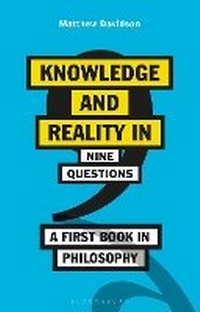
Knowledge and Reality in Nine Questions
A First Book in Philosophy
Published on 28. January 2021
Book
Paperback/Softback
144 pages
978-1-350-16143-6 (ISBN)
Description
Have you ever wondered what makes the questions a philosopher asks different from those asked by a non-philosopher? Is it a desire to seek the truth? Is it their reliance on scientific methods? Or is a philosophical question one that deals with the world we live in?
For the Ancient Greek thinkers Plato and Aristotle, questions about philosophy concerned the fundamental nature of reality and how we know about it. This introduction is based on their views, boiling philosophy down to nine essential questions and using them to reveal how we think about the major topics of metaphysics (the nature of reality) and epistemology (knowledge).
From 'What Am I?' to 'What is Time?', this is a fast-paced tour of the Western philosophical tradition. It walks you through age-old questions about God, free will, skepticism, truth and perception and along the way introduces you to distinctive features and methods including:
? How to differentiate between a good and bad arguments
? How to draw distinctions
? How to clarify the terms and concepts used in common philosophical debates
? How to tackle a thought experiment
By unpacking and exploring each of the nine questions in turn, you find out what it really means to do philosophy. Not only do you emerge with a better understanding of the conceptual landscape around essential philosophical questions, you come to realize why it is that philosophers agree on very little. Here is a golden opportunity to think about some of the most important questions asked by philosophers over across the history of Western philosophical thought and discover why they still matter.
For the Ancient Greek thinkers Plato and Aristotle, questions about philosophy concerned the fundamental nature of reality and how we know about it. This introduction is based on their views, boiling philosophy down to nine essential questions and using them to reveal how we think about the major topics of metaphysics (the nature of reality) and epistemology (knowledge).
From 'What Am I?' to 'What is Time?', this is a fast-paced tour of the Western philosophical tradition. It walks you through age-old questions about God, free will, skepticism, truth and perception and along the way introduces you to distinctive features and methods including:
? How to differentiate between a good and bad arguments
? How to draw distinctions
? How to clarify the terms and concepts used in common philosophical debates
? How to tackle a thought experiment
By unpacking and exploring each of the nine questions in turn, you find out what it really means to do philosophy. Not only do you emerge with a better understanding of the conceptual landscape around essential philosophical questions, you come to realize why it is that philosophers agree on very little. Here is a golden opportunity to think about some of the most important questions asked by philosophers over across the history of Western philosophical thought and discover why they still matter.
Reviews / Votes
A superb book. The most tantalizing problems in philosophy are presented in a clear, accessible way. From now on, when someone asks me for an introduction to philosophy, as it is practised today, I will recommend this book. * Gordon Barnes, Associate Professor of Philosophy, State University of New York at Brockport, USA * An excellent introduction to epistemology and metaphysics for the student or layperson, heartily recommended. It is brief and succinct, wasting no words, but covers the essentials of each topic in a clear and engaging way. * James Van Cleve, Professor of Philosophy, University of Southern California, USA *More details
Language
English
Place of publication
London
United Kingdom
Publishing group
Bloomsbury Publishing PLC
Target group
College/higher education
Dimensions
Height: 214 mm
Width: 134 mm
Thickness: 12 mm
Weight
180 gr
ISBN-13
978-1-350-16143-6 (9781350161436)
Copyright in bibliographic data and cover images is held by Nielsen Book Services Limited or by the publishers or by their respective licensors: all rights reserved.
Schweitzer Classification
Other editions
Additional editions
E-Book
01/2021
1st Edition
Bloomsbury Academic
€19.99
Available for download
E-Book
01/2021
1st Edition
Bloomsbury Academic
€19.99
Available for download
Person
Matthew Davidson is Professor of Philosophy at California State University, San Bernardino, USA. He has taught courses in metaphysics, epistemology, philosophy of religion, and philosophy of language for nearly 20 years.
Content
Introduction
1. A Bit About Philosophy: What Are Thought Experiments?
2. What Am I?
3. Can Technology Make us Immortal?
4. Skepticism, or What If I Can't Tell if I'm in the Matrix?
5. What Is It to Act with Free Will?
6. Can We Know God?
7. What is Time?
8. What is Truth?
9. Are Objects of Perception All in our Mind?
10. Do Fictional Characters Really Exist?
Bibliography
Index
Glossary
Annotated Bibliography
Index
1. A Bit About Philosophy: What Are Thought Experiments?
2. What Am I?
3. Can Technology Make us Immortal?
4. Skepticism, or What If I Can't Tell if I'm in the Matrix?
5. What Is It to Act with Free Will?
6. Can We Know God?
7. What is Time?
8. What is Truth?
9. Are Objects of Perception All in our Mind?
10. Do Fictional Characters Really Exist?
Bibliography
Index
Glossary
Annotated Bibliography
Index