

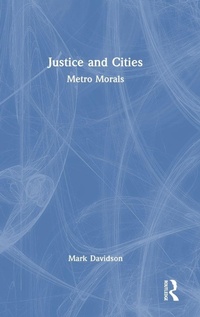
Justice and Cities
Metro Morals
1st Edition
Published on 20. June 2023
Book
Hardback
258 pages
978-0-367-48616-7 (ISBN)
Description
This book explores different theories of justice and explains how these connect to broader geographical questions and inform our understanding of urban problems.
Since philosophers like Socrates debated in the ancient agora, cities have prompted arguments about the best ways to live together. Cities have also produced some of the most vexing moral problems, including the critical question of what obligations we have to people we neither know nor affiliate with. The first part of this book outlines the most well-developed answers to these questions: the justice theories of Utilitarianism, Libertarianism, Liberalism, Marxism, Communitarianism, Conservativism, and recent "post" critiques. Within each theory, we find a set of geographical propensities that shape the ways purveyors of the theories see the city and its moral problems. The central thesis of the book is therefore that competing moral theories have distinct geographical concerns and perspectives, and that these propensities often condition how the city and its injustices are understood. The second part of the book features three studies of contemporary urban problems - gentrification, segregation, and (un)affordability - to demonstrate how predominant justice theories generate distinctive moral and geographical interpretations.
This book therefore serves as an urbanist's guide to justice theory, written for undergraduates and postgraduates studying human geography, urban and municipal planning, urban theory and urban politics, sociology, and politics and government.
Since philosophers like Socrates debated in the ancient agora, cities have prompted arguments about the best ways to live together. Cities have also produced some of the most vexing moral problems, including the critical question of what obligations we have to people we neither know nor affiliate with. The first part of this book outlines the most well-developed answers to these questions: the justice theories of Utilitarianism, Libertarianism, Liberalism, Marxism, Communitarianism, Conservativism, and recent "post" critiques. Within each theory, we find a set of geographical propensities that shape the ways purveyors of the theories see the city and its moral problems. The central thesis of the book is therefore that competing moral theories have distinct geographical concerns and perspectives, and that these propensities often condition how the city and its injustices are understood. The second part of the book features three studies of contemporary urban problems - gentrification, segregation, and (un)affordability - to demonstrate how predominant justice theories generate distinctive moral and geographical interpretations.
This book therefore serves as an urbanist's guide to justice theory, written for undergraduates and postgraduates studying human geography, urban and municipal planning, urban theory and urban politics, sociology, and politics and government.
More details
Language
English
Place of publication
London
United Kingdom
Publishing group
Taylor & Francis Ltd
Target group
College/higher education
Postgraduate and Undergraduate Advanced
Illustrations
33 s/w Abbildungen, 33 s/w Photographien bzw. Rasterbilder
33 Halftones, black and white; 33 Illustrations, black and white
Dimensions
Height: 240 mm
Width: 161 mm
Thickness: 19 mm
Weight
578 gr
ISBN-13
978-0-367-48616-7 (9780367486167)
Copyright in bibliographic data and cover images is held by Nielsen Book Services Limited or by the publishers or by their respective licensors: all rights reserved.
Schweitzer Classification
Other editions
Additional editions
Book
06/2023
1st Edition
Routledge
€58.40
Shipment within 15-20 days
E-Book
06/2023
1st Edition
Routledge
€51.49
Available for download
E-Book
06/2023
1st Edition
Routledge
€51.49
Available for download
Person
Mark Davidson is a Professor in the Graduate School of Geography at Clark University.
Content
Chapter 1 - Introduction: Justice Theory for the Urbanist Part One - Theories of Justice Chapter 2 - Utilitarianism Chapter 3 - Libertarianism Chapter 4 - Liberalism Chapter 5 - Marxism Chapter 6 - Communitarianism Chapter 7 - Conservativism Chapter 8 - Post Critiques Part Two - Urban Applications of Theories of Justice Chapter 9 - Gentrification Chapter 10 - Urban Segregation Chapter 11 - Housing Affordability Chapter 12 - Conclusions (via Camus)